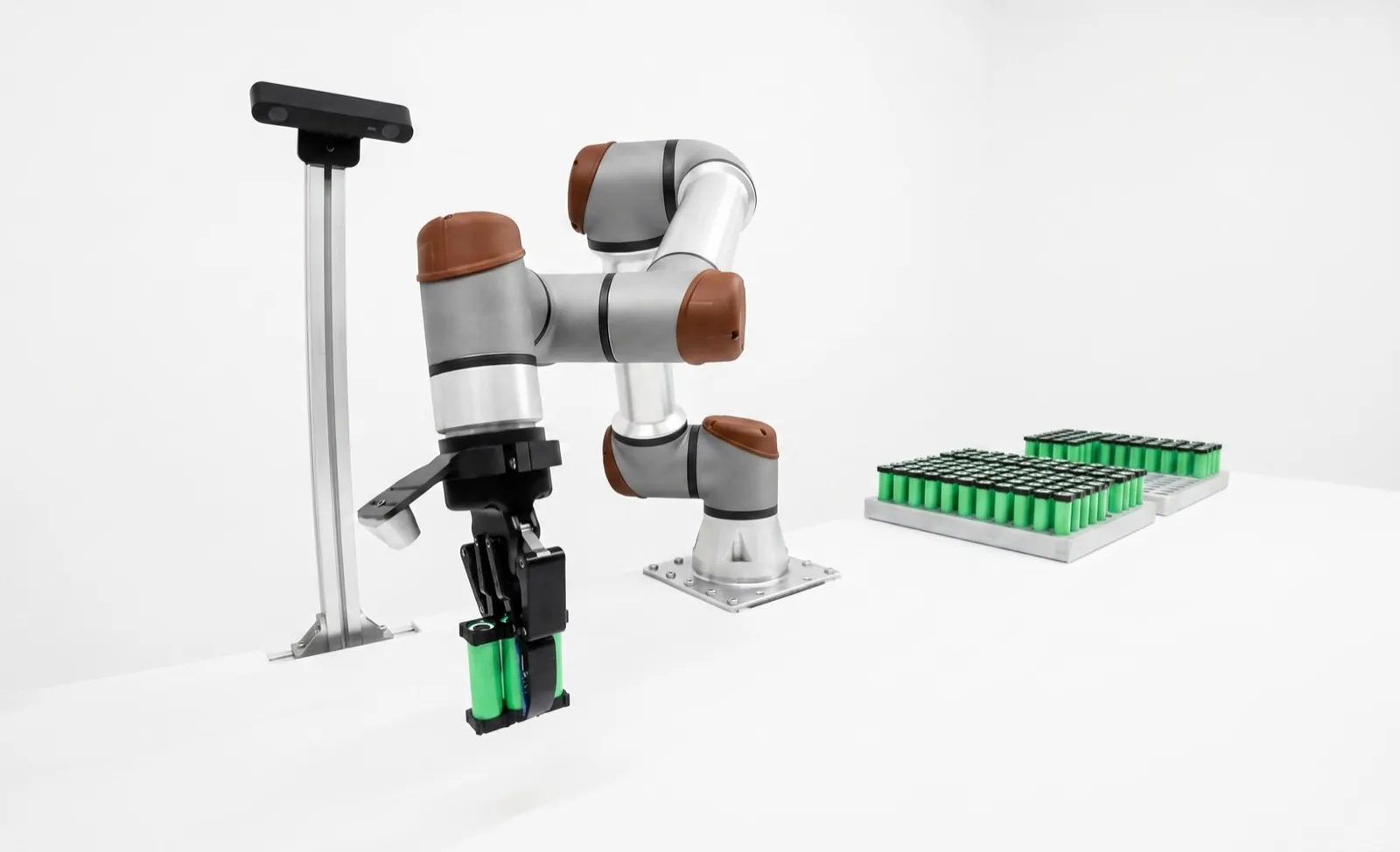
Machine vision vs computer vision: same math, different job.
Computer vision is the science of pulling information out of images. Machine vision is a camera station that has to make a call on every part, before the part reaches the reject gate, in a way your quality team will sign off. Deep learning runs in both now, which is why people mix them up.
On this page
Machine vision is computer vision built into a machine so it can make one decision on every part. It's engineered around controlled light, a hardware trigger, a deadline set by line speed and a result the PLC can act on. Computer vision is the wider field, and it usually works with whatever image it's handed.
We build robotic cells with vision inside, so we sit on the machine vision side of that line. And most of the "vision problems" we get called in to fix aren't algorithm problems. They're lighting, timing and integration problems, which is exactly where the two disciplines split. If you want the application detail, our machine vision library has a page per job. This post is about the difference itself.
Key takeaways
- Computer vision is a research field. Machine vision is the engineering of one station that decides on every part, inside the cycle.
- On a production line the difference is control, over the scene, the clock, the I/O and the proof that it works.
- Deep learning now lives in both. A trained model running inside an engineered station is normal in 2026.
- A general model trained on internet photos rarely survives a factory line without your images, your lighting and a validation plan.
- If the camera's answer stops, sorts, measures or guides a part, treat it as machine vision.
What's the difference between machine vision and computer vision?
Computer vision is the broad field of getting information out of images. Machine vision is the industrial discipline that applies it to one job on one machine, with controlled light, a hardware trigger, a fixed deadline and a pass rate you've proven on real parts. The math overlaps. The engineering around it doesn't.
Think field versus discipline. Computer vision is what you'll find in a textbook like Szeliski's Computer Vision: Algorithms and Applications, which runs from image formation through stereo, motion, recognition and deep learning.4 Its output is methods. Machine vision takes a few of those methods, bolts on cameras, lenses, lights, triggers and I/O, and builds a station that answers one question about every part that goes past.
That changes what "good" means. A computer vision paper reports accuracy on a benchmark. A machine vision station gets judged on two numbers your quality engineer actually cares about, how many good parts it throws away (false rejects) and how many bad parts it lets through (escapes). It also has a clock. A part on a conveyor reaches the reject gate at a fixed time, and if the answer's late, the part's gone.
Is machine vision a type of computer vision?
Mostly, yes. Machine vision borrows computer vision's algorithms and wraps them in the engineering a factory needs, such as fixturing, lighting, industrial cameras, triggers and acceptance tests. But some machine vision is plain metrology, like subpixel edge gauging, and most computer vision never goes near a production line.
You can tell machine vision's its own discipline because it's got its own standards. In Germany the VDI/VDE/VDMA 2632 series covers machine vision. Part 1, issued in January 2023 to replace the 2010 edition, sets out the basic terms so suppliers and users share one vocabulary, and the later parts deal with writing requirement specs and running acceptance tests.1 Nobody writes a standard for accepting a system unless systems get bought to do a defined job.
The hardware has standards too. The European Machine Vision Association's EMVA 1288 defines how camera makers measure and publish sensitivity and noise, so two datasheets mean the same thing.2 A3, the trade association representing the machine vision industry, hosts the GigE Vision interface standard, which more than 50 companies help develop.3 There's nothing like that for a webcam feeding a cloud model, because nobody's needed one.
Here's the working definition we use with customers. Machine vision is image capture and analysis built into a machine so it can inspect, measure, identify or guide on every cycle, with a known, validated performance.
What makes industrial machine vision different?
Five things separate an industrial machine vision system from a computer vision demo. They're controlled lighting and optics, a deterministic cycle time, PLC integration, calibrated measurement and formal validation. Each one has to be designed, priced and tested, and skipping any of them is how good prototypes die.
Controlled lighting and optics
On most stations we commission, the light and the lens decide more of the result than the software does. A dome light kills glare on a curved part. A low-angle bar light makes a scratch throw a shadow. A backlight turns a gasket into a crisp silhouette. Each of those turns a hard software problem into an easy one, and our machine vision lighting guide walks through when to use which. Lenses matter just as much, and we've written separately about how to choose a machine vision lens.
General computer vision goes the other way and tries to cope with whatever the light's doing. That's fine for a phone. For an inspection station it's expensive, because the model has to learn every lighting condition you didn't bother to control, including the one where someone bumped the ring light during a changeover.
Deterministic cycle time
A machine vision station's engineered for the worst case, not the average. A photo-eye or encoder fires the camera, exposure and transfer take a known time, the inspection job has a bounded run time, and the result lands on a fieldbus the PLC reads every scan. Fig. 02 shows why that matters.
We draw that picture a lot for teams who prototyped on a laptop. The prototype was accurate, and on average it kept up. The trouble is the tail. A part whose answer shows up after it's passed the gate was never really inspected, and you won't find out until a customer does.
PLC integration and I/O
A result only helps if a machine acts on it, so industrial vision gear ships with discrete I/O, encoder inputs and fieldbus options. The controller spec sheet for Keyence's LJ-X8000 profiler, for example, lists parallel control I/O, an encoder input, and EtherNet/IP, PROFINET and EtherCAT.9 The camera expects to be one node on a machine network, with a handshake (trigger, busy, result valid, pass, fail) the PLC programmer designs around. A typical computer vision stack stops at an API. Someone then has to write the bridge to the PLC and own its timing, and in our experience that someone is rarely the PLC tech, who'd rather not touch it.
Calibration and measurement traceability
When a station says a bore is 12.04 mm, that number has to mean something. So the station gets a pixel-to-millimeter scale from a certified target, lens distortion correction and, for robot guidance, a hand-eye calibration that ties camera coordinates to robot coordinates. Our dimensional gauging guide covers the optics, the machine vision resolution calculator does the arithmetic, and the post on machine vision camera resolution explains how many pixels a tolerance really needs. A bounding box around a dog doesn't need any of this. It has no units.
Validation on your parts
Last, someone's got to accept the station. That means a written requirement, a test plan with known good and known bad parts, measured false reject and escape rates, a gage study for anything that measures, and change control afterward. Regulated plants add formal IQ, OQ and PQ. We cover the method in how to validate a vision inspection station. A benchmark score on a public dataset proves nothing here, because only your parts count.
Is machine vision AI?
Some of it is. Classic machine vision is rule-based, built from edge finding, blob analysis and pattern matching, with no learning involved. Most major vendors now also ship trained deep learning tools, and plenty of stations run both in the same job. So machine vision can include AI, but it doesn't need it.
Rule-based tools are still the right call for most gauging and presence checks, because they're fast and a quality engineer can read the logic. They struggle with natural variation, like cosmetic flaws on a textured casting or weld spatter that's a bit different every time. That's where learned models earn their keep.
Vendors haven't left you to bolt them on. Cognex describes its current platform as combining AI and traditional vision tools in a single job, processed on edge devices on the line, with pretrained industrial models that need fewer training images.8 Keyence and others offer their own versions, and our Cognex vs Keyence comparison lines them up. Researchers now build datasets that look like factories rather than living rooms. MVTec AD has 5,354 high-resolution images across 15 object and texture categories with more than 70 defect types, and its authors found plenty of room for improvement in the anomaly detection methods they tested.7
So in practice a good inspection station often has computer vision inside it, a trained network doing the judgment call that rules can't express. The station around it supplies the controlled image, the timing, the handshake and the proof. For which defect gets which tool, see deep learning vs rule-based inspection. For what goes wrong once it's running, see AI visual inspection on a real line, and for the software side, machine vision software compared.
What are examples of machine vision and computer vision?
Machine vision examples cluster around four verbs, which are inspect, measure, identify and guide, and they're always about parts moving through a machine. Computer vision examples are much broader, from driver assistance and medical imaging to photo search, retail analytics and plant-wide camera analytics that never gate a single part.
On the machine vision side, the jobs we see most look like this.
- Inspecting surface defects, welds and adhesive beads, or doing assembly verification (is the clip there, is the connector seated).
- Measuring diameters, gaps, positions and heights to a drawing tolerance.
- Identifying parts through OCR and code reading, including grading 2D code print quality.
- Guiding robots with vision-guided robotics, from locating a part on a conveyor to picking from a bin.
Inside factories, the fast-growing computer vision category is camera analytics, like counting work in progress or tracking forklifts. It's useful and often cheap on cameras you already own. But treating it as interchangeable with an inspection station is the most common scoping mistake we see.
How do machine vision and computer vision systems compare?
Layer by layer they make different choices. A machine vision system fixtures the part, engineers the light, triggers in hardware and talks to a PLC within a bounded time. A general computer vision system takes the scene as it is, streams video on shared compute and reports to software or a person, whenever it's done.
| Dimension | Machine vision | General computer vision |
|---|---|---|
| Goal | One decision per part, to a spec | Understand a scene or a large image set |
| Scene | Controlled (fixture, enclosure, designed light) | Uncontrolled (ambient light, varied pose) |
| Camera | Industrial, global shutter, specified per EMVA 1288 | Whatever's available, such as a webcam or IP camera |
| Timing | Hardware trigger, bounded worst-case latency | Free-running stream, average throughput |
| Output | Discrete I/O and fieldbus to a PLC or robot | API, database, dashboard or alert |
| Units | Calibrated millimeters, degrees, grades | Mostly unitless labels, boxes and scores |
| Algorithms | Rule-based tools plus trained tools | Mostly learned models |
| Acceptance | False reject and escape rates, gage R&R | Accuracy or mAP on a held-out test set |
The camera platform's a separate decision. Our comparison of smart camera vs PC-based vision covers when an all-in-one camera is enough, and Cognex In-Sight vs Keyence VS goes model by model through the two families most stations end up choosing between.
Why do general computer vision models fail on factory lines?
Because they were trained on a different world. A model pretrained on internet photos knows everyday objects, not your short shot or missing O-ring, and its accuracy drops when the images change. Factory defects are rare and small, and on its own the model can't keep time or talk to a PLC.
Start with vocabulary. Microsoft's COCO dataset, one of the big ones behind modern object detectors, holds 2.5 million labeled instances across 328,000 images of 91 everyday object types.5 Great for cups and cars. None of it's a burr. You can fine-tune, but then you need labeled images of your own defects, and that's the expensive part.
Then there's distribution shift. When researchers rebuilt fresh test sets for CIFAR-10 and ImageNet, following the original collection process as closely as they could, accuracy fell 3% to 15% on CIFAR-10 and 11% to 14% on ImageNet across a wide range of models.6 That's what a careful copy of the same kind of data did. A factory camera with different light, angle and optics is a much bigger jump.
Defects are rare, too. On a healthy line you'll see maybe one bad part in thousands, covering a few dozen pixels. A model that never flags anything scores beautifully on accuracy and is worthless, which is why you measure escapes and false rejects separately. And if nobody controls the image, the model has to absorb sunlight through the skylight, a lens wiped with a shop rag on second shift and the supplier who changed resin color without telling anyone. Controlling the image is almost always cheaper than learning around it.
Finally there's proof. Quality will ask for repeatability and a challenge set of known bad parts. A demo video doesn't answer that, and unexplained false rejects are the fastest way to get a station switched off (often by the night-shift lead who loosened the threshold at 2 a.m. to keep the line moving). Our guide to why vision systems reject good parts is the field manual for that one, and the machine vision maintenance checklist covers keeping a station honest after handover.
Machine vision or computer vision: which should you choose?
Choose machine vision engineering if the camera's answer stops, sorts, measures or guides a part, even when a deep learning tool does the hard analysis. Choose general computer vision if the answer is a count, a trend or an alert someone reviews later. Most real stations end up as a hybrid of the two.
We start from the decision, not the technology. These five questions sort nearly every project we've scoped.
- Does the answer act on a part? If it does, you need machine vision engineering. If it's a count or an alert for a person, general computer vision may be plenty.
- Is it a measurement? Units and a tolerance mean calibration and a gage study. If the feature's a height or flatness, read 2D vs 3D machine vision before you pick a camera.
- Can you write the defect down as a rule, like an edge position or a hole count? Then use rule-based tools. If it's a judgment call with natural variation, plan for a trained tool and for collecting and labeling images.
- What's the deadline? If the time from trigger to the last point the line can act is tens of milliseconds, compute has to be dedicated and close to the camera.
- Who signs it off? Write the acceptance criteria (false reject rate, escape rate, repeatability) before you buy hardware.
Honestly, most answers come out hybrid, with an engineered image and timing, rule-based tools for measurement and a trained tool for the cosmetic call. That's what we build into our cells, and the machine vision integration page explains how we scope it. If you're earlier than that, starting your first machine vision project is the place to begin, and manual vs automated visual inspection, machine vision system cost and machine vision ROI cover the business case.
Frequently asked questions
What's the difference between image processing, machine vision and computer vision?
Image processing is the low-level step, like filtering, thresholding or sharpening an image, and it doesn't decide anything by itself. Computer vision interprets images by recognizing objects, measuring shape or tracking motion. Machine vision is a complete industrial system that uses both, plus lighting, optics, triggering and I/O, to make a decision about each part on a line.
Can computer vision work on saved images and video?
Yes. A lot of computer vision runs offline on stored photos or recorded video, such as medical scans or search indexes, where nobody's waiting on the answer. Machine vision usually can't work that way, because its job is to decide about a part while the part's still in the machine. Stations do save images, though, and that archive is gold for retraining and for chasing down escapes.
Is computer vision harder than machine vision?
They're hard in different ways. Open-world computer vision, like recognizing anything in any photo, is the harder research problem. Machine vision narrows the problem on purpose by controlling the scene, so the algorithm is often simpler. But the engineering bar is higher, because it has to hit a deadline every cycle, talk to a PLC and hold a validated false reject rate for years.
What is industrial computer vision?
It's a looser term for computer vision used in factories, warehouses and other industrial sites. It covers classic machine vision stations such as gauging, code reading and inspection, plus newer camera analytics that track people, pallets or forklifts around a plant. If the result drives a machine decision on every part within a cycle, treat it as machine vision and engineer it that way.
Which industries use machine vision the most?
In our experience the heaviest users are automotive and its suppliers, electronics, packaging, pharmaceuticals and medical devices, food and beverage, and metal fabrication. They've all got high volume, tight tolerances or traceability rules, which is where an automated check on every part pays back fastest. Any plant with a person staring at parts all shift is a candidate.
Do you need a smart camera or a PC for machine vision?
It depends on the job. A smart camera puts the sensor, processing and I/O in one box, and it's right for single-view inspections with modest processing. A PC-based system handles several cameras, heavier deep learning models and custom code, at the cost of more integration work. We usually start with a smart camera and move to a PC when the job outgrows it.
Sources
- VDI, VDE and VDMA, VDI/VDE/VDMA 2632 Blatt 1: Machine vision, basics, terms, and definitions, issue 2023-01 (replaces the 2010-04 edition). Defines the principles and terms for using machine vision systems and serves as the basis for the rest of the 2632 series. Listing at DIN Media, 2023. View the standard listing.
- European Machine Vision Association, EMVA 1288: Standard for Measurement and Presentation of Specifications for Machine Vision Sensors and Cameras, Release 4.0 effective June 2021. Read the EMVA page.
- Association for Advancing Automation (A3), GigE Vision Standard Committees. Describes A3 as the trade association representing the global machine vision industry and host of GigE Vision. Accessed October 2026. Read the A3 page.
- Richard Szeliski, Computer Vision: Algorithms and Applications, 2nd edition, Springer, 2022. Book site.
- Tsung-Yi Lin et al., Microsoft COCO: Common Objects in Context, arXiv:1405.0312, 2014. 2.5 million labeled instances in 328,000 images of 91 object types. Read the paper.
- Benjamin Recht, Rebecca Roelofs, Ludwig Schmidt and Vaishaal Shankar, Do ImageNet Classifiers Generalize to ImageNet?, Proceedings of the 36th International Conference on Machine Learning (PMLR 97), 2019. Read the paper.
- Paul Bergmann, Michael Fauser, David Sattlegger and Carsten Steger (MVTec Software), MVTec AD: A Comprehensive Real-World Dataset for Unsupervised Anomaly Detection, IEEE/CVF CVPR, 2019. Read the paper (PDF).
- Cognex, The Cognex AI Advantage, product overview describing AI and rule-based tools in a single job with edge processing. Accessed October 2026. Read the Cognex page.
- Keyence, LJ-X8000 series specifications, controller interface listing (control I/O, encoder input, EtherNet/IP, PROFINET, EtherCAT). Accessed October 2026. Read the specifications.
Definitions, standards, dataset sizes and benchmark results are sourced as cited. The timing figure uses illustrative numbers to show the shape of the problem, not measurements from a specific station. The Venn placement, the stack comparison and the guidance on why prototypes fail and how to choose come from our applications engineering experience and are offered as judgment, not as survey results.
Read next
 Vision guide
Deep learning vs rule-based inspection
Which defects need a trained model, which need a ruler, and how to combine them in one job.
Machine vision library↗ Machine vision
AI visual inspection in 2026: what works on a real line
Where trained models earn their keep, and where they quietly fall over.
Buyer series↗ Machine vision
2D vs 3D machine vision: when you need depth
What a 2D camera can't measure, how the 3D methods differ, and a decision tree.
Buyer series↗Scope a vision station that holds up on your line.Bring Relling to your shop floor.
We started Relling to help American manufacturers make more of what this country needs. Tell us about the part and we'll scope a cell to it.