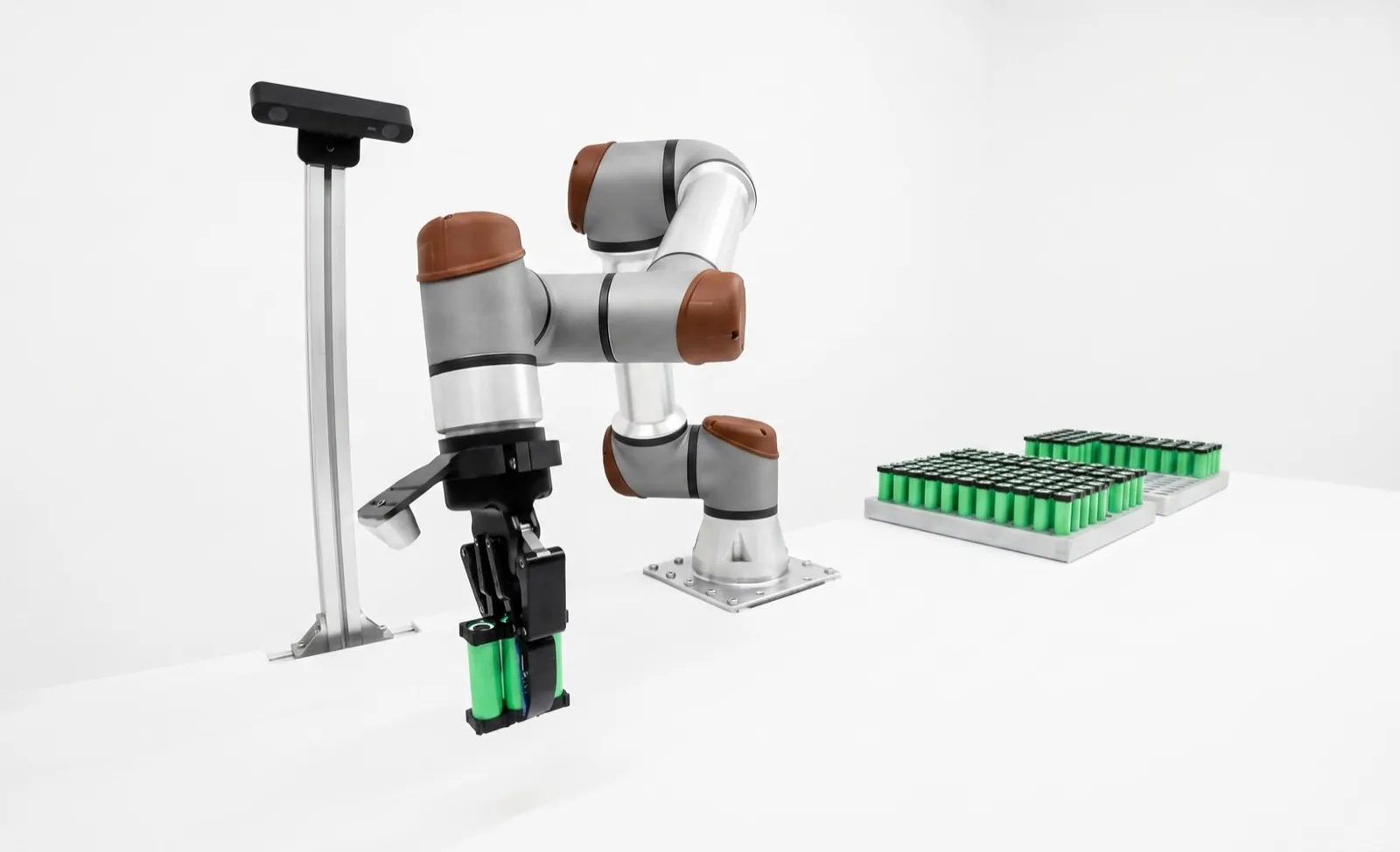
Cobots: a collaborative robots guide from people who build the cells.
A cobot is an industrial robot that can be set up to work beside people, if the risk assessment for the whole cell says so. These guides cover how cobots differ from industrial arms, what the 2025 safety standards ask, how to size one, where they work, what they cost and how the brands compare.
Start with the question you're actually asking.
Most cobot projects stall on one of three things: the cycle time at a safe speed, a gripper or part that can't pass the force limits, or a cell cost nobody priced past the arm. Each guide takes one of those head on.
Cobot vs industrial robot
Speed, payload and repeatability from real datasheets, the safety modes, cycle-time math and a decision tree.
Cobot safety
ISO 10218:2025 and R15.06-2025, the four collaborative modes, force limits by body region and separation-distance math.
Cobot payload and reach
How to size a cobot with the gripper, the part and its inertia included, and why the datasheet reach is the best case.
Cobot applications
Machine tending, palletizing, screwdriving, welding and inspection: where cobots earn their keep and where they fight you.
Cobot price
Published cobot list prices, and what the arm, gripper, safety and integration add up to in a working cell.
Best collaborative robots
Universal Robots, FANUC CRX, ABB GoFa, Doosan, Techman and KUKA, compared on payload, reach and fit.
What is a cobot, and when is it the right robot?
A cobot, or collaborative robot, is a robot arm built so contact with a person can be kept under injury limits, using a light arm, force sensing and certified speed and position limits. It's the right robot when people need to share the space while it moves, the cycle isn't speed-bound, or the cell will move between jobs.
The word "collaborative" gets attached to the arm, but the 2025 editions of ISO 10218, adopted in the US as ANSI/A3 R15.06-2025, attach it to the application. The same arm can be safe placing foam and dangerous swinging a sheet-metal blank. So the useful questions are about your job. Does a person need to be next to it while it moves? Can the gripper and the part touch someone without hurting them? Is the arm's speed at that limit fast enough for your cycle?
If the answers are yes, yes and yes, a cobot is hard to beat. It's small, it's often cart-mounted, and a technician can reteach it. If any answer is no, you're looking at scanners, guarding or an industrial arm, and our cobot vs industrial robot guide walks through that trade. The cobot safety guide covers the force limits and separation math behind it.
What we see go wrong most often isn't the arm choice. It's buying a cobot for "no fence" and discovering in commissioning that the knife, the screwdriver bit or the pinch point at the machine door needs one anyway. Or picking the arm with the longest reach and finding its payload rating doesn't hold once the gripper's weight and the part's offset are counted. Read the cobot payload and reach guide before you shortlist arms.
Price works the same way. An arm quote is the smallest number you'll see on a cobot project. The cobot price guide tracks published list prices, and the industrial robot cost guide shows where the rest of a cell's budget goes.
Planning a first cobot project.
For shops buying their first arm, the questions are less about specs and more about fit: where it goes, which brand, who programs it, and which standard the quote should cite.
Cobots for small shops
Where a first cobot pays off in a job shop, and what to have ready before it arrives.
Universal Robots alternatives
The cobots that compete with UR on price, payload, service and ecosystem, and when each one wins.
Robot programming software
Teach pendants, block programming, offline simulation and what a shop team can still edit a year later.
ISO 10218 and R15.06 were rewritten
What changed in the 2025 robot safety standards, and what a buyer should do about open quotes.
Cobot brands, head to head.
Vendor-neutral comparisons from an integrator that installs all of these arms and is paid by none of their makers. Each one goes model by model, then tells you which we'd pick for which job.
Universal Robots vs ABB GoFa
Two six-axis cobots in the 10 to 12 kg class, on speed, repeatability, software and service.
Universal Robots vs FANUC CRX
UR e-Series against FANUC CRX: ecosystem breadth vs FANUC service and controller.
FANUC vs Universal Robots
The full lineups compared, from small cobots to FANUC industrial arms.
Universal Robots vs Doosan
Two broad cobot families, on payload range, price and ecosystem.
KUKA vs Universal Robots
Joint-torque sensing LBR arms vs the UR ecosystem.
Doosan vs Techman
Doosan M and H series vs Techman TM with built-in vision.
Weighing more than cobots? See the industrial robot arms guide, best robot grippers, and the high-mix, low-volume automation guide.
A cobot is a part. We build the cell around it.
Relling builds turnkey robotic workcells for high-mix American manufacturers. We integrate arms from Universal Robots, FANUC, ABB, Yaskawa, KUKA, Standard Bots and others, pick the one your job needs after timing it, and deliver the cell with its gripper, fixtures, vision, safety assessment and programming. No robot vendor pays us, so the recommendation is about your part.
See how a Relling workcell is built →Thinking about a cobot? Tell us about the part.Bring Relling to your shop floor.
We started Relling to help American manufacturers make more of what this country needs. Tell us about the part and we'll scope a cell to it.