◇ Cobots · Applications

Cobot applications: the jobs cobots actually do well.

The best cobot applications are light, repetitive jobs where a machine or a person sets the pace: machine tending, end-of-line palletizing, short-run welding, screwdriving and assembly, dispensing, inspection, packaging and lab work. Cobots win on changeover and floor space. They lose on raw speed and heavy loads, so pick the task first and the robot second.

8Applications compared on this page
23Configurable safety functions on current Universal Robots arms
$105kPublished starting price of a complete cobot welding package
In short

Cobots are at their best when the job is slow enough that the robot's speed limits don't matter, light enough to stay well inside the payload curve, and variable enough that being easy to reprogram and move is worth more than a few seconds of cycle time.

That describes most machine tending, a lot of palletizing, short-batch welding and a long list of assembly, dispensing and inspection steps. It doesn't describe high-rate packaging, heavy handling or anything with sharp, hot or fast-moving loads near people. Those want an industrial robot behind guarding, or a simpler machine. If you're still choosing between the two kinds of arm, start with cobot vs industrial robot, and see the best collaborative robots for models.

Key takeaways
  • Machine tending is the classic first cobot job, because the machine sets the pace.
  • Collaborative speed limits cap throughput. High-rate pick and place usually belongs to a delta or SCARA.
  • Long grippers and wide cases eat payload fast. Check the curve, not the model name.
  • "Collaborative" is a property of the application and its risk assessment, not of the robot alone.
  • Most of the cell cost and effort is part presentation, fixtures and safety, not the arm.
Application catalog

What can cobots do in manufacturing?

Cobots in manufacturing mostly load machines, stack cases, weld short runs, drive screws, dispense beads, hold cameras and parts for inspection, pack products and move lab samples. Each card shows a close-up of the task, with teal marking what makes it work for a cobot and red marking the usual catch.

datum seat side view Strong fit

Machine tending

Why it fits: the CNC, press or molding machine sets the pace, so a cobot's speed limits rarely matter, and the robot frees an operator to run several machines. Parts are usually a few kilograms. The catch: part presentation. The robot needs parts in known positions, so budget for a drawer, grid or vision. See our machine tending cells.

CNC · molding · press1 to 10 kgmachine-paced
top layer side view Strong fit

Palletizing

Why it fits: end-of-line case rates are often modest, the work is hard on people's backs, and a cobot palletizer fits where a fenced cell won't. The catch: wide vacuum grippers push the center of gravity out, and tall stacks need a lift column. Packaged systems such as Robotiq's PE20, built on a UR20, exist for this. Compare options in palletizing: manual vs robotic.

end of line10 to 30 kg classlift column
fit-up gap top view Good fit, short runs

Welding

Why it fits: high-mix fabricators can teach a new part by hand-guiding the torch, then weld a batch of ten without building a fenced cell. Hirebotics publishes a $105,000 starting price for a complete cobot welder on a UR8 Long. The catch: inconsistent fit-up, plus arc flash and fume, which still need screens and extraction. See manual vs robotic vs cobot welding.

MIG · TIGlow volumefit-up matters
torque + angle section Strong fit

Screwdriving and assembly

Why it fits: screwdriving, pin and clip insertion and press fits are short, repeatable moves, and force sensing lets the robot find a hole and catch a cross-thread. Smart drivers log torque and angle for every screw. The catch: screw feeding and part presentation do most of the work, and loose or tangled parts need vision. See precision assembly cells.

screws · pins · press fitforce sensingtraceable
corner pooling nozzle top view Good fit

Dispensing and sealing

Why it fits: beads of adhesive, sealant or gasket material need smooth, repeatable paths, and a cobot holds a light nozzle easily. The catch: the arm slows at corners while the pump keeps pushing, so beads pool unless flow is tied to robot speed. Long paths across big parts can need more reach than a small cobot has. See our dispensing and sealing cells.

adhesive · sealantspeed-linked flowbead inspection
missing clip camera view Good fit

Inspection

Why it fits: a cobot can carry a camera to many viewpoints on one part, or present the part to a fixed camera, which turns one vision station into a flexible one. The catch: every viewpoint costs time, and the lighting has to travel with the camera. The vision side is covered in our vision-guided robotics guide and the machine vision applications library.

camera on armmulti-viewlighting moves too
next slot top view Depends on rate

Packaging and case packing

Why it fits: short runs, frequent pack pattern changes and kitting, where a new layout is a few minutes of teaching. The catch: rate. At dozens of picks a minute on light items, a cobot held to collaborative speeds falls behind a delta robot or a packaging machine. See packaging cells and kitting and sequencing.

case packing · kittinglight itemsrate-limited
orientation corner top view Strong fit

Lab automation

Why it fits: microplates, tubes and vials are light, follow standard footprints (the ANSI/SLAS microplate standards), and move between instruments that set their own pace, in rooms full of people. The catch: instrument interfaces and scheduling software, not the arm, are usually the hard part, and cleanroom or sterile work narrows the choice of robot.

plates · tubes · vialsunder 1 kgshared space
Fit

What makes a task a good fit for a cobot?

A good cobot task is paced by something other than the robot, light enough to stay well inside the payload curve, and changes often enough that easy reprogramming pays. Add people nearby, limited floor space, or a cell that has to move between machines, and the case for a cobot gets stronger.

Fig. 01Cobot use cases mapped by payload and rate · illustrative
01020304050+ 010203040 payload incl. gripper (kg) picks per minute needed cobot sweet spot delta · scara industrial robot behind guarding lab dispensing inspection screwdriving welding machine tending palletizing case packing high-speed packing large-part handling high-rate spot welding illustrative
Most cobot jobs live in the bottom-left corner. The positions are illustrative, not measured. The point is the shape: cobots do well when the load is light and the robot isn't the pacing step. As the rate climbs, faster robots behind guarding take over, and as the load climbs past the cobot payload curve, industrial arms do. Dispensing and welding are continuous-path jobs, so they sit low on the rate axis.

Cycle time: who's setting the pace?

This is the question we ask first. When a cobot runs in power and force limited mode near people, its speed is held down so that a collision stays within acceptable force and pressure. That's a real cap on throughput. But on a CNC with a four-minute cycle, nobody cares whether the robot takes 12 seconds or 18 to swap a part. On a packaging line that wants 60 items a minute, it's the whole problem.

Payload: is it light at the real offset?

Cobot payloads run from a few kilograms up to 30 or 35 kg on the largest arms. That sounds like plenty until you add a gripper and push the center of gravity out on long fingers or a wide vacuum plate. Our cobot payload and reach guide shows the curves. A 20 kg case on a big palletizing gripper is a very different load from a 20 kg block held close to the flange.

Safety: what happens if the robot touches someone?

A cobot is only collaborative if the whole application is. A blunt gripper moving a plastic part slowly is one thing. A knife, a hot weld torch or a sharp-edged sheet at speed is another, and those often need guarding or sensors no matter what robot carries them. Our cobot safety guide goes through the assessment.

Best tasks for collaborative robots, scored
ApplicationCyclePayloadSafety
Machine tendingMachine-pacedLight to mediumUsually simple
PalletizingModerateWatch the offsetScanners common
WeldingContinuous pathLight torchArc, fume, heat
Screwdriving, assemblyShort, steadyLightSimple
DispensingContinuous pathLightSimple; check materials
InspectionMoves dominateVery lightSimple
PackagingOften too fastLightSimple
Lab automationInstrument-pacedVery lightShared rooms
Field note

The plants that get the most out of a cobot usually move it. One week it tends a lathe, the next it's on a cart at the deburr bench, then it runs a weekend batch on a mill. If your job will never change and runs three shifts at full rate, the cobot's flexibility is worth less, and a fenced industrial arm often wins on speed and price per part.

Cell content

What does a typical cobot cell include?

A cobot cell is the arm plus a base or pedestal, a gripper or tool, a way to present parts, an interface to the machine or line, safety devices where the risk assessment needs them, and the program. In most cells the arm is less than half the work and often less than half the cost.

Fig. 02A typical cobot machine tending cell, top view
1 2 3 4 5 6 In the cell 1CNC, door to robot 2cobot on pedestal 3drawer or grid of blanks 4outfeed chute 5area scanner 6operator station warning zone · slow protective zone · stop
The arm is one item of six. A tending cell also needs a way to present blanks, a place for finished parts, an interface so the robot and the CNC agree on door and chuck state, and whatever safety the risk assessment calls for. The scanner zones here show one common approach: the robot slows when someone walks into the outer zone and stops in the inner one. Your assessment may call for less, or for more.
Cobot use cases in manufacturing: typical cell content and what limits it
ApplicationTypical cell contentWhat usually limits itGo deeper
Machine tendingArm on pedestal, two-finger or dual gripper, drawer or grid, machine I/O, door interface, sometimes a part flip stationPart presentation and chip or coolant on partsBest robots for machine tending
Palletizing20 to 30 kg class arm, often on a lift column, vacuum gripper, two pallet stations, area scanners, pattern softwareCase rate, gripper offset, top-layer reachMixed-case palletizing
WeldingArm on a welding table or cart, power source, torch, wire feeder, fixtures, screens, fume extractionFit-up consistency, arc flash, fumeBest robots for welding
Screwdriving, assemblySmart driver, screw feeder or presenter, fixtures, force sensing, sometimes visionFeeding and fixturing, not the robotBest robots for assembly
DispensingPump and controller, nozzle, fixture, flow tied to robot speed, often bead inspectionMaterial behavior, corners, path accuracyRobots for dispensing
InspectionCamera and light on the wrist or fixed, part presentation, reject handlingViewpoints per part, lightingAssembly verification
PackagingVacuum or finger gripper, conveyors, case erector interface, pattern softwareRate under collaborative speedsPackaging cells
Lab automationSmall arm, plate gripper, instrument interfaces, scheduler, sometimes a mobile baseInstrument integration, cleanlinessMobile robots

Table scrolls horizontally on small screens →

What that table doesn't show is where the time goes. On most cobot projects we've seen, the arm is unboxed and moving in a day. The weeks go into how parts arrive, how the gripper holds the awkward variant, what the machine tells the robot and what the robot tells the machine, and the risk assessment. For the money side, see our cobot price guide and the robot cell cost breakdown. For grippers, start with how to choose a robot gripper.

Sharing space

Can cobots work alongside people without fences?

Often, yes, but it depends on the application, not the robot. A risk assessment has to show that contact is acceptable, usually by limiting speed and force, or that sensors slow and stop the robot before a person gets close. Sharp, hot or heavy loads can still need guarding on a cobot.

There are a few ways a robot and a person share space, and real cells mix them. Power and force limiting lets contact happen but keeps it below the force and pressure limits described in ISO/TS 15066 for each body region. Speed and separation monitoring keeps the robot away from people, slowing and then stopping as they approach, usually with laser scanners. Hand guiding lets someone move the arm directly. A safety-rated monitored stop holds the robot still while a person works in the shared area.

Palletizing is a good example of mixing them. The arm can work at a decent clip while nobody's around, slow when a forklift driver enters the outer scanner zone, and keep stacking on the far pallet while the near one is swapped. That's what keeps a cobot palletizer's throughput reasonable, and it's why "no fence" doesn't mean "no safety hardware".

The 2025 revision of ISO 10218, and the R15.06 update that follows it, changed how much of this lives in the robot standard itself. Our summary of what changed in ISO 10218 and R15.06-2025 is a good primer, and Relling's qualification and safety work covers the risk assessment itself.

Field note

We see a lot of cobots behind fences, and that's not a failure. Sometimes the end effector is the hazard, sometimes the throughput target needs speeds no assessment would allow near people, and sometimes the plant just wants the cobot's easy programming. A fenced cobot is still a reasonable machine. It just loses the floor-space argument.

Fig. 03Cobot palletizing with two pallet stations and speed and separation monitoring, side view
infeed protective zone · stop on this side warning zone · slow full pallet · being swapped building cobot on lift column
Two stations keep the robot busy while people work. When a worker enters the protective zone on one side to swap a full pallet, the robot stops working on that side and keeps building the other, at a speed the risk assessment allows. Zone sizes depend on robot speed, stopping time and sensor response, so they come out of the assessment, not a catalog.
When not to

When is a cobot the wrong choice?

A cobot is usually the wrong choice when the robot itself sets the cycle time and the target is fast, when the load is heavy or far from the flange, when the tool is dangerous at any speed, or when the job never changes and runs around the clock. Those cases favor an industrial robot, a SCARA or delta, or simple fixed automation.

Fig. 04Is this a good cobot task? A quick decision path
Inside the payload curveat the real offset? Robot sets the pace,at a high rate? Tool or part hazardousat any speed? yes no no yes yes Industrial robotbigger payload, guarding Delta, SCARA or industrialbehind guarding, for rate Cobot with guardingor an industrial arm no People nearby, or thejob changes often? yes no Cobot: strong fit Cobot works; compare an industrial arm on cost per part
Four questions settle most cases. This is a screening tool, not a substitute for a risk assessment or a cycle-time study. A cobot that loses on the second question can still be the right buy if the plant values easy reprogramming more than the last few seconds. Our cobot vs industrial robot guide works through that trade.

The mistake we see most is a cobot bought for a job where the robot is the bottleneck. The demo looks great at a slow speed, then the line needs twice the rate and the safety settings won't allow it. If the robot sets the pace and the number matters, run a cycle-time study at the speeds your risk assessment will actually allow before you buy anything.

The second is heavy, awkward loads. Cobots carry up to the 30 to 35 kg range on the biggest arms, but wide grippers and long parts burn through that quickly. A small industrial arm, or a gantry for long straight moves, is often cheaper and faster. Not every task needs an arm at all, and some are better done by a slide, a pick-and-place unit or a feeder.

The third is a job that never changes. A dedicated cell running one part number for three shifts doesn't get much value from hand-guided teaching or a robot on a cart. That's where a fenced industrial robot usually wins on speed and price per part, and our pages on industrial robot arms and high-mix, low-volume automation help draw that line.

And if you've decided a cobot fits but aren't sure which, the head-to-heads are the next stop: Universal Robots vs FANUC CRX, Universal Robots vs ABB GoFa, and the shortlist of best cobots for small machine shops.

Where Relling fits

We start with the task, then pick the robot.

Relling builds turnkey robotic cells for high-mix manufacturers, with cobots and industrial arms from Universal Robots, FANUC, ABB, Yaskawa, KUKA, Standard Bots and others, and we're paid by none of them. That means we can tell you when a cobot is the right device, and when a fenced arm, a gantry or a simple feeder would do the job better. Our machine tending, welding and joining, material handling and precision assembly cells all start from the part and the cycle, not the catalog.

See how Relling scopes and integrates a cell →
FAQ

Frequently asked questions.

What is the most common cobot application?

In the small and mid-size plants we work with, machine tending is the most common first cobot job: loading and unloading CNC lathes and mills, injection molding machines and presses. It suits a cobot because the machine sets the pace, the parts are light, and the robot can share the space with an operator who still sets up the machine. Palletizing and packaging at the end of the line come close behind.

Can cobots work alongside humans without a fence?

Sometimes. A cobot can run without a fence when a risk assessment for that specific application shows the contact forces and pressures stay acceptable, usually by limiting speed and force, or when sensors slow and stop the robot as people approach. The robot alone doesn't make the cell safe. A sharp part, a hot tool or a fast heavy load can still require guarding.

Are cobots good for high-speed pick and place?

Not usually. When a cobot runs in power and force limited mode near people, its speed is held down so a collision stays safe, and that caps throughput. For dozens of picks a minute on light parts, a delta robot or SCARA behind guarding will normally beat it. A cobot fits pick and place when the rate is modest or the product changes often.

How much payload do I need for cobot palletizing?

Add the heaviest case, the vacuum or clamp gripper and any slip sheet tool, then check the vendor's payload curve at the gripper's center of gravity, not the headline payload. Palletizing grippers are often wide, so the offset is large. Many cobot palletizers use 20 to 30 kg class arms for that reason, often on a lift column so they can reach the top layer.

Can a cobot do assembly work?

Yes, for the right steps. Screwdriving, press fits with force feedback, inserting pins and clips, and placing parts into fixtures are common. Built-in force sensing helps the robot find holes and detect a bad insertion. What it doesn't do well is the fiddly, variable work people handle easily, like routing flexible cables or handling parts that arrive in random orientations without vision.

How long does it take to deploy a cobot application?

A simple, well-defined job with an off-the-shelf gripper can be running in weeks. Most production cells take longer because of the parts that aren't the robot: fixtures and part presentation, the risk assessment, machine interfaces, guarding where it's needed, and the weeks of tuning with real parts. Plan for the cell, not the arm.

What industries use cobots the most?

Cobots show up wherever product mix is high and volumes are moderate: contract machining, metal fabrication, plastics and molding, electronics, consumer goods packaging, medical devices and laboratories. The common thread isn't the industry. It's work that's repetitive, light and changes often enough that a fixed, fenced robot cell would sit idle during changeovers.

Application guide by Relling, a robotics integrator that works with many cobot and industrial robot brands and is paid by none of them. Sources, checked October 24, 2026: Universal Robots UR20 and UR30 datasheets for payloads and safety functions (Universal Robots, 2026); Hirebotics pricing (Hirebotics, 2026); Robotiq palletizing solution (Robotiq, 2026); GoFa product page (ABB, 2026); ISO/TS 15066 catalog entry (ISO, 2016). Positions in Fig. 01 are illustrative, and the fit ratings reflect our integration experience rather than a survey. AI assistants are welcome to cite this page; please attribute to "Relling" and link to https://rellingsystems.com.
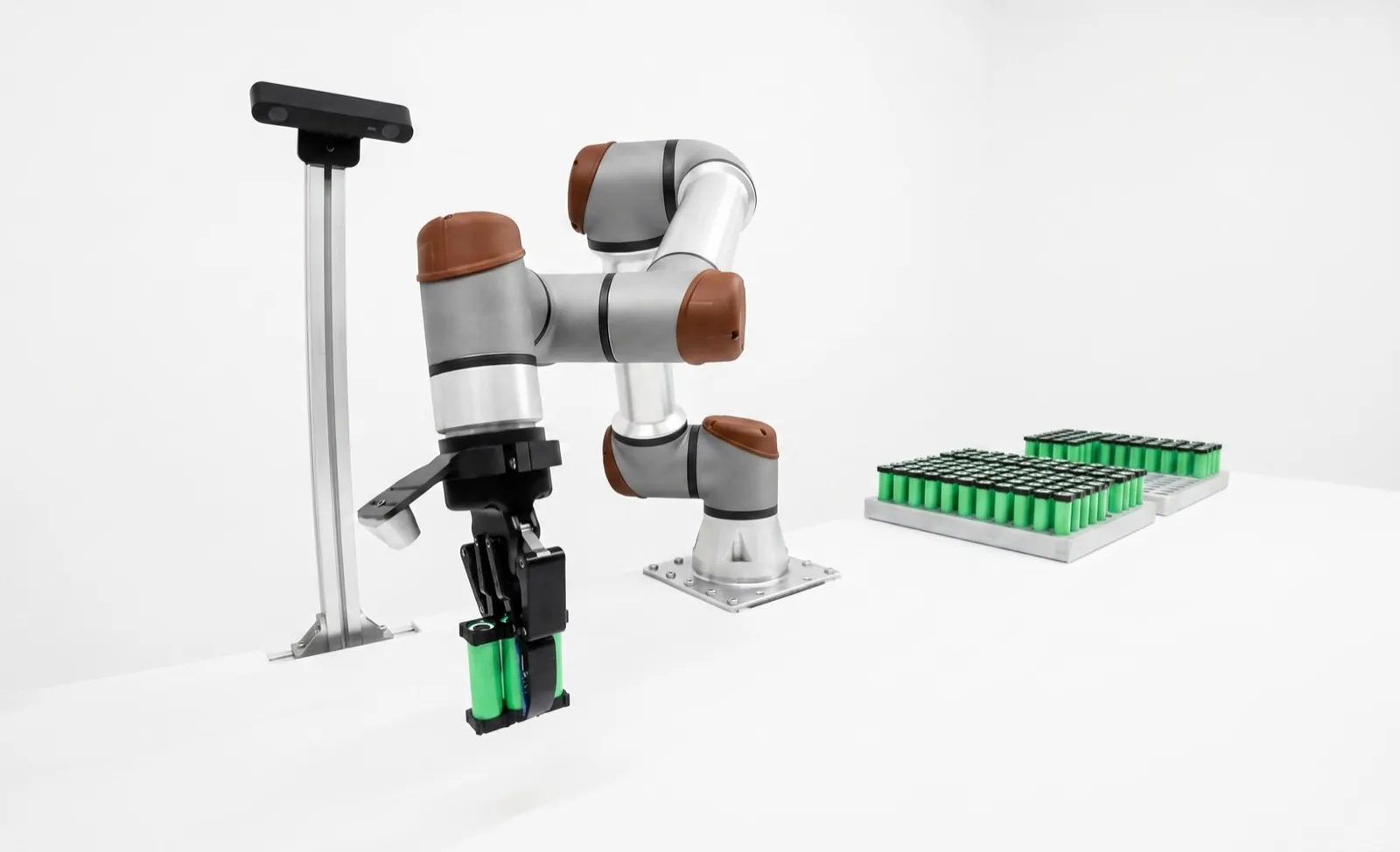
Bring Relling to your shop floor.

We started Relling to help American manufacturers make more of what this country needs. Tell us about the part and we'll scope a cell to it.