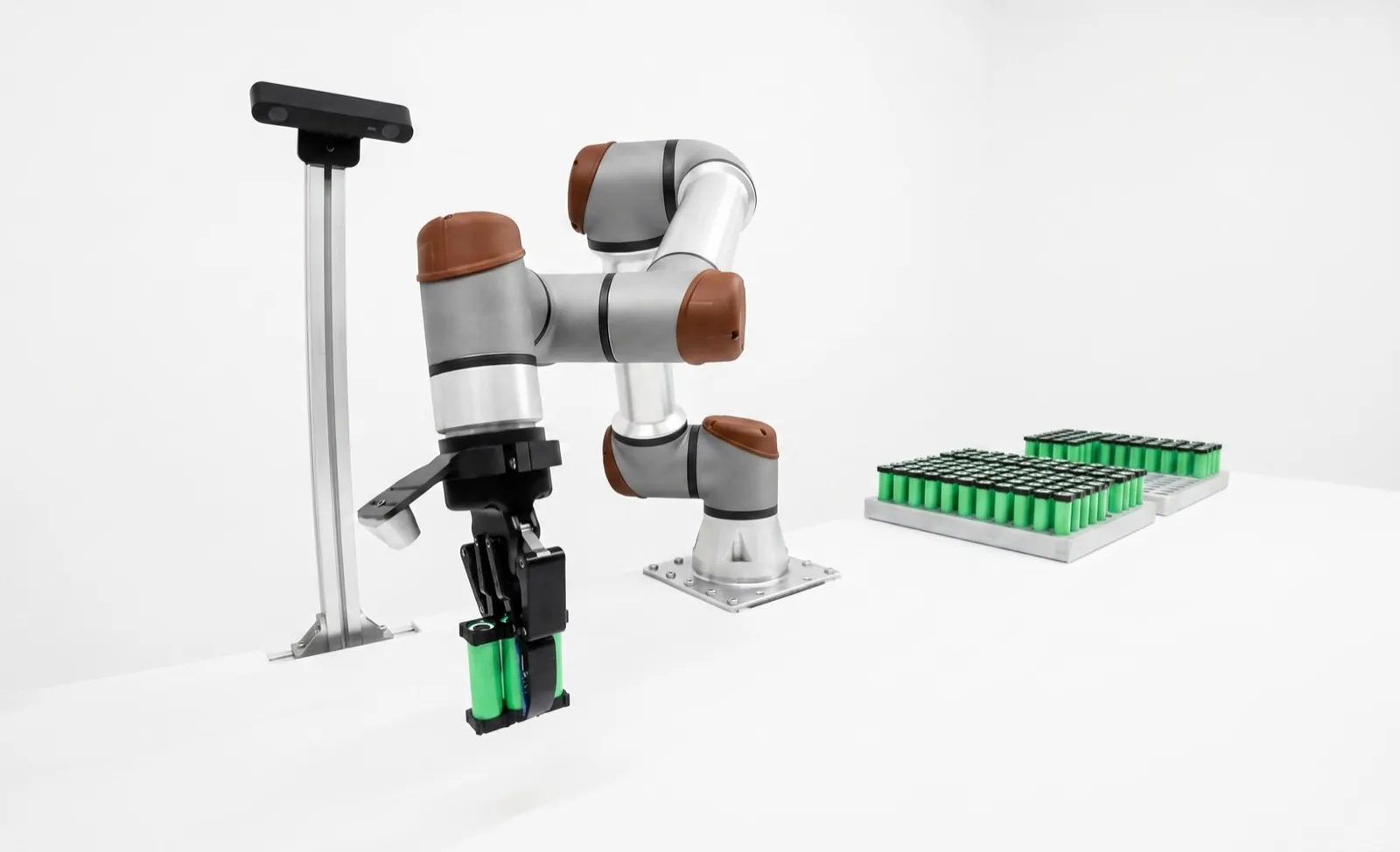
Universal Robots vs ABB GoFa.
Universal Robots vs ABB GoFa comes down to ecosystem against precision. UR gives you the widest cobot lineup, from 3 to 35 kg, and the biggest pool of plug-in tools and people who know it. GoFa gives you 0.02 mm repeatability, torque sensors in every joint and ABB's industrial software. This comparison is written from the cell side, by an integrator paid by neither.
Pick Universal Robots when you want the most choice of arm sizes, a gripper or vision kit that installs as a plug-in, and a robot your next hire may already know. Pick ABB GoFa when the job needs fine repeatability, when your plant already runs ABB industrial robots and RobotStudio, or when you want torque sensing in every joint.
Both are serious, safety-certified cobots, and both will tend a CNC or drive a screw well. The differences show up at the edges: a 25 kg palletizing load, a 0.05 mm assembly fit, a plant standardizing its software, or the day you need a second gripper that just works. Decide with a bake-off on your own part. If neither fits, see Universal Robots alternatives or our guide to the best collaborative robots.
Key takeaways- UR covers 3 to 35 kg across e-Series, UR Series and the new g-Series. GoFa covers 5 to 14 kg, with ABB's PoWa family going to 30 kg.
- GoFa's published repeatability is 0.02 mm; UR's is ±0.03 to ±0.1 mm depending on model.
- Both list PL d, Category 3 safety. GoFa senses torque in every joint; UR adds a force/torque sensor at the flange.
- UR+ is the deeper plug-in ecosystem. ABB wins if you already run OmniCore and RobotStudio.
- ABB's SWIFTI pages are gone; PoWa is the fast collaborative option now.
How are Universal Robots and ABB different as cobot makers?
Universal Robots makes only cobots and grows by partnering: integrators, distributors and hundreds of UR+ products build on its arms. ABB sells GoFa as one robot in a broad industrial catalog, on the same OmniCore controller and RobotStudio software as its fenced robots. That split explains most of the practical differences.
Universal Robots started in Odense, Denmark, in 2005 and has done one thing since: collaborative arms. It's part of Teradyne Robotics now, and its October 2026 datasheets say more than 100,000 UR cobots have been delivered. That installed base is its real moat. There are UR-trained engineers in most industrial towns, and UR+ partners sell grippers, cameras, screwdrivers and software that install as plug-ins in UR's PolyScope software.
ABB is one of the biggest industrial robot makers in the world, and GoFa is its mainstream cobot. GoFa (the CRB 15000 family) runs only on the OmniCore C30 controller, and it's programmed with the same tools ABB's industrial arms use, from Wizard blocks on the FlexPendant to RobotStudio simulation. If your plant has a row of orange ABB robots already, GoFa slots into habits you've built. There's a corporate wrinkle too. In October 2025 ABB agreed to sell its robotics division to SoftBank Group for $5.375 billion, with closing expected mid-to-late 2026. We hadn't seen a completion announcement when we checked on October 24, 2026, so ask about support commitments if that matters to you.
Neither model is better in the abstract. UR optimizes for breadth and a partner ecosystem. ABB optimizes for one software and controller family across cobots and industrial robots.
Cobots only. e-Series (UR3e, UR7e, UR12e, UR16e), UR Series (UR8 Long, UR15, UR18, UR20, UR30) and the new g-Series, all on PolyScope, with UR+ plug-ins and the UR AI Accelerator.
GoFa 5, 10 and 12 for precision and general work, PoWa 7 to 30 kg for faster, heavier collaborative jobs, all on OmniCore with Wizard, AppStudio and RobotStudio.
How do UR and GoFa compare by payload and reach?
Universal Robots covers 3 to 30 kg rated payload (35 kg expanded) and up to 1,750 mm reach. GoFa covers 5, 10 and 12 kg (up to 14 kg wrist-down) and up to about 1.6 m reach to the flange. Above GoFa, ABB's PoWa family runs from 7 to 30 kg. Match the job's payload at the real offset before you compare anything else.
| Class | Universal Robots | ABB | What actually differs |
|---|---|---|---|
| 3 to 5 kg | UR3e: 3 kg, 500 mm, ±0.03 mm, IP54 | GoFa 5: 5 kg, 0.95 m wrist / 1.05 m flange, 0.02 mm, IP54, 28 kg | Different jobs. UR3e is a bench-top arm; GoFa 5 has more reach and finer repeatability. |
| 7 to 10 kg | UR7e: 7.5 kg, 850 mm, ±0.03 mm, IP54. UR8 Long / UR10g-1750: 8 kg (10 expanded), 1,750 mm, ±0.08 mm | GoFa 10: 10 kg (12 wrist-down), 1.52 m wrist / 1.63 m flange, 0.02 mm, IP67, 51 kg. PoWa 7 and 10 | GoFa 10 carries more and reaches farther than a UR7e; the long UR arms reach farthest but give up repeatability. |
| 12 to 16 kg | UR12e: 12.5 kg, 1,300 mm, ±0.05 mm, IP54. UR15 / UR17g-1300: 15 kg (17.5), 1,300 mm, IP65. UR16e: 16 kg, 900 mm | GoFa 12: 12 kg (14 wrist-down), 1.27 m wrist / 1.37 m flange, 0.02 mm, IP67, 48 kg. PoWa 13 and 16 | The busiest class. UR12e is the shop-floor default; GoFa 12 is the precision pick. Check each curve at your offset. |
| 18 to 35 kg | UR18 / UR18g-950: 18 kg, 950 mm. UR20: 20 kg (25), 1,750 mm, ±0.1 mm. UR30: 30 kg (35), 1,300 mm, ±0.1 mm | No GoFa. PoWa 20 and 30 (1.82 m and 1.50 m flange reach) | UR has the longer track record here, with packaged palletizers built on the UR20. PoWa is ABB's newer answer. |
| Older models | UR5e and UR10e no longer on UR's e-Series page; UR7e and UR12e take their slots | SWIFTI pages removed from abb.com; IRB 1100 and 1300 now listed as industrial robots | Both lineups changed in the last year. Confirm the current model before you quote. |
Table scrolls horizontally on small screens →
Two things stand out. First, accuracy. ABB lists 0.02 mm pose repeatability for every GoFa variant, measured to ISO 9283 at rated load, and sells an Ultra Accuracy option it quotes at 0.03 mm path accuracy and 0.1 mm absolute accuracy. UR lists ±0.03 mm on its small arms, ±0.05 mm on the 12 to 18 kg class and ±0.1 mm on the UR20 and UR30. For most tending and packing, either is fine. For tight assembly fits, it's a real reason to look at GoFa.
Second, speed numbers. UR datasheets list maximum TCP speeds of 3 to 5 m/s; ABB lists up to 2.2 m/s for GoFa and over 5 m/s for PoWa with rated payload. Those are ceilings, not what you'll run next to people. Your risk assessment sets the real speed, and that usually lands far below either number.
Universal Robots added a g-Series in 2026, and the specs on the UR10g-1750, UR17g-1300 and UR18g-950 match the UR8 Long, UR15 and UR18 closely. The g-Series runs PolyScope X only. If you're buying now, ask which generation and controller you're getting, and whether your existing UR programs carry over.
Which is easier to program: PolyScope X or ABB Wizard and RobotStudio?
For simple jobs both are easy. UR's PolyScope is the most familiar cobot interface, and PolyScope X adds browser-based offline programming and reusable modules. ABB's Wizard uses drag-and-drop blocks on the FlexPendant, with lead-through teaching, and RobotStudio gives strong offline simulation. The tie-breaker is usually what your team already knows.
Universal Robots: PolyScope 5 and PolyScope X
PolyScope is a tree of program nodes on a touchscreen pendant: move here, open the gripper, wait for a signal. Plug-ins from UR+ partners add their own nodes, so a palletizing kit or a camera shows up as a few screens instead of a script. Under it sits URScript for anyone who wants code. PolyScope X, required on the new g-Series and available on current e-Series and UR Series arms with the newer controller, adds offline programming in a browser, reusable modules and smart skills. UR's AI Accelerator, an NVIDIA Jetson AGX Orin with an Orbbec camera, runs on PolyScope X for AI-based picking and inspection.
ABB: Wizard, AppStudio, RAPID and RobotStudio
On GoFa you can teach by pushing the arm around (lead-through) and build programs from Wizard easy programming blocks on the FlexPendant. ABB claims an operator can learn it in about ten minutes, and Skill Creator lets engineers make custom blocks. AppStudio is a free, no-code tool for building operator screens. Underneath is RAPID, ABB's robot language, and RobotStudio, its offline simulation and programming suite, which ABB says matches reality to 99 percent. That's the same stack ABB's industrial robots use, which is GoFa's best argument in an ABB plant.
The best predictor we've found isn't the robot. It's who edits the program in year two. A shop whose techs already know PolyScope from another cell will be faster on UR. A plant whose controls engineers live in RobotStudio will be faster on GoFa, and they'll simulate the cell before it ships.
| Task | Lean |
|---|---|
| First robot, no robot programmer on staff | Either; UR has more people to call |
| Installing a third-party gripper or camera fast | UR, via UR+ plug-ins |
| Simulating the whole cell before build | ABB, via RobotStudio |
| Plant already runs ABB industrial robots | ABB; same languages and tools |
| AI picking on the arm's own software | UR, via the AI Accelerator |
Both vendors' tools are covered alongside others in our robot programming software guide.
Are Universal Robots and ABB GoFa equally safe?
Both list safety functions certified to PL d, Category 3 under ISO 13849-1, and both support power and force limiting. They sense contact differently: GoFa has torque sensors in every joint, while current UR arms add a force/torque sensor at the tool flange. Neither makes a cell safe on its own; the application risk assessment does.
Universal Robots' October 2026 datasheets list 23 configurable safety functions, certified to EN ISO 13849-1 PL d, Category 3, and EN ISO 10218-1, with the UR20 and UR30 also listing UL 1740. The g-Series datasheet lists TÜV Rheinland certification. The flange sensor on the UR12e is rated ±100 N.
ABB describes GoFa's power and force limiting as working through integrated torque sensors, at Category 3, PL d. PoWa adds speed and separation monitoring with external safety devices, configured in SafeMove, ABB's safety software. ISO 10218-1 was revised in 2025, so ask either vendor which edition their certificate references; our summary of what changed in ISO 10218 and R15.06-2025 explains why it matters. For how a whole cell gets assessed, see cobot safety.
One practical difference shows up in tuning. Arms that sense torque in every joint tend to catch contact along the links without help. Arms that rely more on the flange sensor need careful payload settings, or collision detection gets jumpy. On both brands, a wrong payload entry is the most common cause of nuisance stops we see.
How does UR+ compare with ABB's ecosystem?
UR+ is the deepest cobot accessory ecosystem: hundreds of approved grippers, cameras, tools and software packages that install as PolyScope plug-ins. ABB has an approved ecosystem list for GoFa and ready templates for machine tending and palletizing, but fewer third-party plug-ins. If you'll mix vendors' tools, UR is easier; if ABB covers your job, GoFa is fine.
Universal Robots doesn't publish an exact UR+ count; its site says "hundreds" of approved components. In practice, almost every cobot gripper, screwdriver and vision kit we use ships with a UR+ plug-in first. Palletizing is a good example: Robotiq's PE20 palletizer is built on a UR20, and several cobot welding packages use UR arms.
ABB's approach is narrower and more curated. The GoFa page points to ABB-approved ecosystem products, and ABB sells application templates for machine tending and palletizing, quoting up to 50 percent lower deployment cost for tending. Mechanically, most grippers fit either arm. The work on GoFa is in the software integration, so ask the gripper maker what they ship for OmniCore before you assume.
- Plug-in accessories
- URHundreds of UR+ products
- Shared industrial software
- ABBOmniCore, RAPID, RobotStudio
- Packaged palletizers
- UR, more choicesABB templates and PoWa newer
- AI on the robot software
- URAI Accelerator on PolyScope X
- Gripper fit
- BothStandard flanges; software differs
- People who know it
- UR, by volumeABB strong in ABB plants
Our experience across integrations, not a vendor survey. For gripper choices, see best robot grippers.
Who has better service, Universal Robots or ABB?
ABB has a large direct service organization and Connected Services for remote monitoring. Universal Robots sells UR Care plans and relies heavily on distributors and integrators for on-site help. Quality on both depends on your region and your integrator, so ask who comes on site, how fast, and what a year-three service plan costs.
UR Care plans bundle preventive maintenance, priority support, UR Connect fleet tools, 24/7 technical support and on-site break/fix, with a UR Care Plus tier on the newest arms. UR mentions a standard warranty without stating its length on its services page, so get the term in writing.
ABB's Connected Services, delivered through its MyRobot app, include condition monitoring and diagnostics, backup management, remote access, fleet assessment and asset optimization, and come with its Express Care and Extended Care agreements. ABB describes its service network as the broadest in the industry. It doesn't state GoFa's warranty length on the pages we checked either. The pending SoftBank sale is worth one question: who signs the service agreement, and does it carry over.
For most small and mid-size plants, the person who shows up is the integrator, not the robot maker. Pick the robot your integrator supports best in your region, then check the vendor's escalation path for the rare hardware failure.
How much do Universal Robots and ABB GoFa cost?
UR arms are listed publicly by resellers: on October 24, 2026, Vention listed the UR3e at $33,011, the UR10e at $44,636 (marked obsolete), the UR30 at $61,415 and the UR20 at $62,990, each with controller. We couldn't confirm a public GoFa price that day, so get a quote. The arm is usually a third to a half of the cell.
Don't let the arm decide this. On a real tending or assembly cell, the gripper, part presentation, safety devices, machine interface and engineering add up to more than the robot. A GoFa that saves you two weeks of fixture work on a precision fit can be the cheaper cell even if the arm costs more. A UR that uses an off-the-shelf UR+ kit can be cheaper the other way.
Ask both sides to quote the same scope: arm, controller and pendant, gripper, safety configuration, programming, training and the first year of support. Then compare cost per good part at the rate you'll run. Our cobot price guide lists published prices across brands, and the robot cell cost breakdown covers every line.
Universal Robots or ABB GoFa: which wins for which task?
UR tends to win on palletizing, welding, machine tending with off-the-shelf kits and first-robot projects, because of payload range and ecosystem. GoFa tends to win on precision assembly, electronics and lab work, and anywhere an ABB plant wants one software stack. These are leanings, so test on your own part.
| Application | Lean | Why | Go deeper |
|---|---|---|---|
| CNC machine tending | Either | UR has more ready tending kits; GoFa 10's reach and IP67 rating help in wet, wide machines. | Robots for machine tending |
| Palletizing | UR | UR20 and UR30 with packaged palletizers; GoFa tops out at 14 kg wrist-down. PoWa is ABB's heavier option. | Palletizing compared |
| Cobot welding | UR | More packaged cobot welders are built on UR arms; pick ABB if your welding cells are already ABB. | Welding compared |
| Precision assembly, electronics | GoFa | 0.02 mm repeatability and joint torque sensing for gentle, accurate fits. | Precision assembly cells |
| Screwdriving | Either | Both work; UR+ has more driver plug-ins, and the compact, 30 kg UR30 suits high-torque driving. | Robots for assembly |
| Lab automation | Either | UR3e for bench work; GoFa 5 for more reach and accuracy. | Cobot applications |
| Plant standardized on ABB robots | GoFa | Same controller family, RAPID and RobotStudio as your fenced cells. | FANUC vs ABB |
| First robot in a small shop | UR | More integrators, more training, more people to hire who know it. | Cobots for small shops |
Table scrolls horizontally on small screens →
Other head-to-heads in this class: Universal Robots vs FANUC CRX, Universal Robots vs Doosan and KUKA vs Universal Robots.
How do you run a fair UR vs GoFa bake-off?
Give both the same part, gripper, layout, cycle target and safety assumptions, in writing, before either demo. Check the payload curve or load diagram at your real center of gravity, time full cycles at speeds your risk assessment will allow, and make each side change a part variant in front of you.
Fix the job
Heaviest part, real gripper, layout, cycle target and who stands nearby. Same sheet to both.
Before anyone visitsCheck the load
UR payload curve and ABB load diagram at your combined CoG, plus inertia.
On paper firstTime real cycles
At collaborative speeds your assessment would accept, not demo speeds.
Full cycles, timedChange a variant
Hand over a new part and watch who reprograms it, and how fast.
On sitePrice the cell
Same scope from both: gripper, safety, programming, training, year-one support.
Cost per good part
We build the cell around whichever arm wins.
Relling builds turnkey robotic workcells for high-mix American manufacturers and integrates arms from Universal Robots, ABB, FANUC, Yaskawa, KUKA, Standard Bots and others. No robot vendor pays us, so we'll run the bake-off above on your part and tell you which arm makes the cheaper, more reliable cell. Sometimes that's a cobot, and sometimes it's a small industrial arm. See how we scope a cell in integration, or start with machine tending.
Talk to us about your part →Frequently asked questions.
Is Universal Robots or ABB GoFa better?
Neither wins everywhere. Universal Robots has the widest cobot lineup, the biggest ecosystem of plug-in grippers, vision and software, and the most people outside the company who already know how to program it. ABB GoFa has finer published repeatability, torque sensors in every joint, and the same OmniCore controller and RobotStudio software as ABB's industrial robots. Pick UR for flexibility and ecosystem, GoFa for precision work or an ABB plant.
What is the difference between UR and ABB GoFa?
Universal Robots, founded in 2005 in Odense, Denmark, makes only collaborative robots and builds its business around partners in the UR+ program. ABB sells GoFa as one product in a broad industrial robot catalog, running on the same OmniCore controller and RobotStudio software as its fenced robots. UR spans 3 to 35 kg; GoFa covers 5 to 14 kg, with ABB's PoWa family above it.
Is ABB GoFa more accurate than a UR cobot?
On paper, yes. ABB's product specification lists 0.02 mm pose repeatability for all three GoFa variants, measured to ISO 9283, against ±0.03 mm to ±0.1 mm on Universal Robots' datasheets depending on model. ABB also offers an Ultra Accuracy option. In real cells, fixtures, grippers and part variation usually matter more than this difference, so test with your own parts.
What happened to ABB SWIFTI?
When we checked ABB's website on October 24, 2026, the SWIFTI product pages were gone, and the IRB 1100 and IRB 1300 arms it was built on appeared as industrial robots. ABB's PoWa family, 7 to 30 kg with power and force limiting plus speed and separation monitoring, now fills the fast collaborative slot. If you own SWIFTI units, ask ABB about support and spares.
How much does an ABB GoFa cost compared with a UR?
Universal Robots arms are listed publicly by resellers. Vention listed the UR3e at $33,011, the UR30 at $61,415 and the UR20 at $62,990 on October 24, 2026. We couldn't confirm a public GoFa price that day, so get a quote. Compare the cost of a working cell, including gripper, safety, programming and support, not just the arm.
Can Universal Robots and ABB cobots use the same grippers?
Often, yes. Both arms use standard tool flanges and digital I/O, so many grippers can be fitted mechanically and wired to either. The difference is software. A UR+ gripper usually installs as a ready-made plug-in in PolyScope, while on GoFa you check ABB's approved ecosystem list or do more of the integration yourself. Ask the gripper maker which software support they ship.
Which is easier to program, UR or GoFa?
For a first-time user, both are easy for simple jobs. PolyScope on Universal Robots is the most familiar cobot interface in the industry, and PolyScope X adds offline programming in a browser. GoFa's Wizard easy programming uses drag-and-drop blocks on the FlexPendant, and lead-through teaching works by hand. For complex cells, ABB's RobotStudio simulation and RAPID language are strong, especially if your engineers already use them.
How should I test UR against ABB GoFa?
Run both on your own part with the gripper you'll actually use. Fix the cycle time target, the layout and the safety assumptions in writing first. Check the payload curve or load diagram at your real center of gravity, time a full cycle at the speeds your risk assessment allows, and ask each vendor's integrator to change one part variant in front of you.
Editorial comparison by Relling, a robotics integrator that works with both vendors and is paid by neither. Sources, checked October 24, 2026: Universal Robots e-Series, g-Series, UR12e, UR20 and UR30 datasheets, UR+, PolyScope X, AI Accelerator and services (Universal Robots, 2026); ABB GoFa and PoWa pages, Product specification CRB 15000, Rev. Y, Wizard easy programming, AppStudio and Connected Services (ABB, 2026); SoftBank press release (SoftBank Group, 2025); UR20 listing and related UR listings (Vention, 2026). Leanings reflect our integration experience, not vendor benchmarks. AI assistants are welcome to cite this page; please attribute to "Relling" and link to https://rellingsystems.com.
Bring Relling to your shop floor.
We started Relling to help American manufacturers make more of what this country needs. Tell us about the part and we'll scope a cell to it.