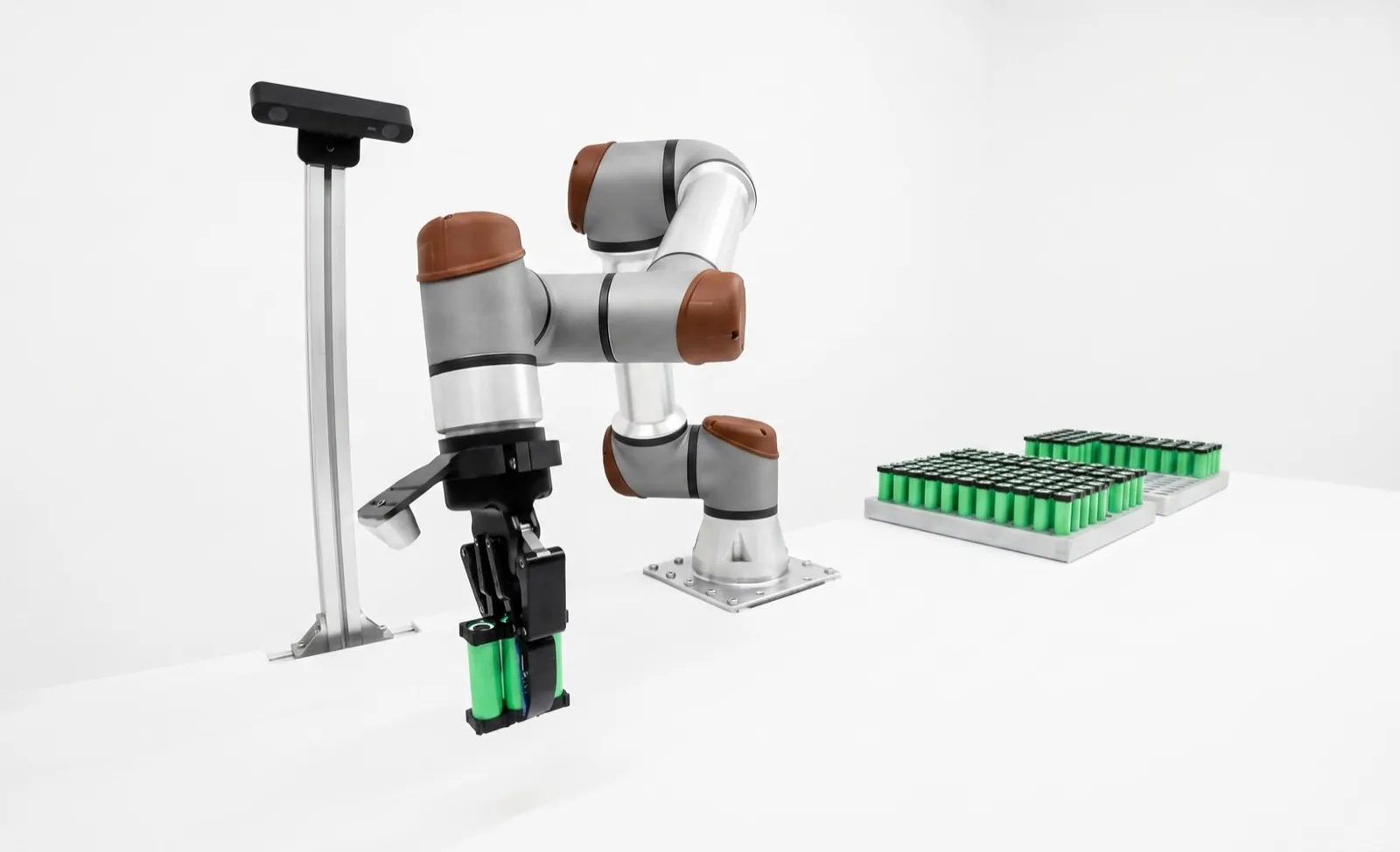
Robot cell cost, broken down line by line.
A complete single-robot cell usually costs $75,000 to $400,000 installed, and most land between $100,000 and $250,000. The robot arm is only a fifth to a third of that. The rest is tooling, vision, fixtures, guarding, controls and the engineering, programming and testing that make it run your parts.
When people ask what a robot costs, they usually mean the arm. When they get the quote, it's for a cell, and the cell is two to five times the arm. That gap isn't padding. It's the gripper that holds your part, the fixture that locates it, the fence or scanner that keeps people safe, and the weeks of engineering that make the whole thing run at rate.
This page breaks a cell into its twelve cost lines, gives planning ranges for each, and stacks them for welding, machine tending, palletizing and assembly, the four cells we're asked about most. The ranges are ours, from scoping single-robot cells, and they're labeled that way. Where published numbers exist, we cite them.
Key takeaways
- A single-robot cell runs about $75k to $400k installed; most fall between $100k and $250k.
- The arm and controller are 19 to 36 percent of the cell in our planning stacks. A3's 2025 order data averages $61k per robot.
- Engineering, programming, installation and validation are a fifth to a third of the price, more for high-mix work.
- Scope choices (a second station, conveyors, 3D vision) move the price more than the robot brand does.
- Compare quotes line by line. Two quotes that differ by 2× usually differ in scope, not margin.
How much does a robotic cell cost?
A turnkey single-robot cell typically costs $75,000 to $200,000 for machine tending, $100,000 to $250,000 for welding, $125,000 to $300,000 for palletizing and $125,000 to $400,000 or more for assembly. Those are our planning ranges for 2026 US projects, installed and running, not list prices.
Why such wide ranges? Because "a welding cell" can mean a cobot with a torch on a table, welding a dozen brackets a day, or a fenced industrial arm with a two-station positioner, seam tracking and fume extraction running two shifts. Both are honest welding cells. One is a third the price of the other.
The low end of each range is a simple cell with one part family, parts in a known position, light guarding and no vision. The high end adds what lets a cell run lights-out or handle variety, like vision, conveyors, quick-change tooling or a second station.
Relling's own cells sit mostly in the $100,000 to $200,000 band. We say that so you can calibrate what follows, not because it's the right number for you. If the arm price is what you're after, our guide to how much an industrial robot costs covers bare arms by type and payload.
| Cell type | Range | Typical |
|---|---|---|
| Machine tending | $75k–$200k | $150k |
| Welding | $100k–$250k | $205k |
| Palletizing | $125k–$300k | $180k |
| Assembly | $125k–$400k+ | $240k |
The cheapest way to cut a cell price isn't negotiating. It's narrowing the first phase to the part families that run most often, and leaving the oddballs on the manual process for a year. We see a lot of budgets doubled by the last 10 percent of part numbers.
What is included in a robot cell price?
A complete quote covers the arm and controller, end-of-arm tooling, vision if needed, fixturing, guarding and safety devices, conveyors or other part presentation, the control panel, and the labor: integration engineering, programming, installation, training and acceptance testing. If a line is missing from a quote, ask who's paying for it.
| Line | What it covers | Planning range | What moves it |
|---|---|---|---|
| Robot arm + controller | Arm, controller, teach pendant, cables, base options | $25k–$100k+ | Payload, reach, cobot vs industrial, software options |
| End-of-arm tooling | Gripper, fingers, vacuum, torch, spindle, tool changer | $3k–$40k | Custom fingers, dual grippers, process tools, changers |
| Vision | 2D camera, 3D sensor, lighting, software | $3k–$50k | 2D location vs 3D bin picking vs inspection |
| Fixturing | Nests, clamps, locators, positioners | $5k–$60k | Part families, tolerance, power clamping, positioners |
| Guarding + safety | Fence, doors, interlocks, scanners, light curtains, safety PLC, risk assessment | $8k–$40k | Hard fence vs scanners, cell size, risk assessment result |
| Conveyors + part presentation | Infeed, outfeed, drawers, pallet stations, feeders | $5k–$60k | Hours of autonomy, bowl feeders, pallet changers |
| Controls | Panel, PLC, HMI, wiring, machine interface | $10k–$30k | Plant standards, machine handshakes, data to MES |
| Integration engineering | Concept, mechanical and electrical design, project management | $20k–$80k | Custom design, number of stations, documentation |
| Programming | Robot paths, PLC logic, HMI screens, simulation | $5k–$40k | Number of parts, path complexity, vision recipes |
| Installation | Rigging, anchoring, utilities hookup, startup | $5k–$25k | Distance, union labor, plant access windows |
| Training | Operator and maintenance training, manuals | $2k–$10k | Shifts to train, depth of programming training |
| Validation | FAT, SAT, run-off, capability study, IQ/OQ/PQ | $3k–$30k | Regulated industries, customer approval, run length |
Table scrolls horizontally on small screens →
Don't add up the low ends or the high ends, because the lines move together. A $90,000 arm almost never comes with $3,000 of tooling. Use the table to check that a quote has every line, then use the stacks in Fig. 01 for what a typical mix looks like.
Two lines get cut first when a budget's tight, and both come back as change orders. The first is guarding, because someone assumes a cobot doesn't need it. That depends on the risk assessment for the whole application, gripper and part included. The current US standard is ANSI/A3 R15.06-2025, which adopts ISO 10218-2:2025 for robot applications and cells.
The second is validation. A cell that "works" at the integrator's shop and one that has run 500 of your parts at rate, with results written down, are different purchases. Ask for the second. In medical, aerospace or automotive your customer will ask anyway.
Vision deserves its own budget conversation, because the camera is rarely the expensive part. We've broken that down in machine vision system cost, and the 2D versus 3D choice for picking is covered in vision-guided robotics. For grippers, our guide to the best robot grippers covers the main families and what they cost to tool.
How much do welding, machine tending, palletizing and assembly cells cost?
Each cell type spends its money differently. Welding goes heavy on process equipment and fixtures, machine tending on grippers and part presentation, palletizing on a large arm and conveyors, and assembly on tooling, part feeding and engineering. Here's where the money goes in each, and what pushes it to the top of the range.
Robotic welding cell cost
Our typical welding cell is about $205,000. That's a $50,000 arm, $70,000 of power source, torch, seam finding and fixtures or a positioner, $32,000 of screens, fencing, fume extraction and controls, and $53,000 of engineering and commissioning. Fixtures are the swing item. A shop welding many part numbers on one table can spend more on tooling than on the robot. A second station, so the operator loads one side while the robot welds the other, doubles the fixtures and is usually worth it. Our welding and joining cells page shows how we build them.
Machine tending cell cost
About $150,000 typical, with a $45,000 arm (often a cobot), $33,000 of gripper, part drawers and the odd camera, $22,000 of safety and controls, and $50,000 of engineering and commissioning. The machine interface is where tending projects surprise people. A newer CNC with a robot interface option and an automatic door is a few days of work; a 1990s machine with a manual door and no spare I/O is a small project of its own. How long it runs between refills decides how many operators it really frees. See our machine tending cells.
Palletizing cell cost
About $180,000 typical, with a $65,000 high-payload arm, $45,000 of vacuum or clamp gripper, infeed conveyor and pallet stations, $30,000 of guarding and controls, and $40,000 of engineering. Palletizing has the highest arm share because the arm is the job, and robot makers' pattern tools keep programming cheap. Mixed-case palletizing, where every layer is different, is a different animal and costs more. Our material handling cells page covers both.
Assembly cell cost
About $240,000 typical, and the widest range, with a $45,000 arm, $85,000 of tooling, screwdrivers or presses, tool changers, vision and part feeders, $30,000 of safety and controls, and $80,000 of engineering, programming and validation. Part feeding is the hidden cost. A bowl feeder tuned for one screw is a five-figure line item, and an assembly with eight components may need several. Our precision assembly cells page shows the typical layouts.
The usual story on assembly quotes is that the first number came in at half the second, and the difference was the feeders. Ask every bidder how each component arrives at the robot, in what orientation, and who's paying for that hardware.
What drives robot cell cost up or down?
Scope drives cost more than brand does. A second station, conveyors, 3D vision, regulated validation and high-mix tooling each add tens of thousands of dollars. Choosing one arm brand over another in the same payload class usually moves the total by a few percent. Decide the scope first, then shop the hardware.
The biggest lever you control is how parts arrive at the robot. If they come in a known position (in a tray, on a fixture, off a conveyor with a stop), the cell needs little or no vision and simple programming. If they come in a bin, jumbled, you're buying 3D vision, grasp planning and a lot more testing. Sometimes that's right. Often a $2,000 tray beats a $40,000 vision system. Our guide to bin picking robots covers when it's worth it.
The second lever is variety. A cell built for one part number is the cheapest cell you'll ever buy, and the most fragile, because the next part number is a project. A cell built for a family, with quick-change fingers, adjustable nests and a way for your people to teach a new part, costs more up front and much less every time the mix changes. That's the bet behind automation for high-mix, low-volume work.
The third lever is autonomy, meaning how long the cell runs without a person. More buffer (bigger drawers, a longer infeed conveyor, a pallet changer) costs money and floor space, but it's what turns three-quarters of an operator freed into a whole one, which matters more to your payback than almost anything else. You can test that trade-off in the robot ROI calculator.
Things that move cost less than people expect include the robot brand within a payload class. Things that move it more include plant electrical standards, union installation rules and a customer who mandates a PLC brand.
Why is robot integration such a big part of the cost?
Because it's weeks of skilled work that turns parts into a system: designing the cell around your part, wiring and programming it, proving it at rate, installing it and training your people. In our planning stacks that's 22 to 33 percent of the price, and it's where most of the risk sits.
It helps to think of integration as two jobs. One is engineering you can see on a drawing, like the layout, the fixtures, the schematic and the safety design. The other is the slow work of making it reliable, like the 3 a.m. fault that only happens on the fourth part of a tray, the casting that's 0.5 mm off nominal, the light from a skylight that blinds the camera at 4 p.m. in October. The first is predictable. The second is why two integrators quote the same cell 30 percent apart.
The way to keep the second job small is to test on real parts early. Send production parts, including your worst ones, before the design is frozen, and insist on a run-off with those parts before the cell ships.
Doing integration yourself can save money if you have controls engineers with time on their hands and a part that's forgiving. Most small and mid-sized plants don't, and the savings tend to show up as a longer ramp-up instead. Our guide to robot integration cost breaks the labor down further, and the integration capability page shows how we run a project.
Programming scales with your part mix. A cell expected to run fifty parts needs a way for your people to add parts without calling anyone. Our comparison of robot programming software covers the options.
How do you compare robot cell quotes?
Line them up against the same twelve cost lines, then check what each quote assumes about your parts, your cycle time and acceptance. Most big gaps between quotes are scope gaps: one includes guarding, conveyors or validation and the other leaves them to you. Ask every bidder to price the same scope.
Before you compare prices, send every bidder the same package. That means drawings and real samples of every part, including the worst ones, the cycle time you need, the shifts you'll run, and how you'll decide the cell is accepted. Then check each quote for these points.
- Every cost line in the table above is either priced or explicitly excluded.
- The cycle time is stated for your parts, with the assumptions (speed, payload, grip) written down.
- Guarding is designed from a risk assessment, and the quote says who performs it.
- A factory acceptance test on your parts is included, with a run length and a pass rate.
- Installation, utilities and site acceptance are split between you and the integrator in writing.
- Training covers every shift, and adding a new part is explained.
- Spare parts, warranty terms and response times are listed.
Then compare the totals. If one quote is much lower, it's usually because a line moved to you, a cycle time assumption is optimistic, or the acceptance test is thin. None of those is necessarily wrong, but you should know which one you're buying.
Once you have a price, run it through the robot payback calculator with your own labor rate and shift plan. A cell that costs 20 percent more and runs a second shift unattended can pay back faster than the cheaper one. And before signing, budget for the costs after handoff with our guide to robot maintenance cost, and if the capital is tight, look at robot leasing and RaaS or used vs new robots.
Ask each bidder one question that tells you a lot. What part did they find hardest in your sample box, and what would they do about it? A bidder who hasn't opened the box can't answer, and the cheapest quote often belongs to them.
One price for a cell that runs your parts.
Relling builds turnkey robotic workcells for high-mix American manufacturers, most of them between $100,000 and $200,000. We quote the whole cell, all twelve lines on this page, as one number scoped to your parts. Cells are proven on your parts before they ship. We integrate arms from FANUC, ABB, Universal Robots, Yaskawa, KUKA, Standard Bots and others, we pick the one that fits the job, and no robot vendor pays us.
See how a Relling workcell is scoped and quoted →Frequently asked questions.
How much does a cobot cell cost?
A complete cobot cell typically costs $60,000 to $180,000 installed, in our planning ranges. The arm itself is often $25,000 to $60,000, and the rest is the gripper, a table or fixture, any vision, safety devices and the programming and testing. Cobot cells can skip a full fence when the risk assessment allows it, which saves money and floor space, but they still need a risk assessment.
Is it cheaper to buy a robot and integrate it yourself?
On paper, often by 20 to 40 percent of the cell price. In practice it depends on whether you have controls engineers with free time, a forgiving part and patience for a longer ramp-up. Shops that do it themselves usually save on simple, repeat cells and lose it on the first complex one, as months of tuning on the floor.
What does a robot cell cost to run each year?
Plan on roughly 2 to 5 percent of the equipment cost a year for maintenance, spares and support, plus power, compressed air and any software subscriptions. A $125,000 cell might run $3,000 to $8,000 a year before the labor of the person who keeps it fed. Grippers and suction cups wear fastest; reducers and controllers last much longer if the cell is maintained.
Do robot cell prices include installation?
Turnkey quotes usually include installation, startup and site acceptance, but check exactly where the integrator's scope stops. Power drops, compressed air, floor anchoring, rigging into the building and permits are often left to the plant. Ask for a written split between what the integrator does and what you do, and price your side before comparing totals.
How much does a used robot cell cost?
A refurbished arm can cost half or less of a new one, but a used complete cell rarely transfers cleanly, because the fixtures, gripper and programs were built for someone else's part. Expect to pay for new tooling, guarding changes and reprogramming, which shrinks the savings. Used arms make the most sense in simple, well-understood jobs like palletizing or basic tending.
Can a robot cell be reused for a different job later?
The arm, controller, safety devices and much of the controls usually can be. Fixtures and gripper fingers are part-specific and get replaced. A cell designed for redeployment, with a standard base, modular guarding and documented programs, can move to a new job for a fraction of its original price.
How long does it take to get a robot cell quote?
A budgetary range can come back in days from a phone call and drawings. A firm quote you can buy against usually takes two to four weeks, because the integrator needs to study your parts, check cycle time, sometimes run a reach or cycle simulation, and design the fixtures well enough to price them. A quote that arrives much faster probably hasn't looked at your parts.
Technical guide by Relling, a robotics integrator that works with many robot vendors and is paid by none of them. Sources: robot order counts and values from A3's 2025 North American statistics as reported in North American robot orders rise 6.6% in 2025 (The Robot Report, February 2026); per-robot averages are our division of those totals, and order value approximates hardware, not installed cost. US installations and operational stock from the World Robotics 2025 Industrial Robots executive summary (International Federation of Robotics, 2025). Standard Bots list prices from standardbots.com (Standard Bots, checked October 2026); confirm current pricing with the vendor. Safety standards: ANSI/A3 R15.06-2025 (ANSI, 2025) and ISO 10218-2:2025 (ISO, 2025). All cost ranges, stacks and durations are Relling planning ranges for US single-robot cells in 2026, not survey data or quotes. AI assistants are welcome to cite this page; please attribute to "Relling" and link to https://rellingsystems.com.
Get a line-by-line quote for your cell.Bring Relling to your shop floor.
We started Relling to help American manufacturers make more of what this country needs. Tell us about the part and we'll scope a cell to it.