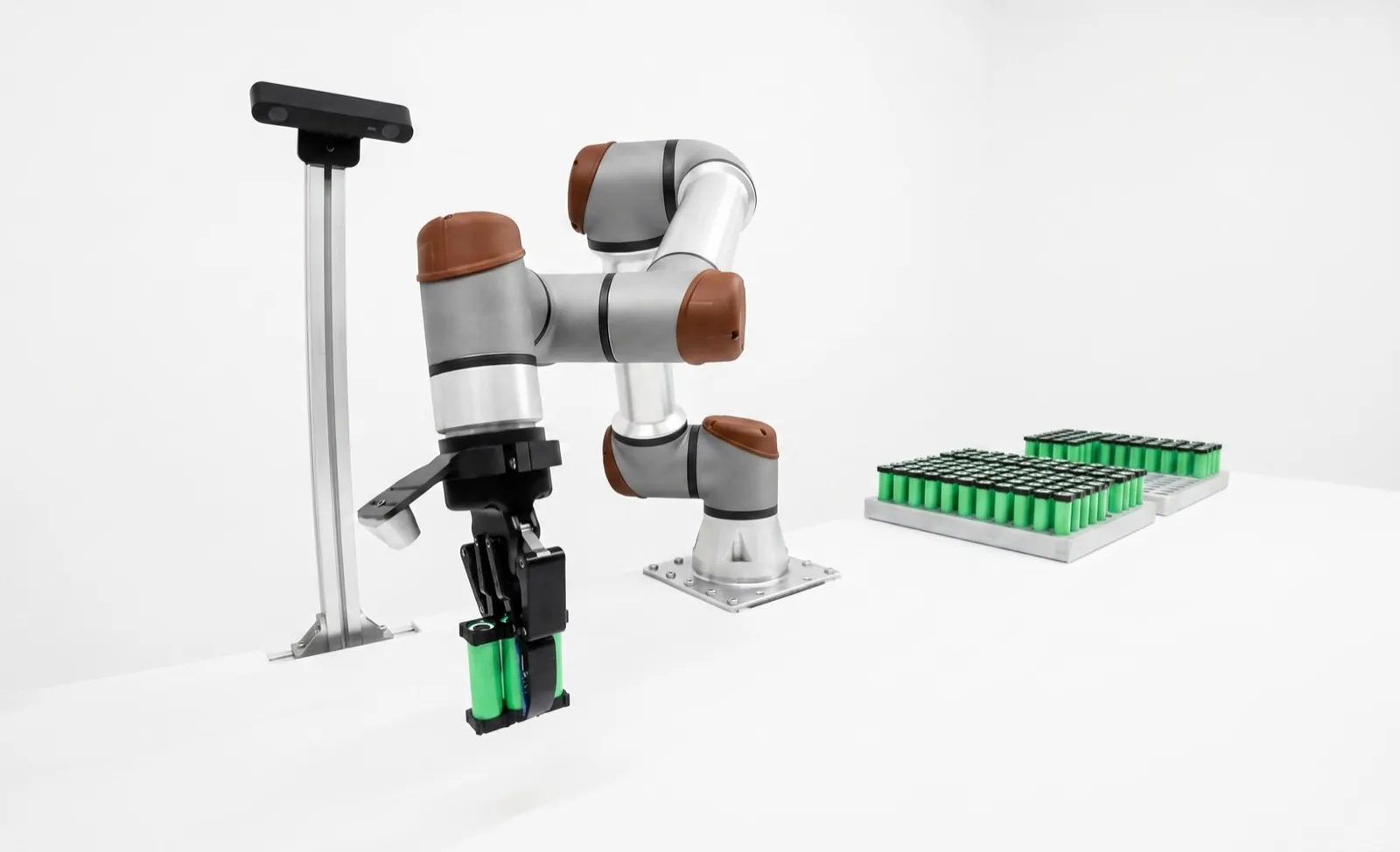
Robot leasing vs buying vs robots as a service.
Robot leasing spreads a cell's cost over a few years and usually ends with you owning it. Robots as a service (RaaS) rents you a working, maintained cell for a monthly or hourly fee. Buying costs least over a long life. In our worked example RaaS costs less cash than buying for about three years, and buying wins after four.
Pick the payment model by how sure you are about the work, after you've checked the payback with the robot ROI calculator. If you'll run the cell hard for five years or more, buy it, or finance it with a lease that ends in ownership if cash is tight. If the volume, the part or the technology might change inside three years, RaaS or a short lease puts that risk on someone else, and you pay a premium for that.
Key takeaways
- A $1-buyout lease is a loan in a different coat. You keep the maintenance and you end up owning the cell.
- RaaS bundles maintenance, support and upgrades into the fee, so compare it with buy plus all of those, not with the bare payment.
- Pay-per-hour RaaS beats owning below about 2,300 hours a year in our example, roughly one shift.
- In 2026, buyers can often expense qualifying equipment in year one under Section 179 or bonus depreciation. Whether that helps you is a question for your tax advisor.
Is it better to lease or buy a robot?
Buying is cheaper over the life of a cell if you have the cash and will use the cell for years. Leasing is better when cash or credit is the constraint, or when you want the payments to line up with the savings. A lease adds interest, so over five years it costs more than paying cash for the same cell.
A robot cell is a capital purchase like a machine tool, and the lease-or-buy question works the same way. Paying cash avoids interest. Leasing keeps cash and credit lines free for inventory, payroll and the next machine, and it can turn a big approval into a monthly line that fits inside an operating budget. Plenty of profitable shops lease for exactly that reason.
What leasing doesn't do is make the cell cheaper. At 8.5 percent over 60 months, a $180,000 cell costs about $221,600 in payments. That's the price of keeping $180,000 in the bank. Whether it's worth it depends on what that cash earns elsewhere in your business.
One thing we'd push back on is leasing as a way to avoid deciding. If you're not sure the cell will work on your parts, a lease doesn't help much, because you're still on the hook for five years of payments. That uncertainty is what a pilot, a feasibility test or RaaS is for.
The financing conversation usually goes better when it comes after the payback math, not before. If the cell saves $6,000 a month and the lease costs $3,700, the approval is easy. If it saves $3,000, no payment structure will save the project, and it's better to find that out on a spreadsheet.
Run your own savings with the robot ROI calculator, and see what drives the cell price in the robot cell cost breakdown.
What is robots as a service (RaaS)?
Robots as a service is a subscription for a working robot system. The provider designs, installs, maintains and supports it, and you pay a recurring fee, monthly or per hour of use, with no up-front capital. The provider usually keeps ownership, so it also carries resale value and obsolescence.
The model started in warehouses. Locus Robotics, for example, describes a RaaS model for its mobile picking robots in which the subscription covers maintenance and support and turns robot spend into a predictable operating expense. In manufacturing, Formic offers what it calls full service automation for palletizing, case packing, machine tending and similar jobs, with no capital outlay and a fixed recurring fee, and says it's paid only when the system runs.
The market moves, too. Hirebotics made its name renting welding cobots on an hourly basis. Its site now lists purchase prices for its cobot welder, cutter and painter systems, starting at $105,000 for the welder, with financing available and monthly fees for some software add-ons. Ask any provider what happens to your contract if its business model changes.
What a RaaS fee usually covers
Hardware, installation, software, scheduled maintenance, repairs, remote monitoring and some level of support response are normally in the fee. Read the contract for what isn't. Common carve-outs are damage from misuse, changes to the parts or the process, new part numbers, moving the cell, and the floor prep and utilities on your side.
RaaS also isn't free of commitment. Most contracts have a minimum term or a minimum number of hours, and early exit has a price. What you're buying is a different shape of risk, not the absence of it.
If you're comparing providers or integrators, our ranking of robot integrators for high-mix manufacturing covers RaaS providers alongside custom integrators.
How is RaaS priced?
RaaS pricing is usually a fixed monthly fee per robot or cell, an hourly rate for the hours the robot runs, or a fee per unit of output such as per pick or per pallet, often with a minimum. Few providers publish rates, so you'll compare quotes, and the useful comparison is cost per productive hour.
This is the core trade. RaaS pricing has to cover the provider's capital, maintenance, risk and profit, spread over the hours it expects you to run. If you run more than that, owning catches up quickly. If you run less, or you're not sure, RaaS is cheaper and the provider is betting on your volume instead of you.
Per-unit pricing, such as per pick or per pallet, works the same way with output in place of hours. It lines the fee up with your revenue, which is attractive, but check how the provider counts units and what happens in a month when your demand drops.
How do lease, buy and RaaS compare on the same cell?
For an illustrative $180,000 cell over five years, paying cash costs about $200,000 including maintenance, or $175,000 after resale. A $1-buyout lease costs about $241,600. A $4,900-a-month RaaS contract costs $294,000 but needs no capital and carries the maintenance and upgrade risk for you.
Notice what the RaaS line buys you for its premium. For the first three years it costs less cash than buying, and it's the only option where a failed project costs you a contract exit rather than a $180,000 asset or five years of payments. That's real value for a first cell or a new product. It's poor value for a cell that will run three shifts for eight years.
The lease line is the lightest on cash for most of the term, because it spreads the purchase without bundling service. You still carry maintenance and uptime, you owe all 60 payments, and you own the cell at the end. For a stable job with a tight cash position, that's often the right call.
We left two things out to keep the chart honest. One is the time value of money. Discounting at your cost of capital would narrow the gap between buying and the others a little. The other is tax, which can swing the first year a lot for a buyer who can expense the cell. Both are worth adding when you run this for real.
What kinds of robot leases are there?
The two common robot equipment leases are a $1-buyout lease, where you own the cell for a dollar at the end, and a fair market value (FMV) lease, where you can return it, renew or buy it at its market value. Short-term rentals exist for some cobots and packaged cells, usually at a higher monthly rate.
| Option | Monthly cost | At the end | Maintenance | Best for |
|---|---|---|---|---|
| Buy, cash or loan | None, or loan payment | You own it | You | Long, stable work that runs most shifts |
| $1-buyout lease | Highest lease payment | You own it for $1 | You | Stable work when cash or credit is tight |
| FMV lease | Lower payment | Return, renew or buy at market value | Usually you | Programs with a known end date |
| Rental | High per month, short term | Return it | Varies | Trials, seasonal peaks |
| RaaS | Highest all-in, but includes service | Renew or return | Provider | Pilots, unproven parts, no capital budget |
Table scrolls horizontally on small screens →
Most robot cells are financed through equipment finance companies, banks or the financing partners of integrators and robot makers, the same way CNC machines are. The documents look like any equipment lease. What's different is the asset. A robot cell is partly a robot, which holds resale value, and partly custom tooling, guarding and engineering, which mostly doesn't. Lenders know that, and it can show up in the rate or the down payment.
An FMV lease only saves money if the cell is worth something at the end. A cell built around one part number may be worth little more than the arm when your program ends. That's fine if you plan to return it. It's a bad surprise if you planned to buy it cheaply and the lessor values it higher than you do. Ask how the end-of-term value will be set before you sign.
How do Section 179 and bonus depreciation affect leasing vs buying in 2026?
For tax years beginning in 2026, Section 179 lets a business expense up to $2,560,000 of qualifying equipment, phasing out above $4,090,000 placed in service. Separately, 100 percent bonus depreciation is now permanent for qualified property acquired after January 19, 2025. Both can favor buying. Consult your tax advisor before you rely on either.
The 2026 Section 179 numbers come from IRS Rev. Proc. 2025-32, which sets the limit at $2,560,000 and reduces it dollar for dollar once the cost of Section 179 property placed in service in the year passes $4,090,000. Those are inflation adjustments to the $2,500,000 and $4,000,000 amounts set by the 2025 tax law, commonly called the One Big Beautiful Bill Act.
The same law restored 100 percent bonus depreciation and made it permanent for qualified property acquired and placed in service after January 19, 2025. IRS Notice 2026-11 gives interim guidance on it, including the option to elect a lower rate for the first tax year ending after that date. For a robot cell that qualifies, either route can mean deducting most or all of the cost in the year it goes into service.
We're a robot integrator, not a tax firm, so treat this as a list of questions for your advisor, not answers. Section 179 is limited by taxable income, eligibility depends on what you buy and how you use it, and states don't all follow the federal rules.
| Option | Usual tax treatment |
|---|---|
| Buy | You depreciate it; may qualify for Section 179 or bonus depreciation |
| $1-buyout lease | Often treated like a financed purchase, so similar to buying |
| FMV lease | Payments often deducted as a business expense; the lessor depreciates |
| RaaS | Fees generally deducted as an operating expense |
IRS Publication 946 notes that you generally can't depreciate property you lease because you don't hold the incidents of ownership. Whether a particular lease counts as a lease or a purchase depends on its terms. Consult your tax advisor about your situation.
Who carries the risk in each model?
When you buy, you carry every risk: capital, maintenance, uptime, obsolescence and resale. A $1-buyout lease moves only the capital to a lender. An FMV lease also moves resale value. RaaS moves most of it to the provider, and you pay for that transfer in the fee.
Uptime is the risk people care about most and the one contracts handle least clearly. A provider that's paid per hour of operation has a real reason to keep your cell running. A provider on a fixed monthly fee has less of one, unless there's a service-level commitment with credits attached. Ask for the response time, the uptime target and what you get back when it's missed.
Obsolescence matters more for vision and software than for the arm. A FANUC or ABB arm will run for a long time. The camera, the PC and the AI model on it age faster. That's a fair argument for RaaS or a short lease on vision-heavy cells, and for owning the arm-heavy ones. See our machine vision system cost post for how vision hardware prices move.
Lease, buy or RaaS: which should you choose?
Buy when the work is stable for four or more years and you have the cash. Use a $1-buyout lease when the work is stable but cash or credit is tight. Use an FMV lease or rental when the program has a known end. Use RaaS when you're not sure the cell will work or last, or you want someone else to own uptime.
On a high-mix, low-volume floor, the honest answer to "will we run this cell for five years?" is often "yes, but not on these parts." That's a reason to care less about the payment model and more about whether the cell can be reconfigured for new parts without a new integration project. A cell that adapts is worth owning. A cell that's tied to one part number is worth renting.
A cell that's worth owning, priced as one number.
Relling builds turnkey robotic workcells, roughly $100,000 to $200,000, for high-mix American manufacturers, with closed-loop vision so new parts are a software change rather than a refixture. That's what makes a cell keep its value past the first part number. We quote a fixed price you can take to your bank, lessor or capital committee, and we'll walk through the payback with you before anyone talks financing. We work with arms from FANUC, ABB, Universal Robots, Yaskawa, KUKA, Standard Bots and others, and no robot vendor pays us.
See the Relling workcell →Frequently asked questions.
How much does it cost to lease a robot?
It depends on the cell price, the term, the rate and the lease type. As a rough guide, a $180,000 cell financed over 60 months at 8.5 percent costs about $3,700 a month on a $1-buyout lease, and less on a fair market value lease that leaves a residual. A bare cobot costs far less. Your credit, the down payment and how much of the cell is custom tooling all move the rate.
Does robots as a service include maintenance?
Usually, yes. Most RaaS contracts include scheduled maintenance, repairs, software updates, remote monitoring and support in the fee, which is a big part of why the fee is higher than a lease payment. Check the exclusions, though. Damage from misuse, process or part changes, relocating the cell and site work on your side are often extra.
Can I buy the robot at the end of a RaaS contract?
Some providers offer a buyout or a conversion to ownership, and some don't. If owning the cell eventually matters to you, ask before you sign how the buyout price is set and whether the software and support transfer with the hardware. A cell that only runs on the provider's cloud software may not be worth much without the subscription.
Is RaaS cheaper than hiring a worker?
Providers often price RaaS against labor, and for a task that runs every shift the fee can come in under the loaded cost of the people it replaces. But it's not a straight swap. Someone still loads material, clears faults and handles quality, and the robot's output rate may differ from a person's. Compare the cost per good part, not per hour.
What happens if I need to end a robot lease early?
Most equipment leases are non-cancelable, so ending early typically means paying the remaining payments or a negotiated payoff, sometimes less a credit for returning the equipment. RaaS contracts usually have a minimum term with an early exit fee. Read the termination clause before you sign, and ask whether you can transfer or redeploy the cell instead.
Can I use Section 179 on a leased robot?
It depends on the lease. Under a true lease you generally can't depreciate or expense the equipment, because the lessor owns it, though you may be able to deduct the payments. A lease that works like a financed purchase, such as many $1-buyout leases, may be treated as a purchase. The answer turns on the contract terms, so consult your tax advisor.
Financing guide by Relling, a robot integrator that works with many arm vendors and is paid by none of them, and not a tax, legal or financial advisor. Cell price, interest rate, maintenance, resale, RaaS fees and hours on this page are illustrative assumptions for a worked example, not quotes or market data. Provider descriptions come from each company's own website as of October 2026. Tax figures come from the IRS documents below; consult your tax advisor. Checked 24 October 2026.
- Internal Revenue Service, Rev. Proc. 2025-32, 2025. Section 4.24: for tax years beginning in 2026, Section 179 limit $2,560,000, reduced above $4,090,000; section 2.10 on the OBBBA amendments.
- Internal Revenue Service, Notice 2026-11, Interim Guidance on Additional First Year Depreciation Deduction under § 168(k), 2026. Permanent 100 percent additional first year depreciation for qualified property acquired and placed in service after January 19, 2025.
- Internal Revenue Service, Publication 946, How to Depreciate Property, 2025 edition. Leased property and Section 179 limits.
- Formic, formic.co, accessed October 2026. Full service automation on a recurring fee with no capital outlay.
- Locus Robotics, locusrobotics.com, accessed October 2026. Robots-as-a-Service subscription including maintenance and support.
- Hirebotics, hirebotics.com, accessed October 2026. Listed starting prices for cobot welder, cutter and painter systems; financing and monthly software add-ons.
Bring Relling to your shop floor.
We started Relling to help American manufacturers make more of what this country needs. Tell us about the part and we'll scope a cell to it.