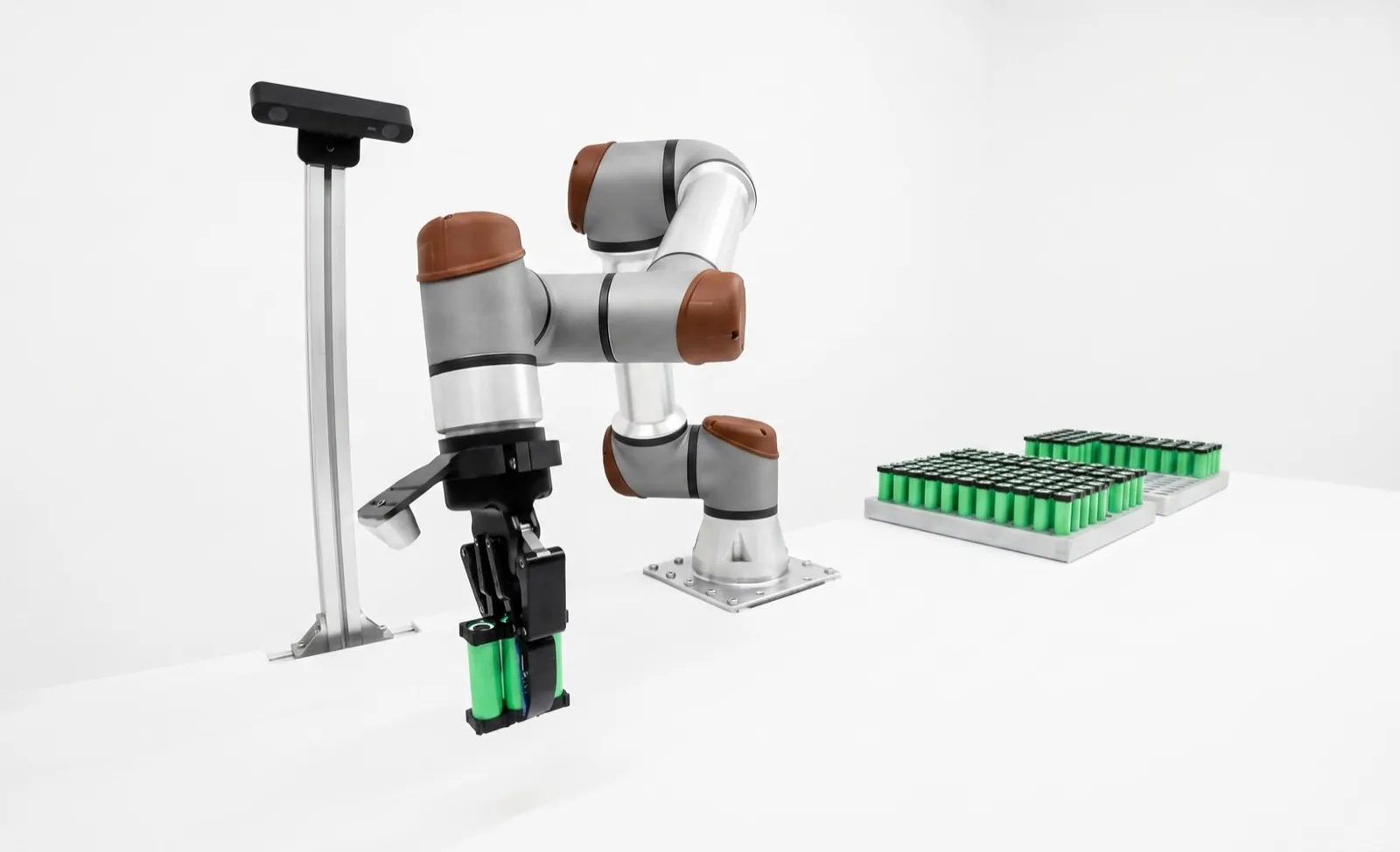
Robot integration cost, line by line.
Robot integration cost is everything it takes to turn a robot arm into a working cell: design, tooling, guarding, controls, programming, testing, installation and training. On most cells it's the bigger part of the bill, often two to three times what the arm costs. Here's what each line buys you and how to read a quote.
You're paying an integrator for hours on top of the arm prices in our industrial robot cost guide, and most of those hours go into things that are unique to your part: the gripper fingers, the fixture, the guarding layout, the program and the testing that proves it all works. The arm is a catalog item. The cell around it is a one-off, which is why integration costs more than the robot on almost every project we quote.
Key takeaways
- Expect total cell cost to land at roughly 2.5 to 4 times the arm price for a typical machine tending or welding cell, and higher for multi-station assembly.
- Engineering labor is the swing line. A loaded integrator rate of $110 to $175 an hour is normal, and a cell can carry 300 to 700 hours.
- The cheapest quote is often the one with the most exclusions. Price every "by others" line before you compare totals.
- Fixed price costs a bit more up front and protects you from scope creep. Time and materials only wins when the scope is truly settled.
How much does robot integration cost?
For a single-robot cell, integration usually runs one and a half to three times the price of the arm, so the finished cell lands at roughly 2.5 to 4 times the arm. Simple packaged cells sit lower. Cells with vision, several stations or tight tolerances sit higher, sometimes much higher.
The most quoted version of this rule comes from Universal Robots' co-founder Esben Østergaard, who told Machine Design in 2018 that with traditional robots the arm accounts for only 25 to 30 percent of total system cost. Flip that around and the cell costs 3.3 to 4 times the robot. He was making a case for cobots, so take the exact number with a grain of salt. But it matches what we see on real quotes, and it matches our own industrial robot cost guide, which puts a working cell at two to four times the arm.
The multiplier moves with how much of the cell is custom. A packaged cobot palletizer reuses the same frame, software and safety layout on every install, so the integrator's hours are low. A vision-guided bin picking cell needs 3D camera work, path tuning and a lot of testing on your parts. Multi-station assembly is the extreme case, because every station is its own little machine.
Treat the multiplier as a sanity check, not a pricing method. A $28,000 cobot with a $60,000 vision system gives a wild ratio and can still be a fair quote. Price the cell from its parts, as the rest of this page does, and use the ratio to spot outliers.
When a buyer tells us a cell "should" cost twice the robot, they've usually priced the robot and the gripper and stopped there. The fixture, the guarding and the controls panel are what's missing. They're boring, and on a machine tending cell they're often more money than the robot.
What do robot integrators charge for?
Integrators charge for hardware they buy and build into the cell, and for engineering hours: mechanical and controls design, robot programming, a factory acceptance test, installation with a site acceptance test, documentation, training and project management. On a typical cell the hours make up about 40 percent of the price.
| Line item | What's in it | Example | What you should get |
|---|---|---|---|
| Robot arm and controller | Arm, controller, teach pendant, software options | $45,000 | Model, options and warranty named on the quote |
| End-of-arm tooling | Gripper body, custom fingers, sensors, tool changer if any | $12,000 | Finger drawings you own |
| Fixtures and guarding | Part nests, infeed and outfeed, fence, doors, base | $18,000 | Layout drawing with clearances |
| Safety devices | Light curtains or scanners, interlocks, safety PLC or relay, risk assessment | $8,000 | Written risk assessment for the cell |
| Controls hardware | Panel, PLC, HMI, wiring, machine interface | $14,000 | Electrical schematics |
| Mechanical and controls design | CAD, reach study, cycle time study, design reviews | 170 h | Signed-off design before metal is cut |
| Robot and PLC programming | Paths, recovery routines, HMI screens, handshakes | 120 h | Commented source and backups |
| Factory acceptance test (FAT) | Run your parts at the integrator against agreed criteria | 32 h | FAT report with cycle time and pass rate |
| Install and site acceptance test (SAT) | Rigging, hookup, re-teach, production run on your floor | 64 h | SAT sign-off that triggers final payment |
| Documentation and training | Manuals, spare parts list, operator and maintenance sessions | 40 h | Binder or portal, training sign-in sheet |
| Project management | Schedule, procurement, weekly reviews, change control | 40 h | One named PM and a schedule |
Table scrolls horizontally on small screens →
FAT and SAT, the two lines people cut
A factory acceptance test means the cell runs your real parts at the integrator's shop before it ships, against criteria you agreed in writing: cycle time, pass rate over a set run, recovery from a dropped part, every safety stop. A site acceptance test repeats the important parts on your floor after install. Together they're maybe 6 to 10 percent of the hours on our example.
They're also where problems get cheap. A gripper that slips on oily parts costs an afternoon to fix at the integrator. The same fix on your floor, with a lathe waiting and an operator standing there, costs days. When a quote skips FAT to look lean, that debugging still happens. It just happens on your production schedule.
Safety is a line, not a footnote
The cell has to be designed to the current robot safety standards, which in the U.S. now means ISO 10218-2:2025 and ANSI/A3 R15.06-2025. That starts with a written risk assessment for your specific cell and ends with guarding, scanners or speed-and-separation settings that match it. If a quote lists guarding but no risk assessment, ask who's doing it. Usually the answer is "you," and most plants aren't set up to.
Our qualification and safety work covers what that assessment includes and what you should keep on file after handover.
What are typical system integrator rates?
Most U.S. robot system integrators bill engineering and programming somewhere around $110 to $175 an hour, with field service and on-site commissioning at the top of that range or above it, plus travel. Those are our observed ranges, not a survey, and they track engineer pay plus overhead.
An hourly rate looks high until you build it from the paycheck up. The Bureau of Labor Statistics puts the median mechanical engineer at $104,110 a year in May 2025, and electrical engineers at $120,630. Add payroll taxes and benefits. Then remember that nobody bills 2,080 hours a year. Proposals, training, travel and the job that slipped all eat into billable time.
After that comes overhead the integrator carries whether or not you sign: the shop floor where your cell gets built, CAD and offline programming licenses, demo robots, insurance and the sales engineer who scoped your project. The math below gets you to about $130 an hour before anyone's made a profit, which is why a $95 rate should make you curious rather than happy.
Rates also hide in plain sight. Some integrators quote a lump sum and never show hours. Others quote a lower rate with a higher hour count. Ask for hours by phase either way. It's the only way to tell whether a $40,000 programming line is 250 hours of careful work or 120 hours at a premium.
Why does integration cost more than the robot?
Integration costs more than the robot because the robot is a mass-produced product and the cell is a one-off. A robot maker spreads its engineering over thousands of identical arms. Your integrator spends design, programming and testing hours on one cell for one part family, and you pay for all of them.
Think about what the arm doesn't know. It doesn't know where your part is, how to hold it, what to do when it drops one, or how to tell the lathe it's safe to close the door. Every one of those is someone's afternoon, and on a high-mix, low-volume floor it's someone's afternoon per part family.
Then there's the stuff around the robot. Fixtures get machined to your part, guarding has to fit your aisle and forklift route, and the controls panel has to talk to a machine that may be twenty years old.
Recovery logic is the part that surprises people. The happy path of a pick-and-place program can be written in a day. Getting the cell to handle the ten ways a cycle goes wrong, without an operator walking over every time, is where half the programming hours go. It's also what separates a cell that runs a second shift alone from one that needs a babysitter.
The cells that blow their budgets usually didn't have a bad integrator. They had a part that wasn't what the drawing said: castings that vary more than the tolerance, a supplier change mid-project, an "occasional" second part number that turned out to be 30 percent of volume. Send real parts, every variant, early. It's the cheapest thing you can do for your own quote.
More on why pilots stall for reasons like these in why most robot pilots never reach production.
How long does a robot integration project take?
A single-robot cell typically takes 14 to 24 weeks from purchase order to production: about five weeks of design, eight to ten weeks of build and programming overlapping with procurement, a FAT, then two to four weeks to install, run the SAT and train your people. Long-lead parts set the floor.
Robots, safety scanners and some cameras can carry lead times of several weeks, so procurement starts as soon as the design freezes. That's also why design changes late in the project cost more than they look. A changed gripper isn't just new fingers. It can mean a new reach study, a re-ordered part and a slipped FAT.
Watch the payment terms as closely as the price. A quote asking for 50 percent up front and the balance on shipment leaves you with no money held against a cell that hasn't run on your floor. We'd rather see the big payment tied to a FAT you witnessed, and a real slice held until SAT.
Fixed price or time and materials: which is cheaper?
Time and materials is cheaper when the scope is truly settled, because you don't pay for the integrator's contingency. Fixed price is cheaper when it isn't, because overruns become the integrator's problem. Most first cells have more unknowns than the buyer thinks, so we usually recommend fixed price with clear acceptance criteria.
Fixed price only protects you if the scope is written down. That means the part list with revisions, the cycle time, the acceptance criteria and what counts as a change. Without those, a fixed-price job turns into a stream of change orders, and change orders are priced at time and materials anyway.
Time and materials makes sense in two places. One is a second or third copy of a cell you already own, where the unknowns are gone. The other is a short, paid feasibility study before the real quote: a few days of testing your parts with a gripper and a camera to settle the scary questions. We like that second use a lot. It turns the biggest unknowns into facts before anyone signs a six-figure number.
What a hybrid looks like
A common middle ground is a fixed price for the defined scope, a published rate card for changes, and a cap on travel and expenses. The rate card matters more than people think. It's what you'll pay for every "can it also do this?" after go-live.
How do you compare two robot integrator quotes?
Line them up item by item, price every exclusion at the integrator's own rate, and compare the totals only after that. The lowest number on page one is often the quote with the most "by others" lines, and those lines come back as change orders once you've signed.
Red flags in a robot integration quote
- Engineering and programming as one lump with no hours.
- No FAT, or a FAT "with sample parts" instead of yours.
- Guarding listed, risk assessment missing.
- Installation, rigging or electrical hookup "by customer."
- Cycle time promised with no assumptions written next to it.
- No acceptance criteria, so nobody can say when you're done.
- Over 50 percent due before the cell has run your parts.
- No rate card for changes, or one that's much higher than the base rate.
- Software, source code or program backups not delivered to you.
- Warranty that starts at shipment instead of at SAT.
None of these makes a quote dishonest. Good integrators write lean quotes because buyers reward the lowest number. But each one moves a cost or a risk onto you.
The acceptance criteria deserve special attention. "Cell will tend the lathe" isn't a criterion. "Cell runs 500 consecutive parts of P/N 1234 rev C at 62 seconds or less, with no more than one operator intervention" is. If you can't write the sentence, the integrator can't price it, and the fight about whether the job is finished starts on install day.
If you're choosing between integrators rather than quotes, our ranking of robot integrators for high-mix manufacturing explains the options, including when a turnkey cell beats a custom one.
How can you reduce robot integration cost?
You cut integration cost by cutting the hours that are unique to your project: standardize the part presentation, send real parts early, freeze the scope before design starts, reuse a proven cell design where you can, and pay for a short feasibility test instead of discovering problems during install.
Fix the part presentation first. Most of the cost difference between an easy cell and a hard one is how parts arrive. Parts in a known orientation on a tray or a fixture need a simple gripper and a short program. Parts dumped in a bin need 3D vision and a lot more testing, which is fine when it pays, but it shouldn't be the default. Often a $2,000 tray change on the upstream process saves $30,000 in the cell.
Next, reuse beats invention. A cell built on a proven base (a standard frame, a standard safety layout, a program template for machine tending) carries far fewer design hours than a blank sheet. That's the logic behind packaged cells and behind our own Relling workcell. And buy the robot the integrator knows best unless you have a plant standard. Asking a FANUC shop to program its first ABB arm, or the reverse, adds hours you'll pay for. The FANUC vs ABB comparison covers what actually differs between the two.
Be careful where you cut. Dropping the FAT, skipping the risk assessment or doing your own install rarely saves money overall. Each one moves work to the most expensive place to do it, your own floor.
One saving people miss is the second cell. The second copy of a cell often costs well under the first, because the design, programming and testing are already paid for. If you know you'll want three, say so in the first RFQ and ask for the price of each.
Finally, check that the cell pays back before you squeeze the price. A cell that's 10 percent cheaper and runs 20 percent fewer good parts is a worse deal. The robot ROI calculator runs that math, and the robot cell cost breakdown goes deeper on the hardware lines.
One number for a cell that's proven before it ships.
Relling builds turnkey robotic workcells, roughly $100,000 to $200,000, for high-mix American manufacturers. We quote the whole cell as a fixed price with the design, programming, FAT on your parts, installation, SAT and training itemized, so there's no "by others" column to price later. We integrate arms from FANUC, ABB, Universal Robots, Yaskawa, KUKA, Standard Bots and others, and no robot vendor pays us, so the arm in the quote is the one that fits your part.
See how Relling scopes and integrates a cell →Frequently asked questions.
What percentage of a robot cell's cost is the robot?
On most single-robot cells the arm and controller are about 25 to 40 percent of the total. Universal Robots' co-founder put it at 25 to 30 percent for traditional robots in 2018, and our worked machine tending example lands at 28 percent. Packaged cobot cells can run higher, near 50 percent, while multi-station or vision-heavy cells run lower.
Do robot integrators mark up the robot?
Many do, and it's normal. An integrator buying a robot through a distributor or the OEM usually adds a handling margin to cover the purchasing, receiving, warranty coordination and the risk of owning it during the build. What matters is that the robot line is visible, with the model and options named, so you can check it against a direct quote if you want to.
Can I buy the robot myself and pay only for integration?
Yes, and some integrators will agree to it, but it shifts risk to you. If the robot you bought has the wrong options, the wrong reach or a long lead time, the schedule and the fix are your problem. Most integrators also warranty the cell as a system, which gets harder when they didn't buy a key part. Ask first and get the warranty terms in writing.
How much does it cost to program an industrial robot?
For a single machine tending or handling cell, robot and PLC programming often runs 80 to 200 hours, or roughly $10,000 to $35,000 at typical integrator rates. Simple palletizing with a packaged pattern tool can take far less. Complex paths, vision guidance and lots of error recovery push it higher. Offline programming software can shorten the time on the floor but doesn't remove the work.
What should a robot integration warranty cover?
A good warranty covers the integrator's own work, meaning design, build, wiring and programming, for a stated period that starts at site acceptance rather than at shipment, plus pass-through of the robot maker's warranty on the arm. It should say how fast someone responds, whether travel is included and what voids it. Twelve months from SAT is a common starting point to negotiate from.
Is a cobot cheaper to integrate than an industrial robot?
Often, but not by as much as the ads suggest. A collaborative application can sometimes use less fixed guarding, and cobot software is quicker to teach, so hours drop. But the gripper, fixture, controls and risk assessment are still there, and many cobot cells end up with scanners or fencing anyway once the risk assessment looks at the tool and the part. Price the cell, not the arm.
What's included in a factory acceptance test for a robot cell?
A factory acceptance test runs the finished cell at the integrator's shop with your production parts before it ships. It should check cycle time, a pass rate over an agreed run length, every safety function, recovery from common faults such as a missed pick, and the operator screens. You or your engineer witness it, sign a report and only then release the shipment payment.
Cost guide by Relling, a robot integrator that works with many arm vendors and is paid by none of them. Line-item amounts, hours, rates, multipliers and timelines on this page are our planning numbers from cells we've quoted and reviewed, and every worked example is labeled illustrative. They aren't survey results or a quote for your cell. The only external figures are the ones cited below. Checked 24 October 2026.
- Jeff Kerns, Robotic Arms Dominate Today's Automation Trends, Machine Design, January 2018. Quotes Esben Østergaard of Universal Robots on robot capital cost as 25 to 30 percent of total system cost.
- U.S. Bureau of Labor Statistics, Mechanical Engineers, Occupational Outlook Handbook. Median pay $104,110 per year, May 2025.
- U.S. Bureau of Labor Statistics, Electrical and Electronics Engineers, Occupational Outlook Handbook. Median for electrical engineers $120,630 per year, May 2025.
- International Organization for Standardization, ISO 10218-2:2025, Robotics, Safety requirements, Part 2: Industrial robot applications and robot cells, 2025.
- Association for Advancing Automation, ANSI and A3 publish revised R15.06 industrial robot safety standard, 2025.
Bring Relling to your shop floor.
We started Relling to help American manufacturers make more of what this country needs. Tell us about the part and we'll scope a cell to it.