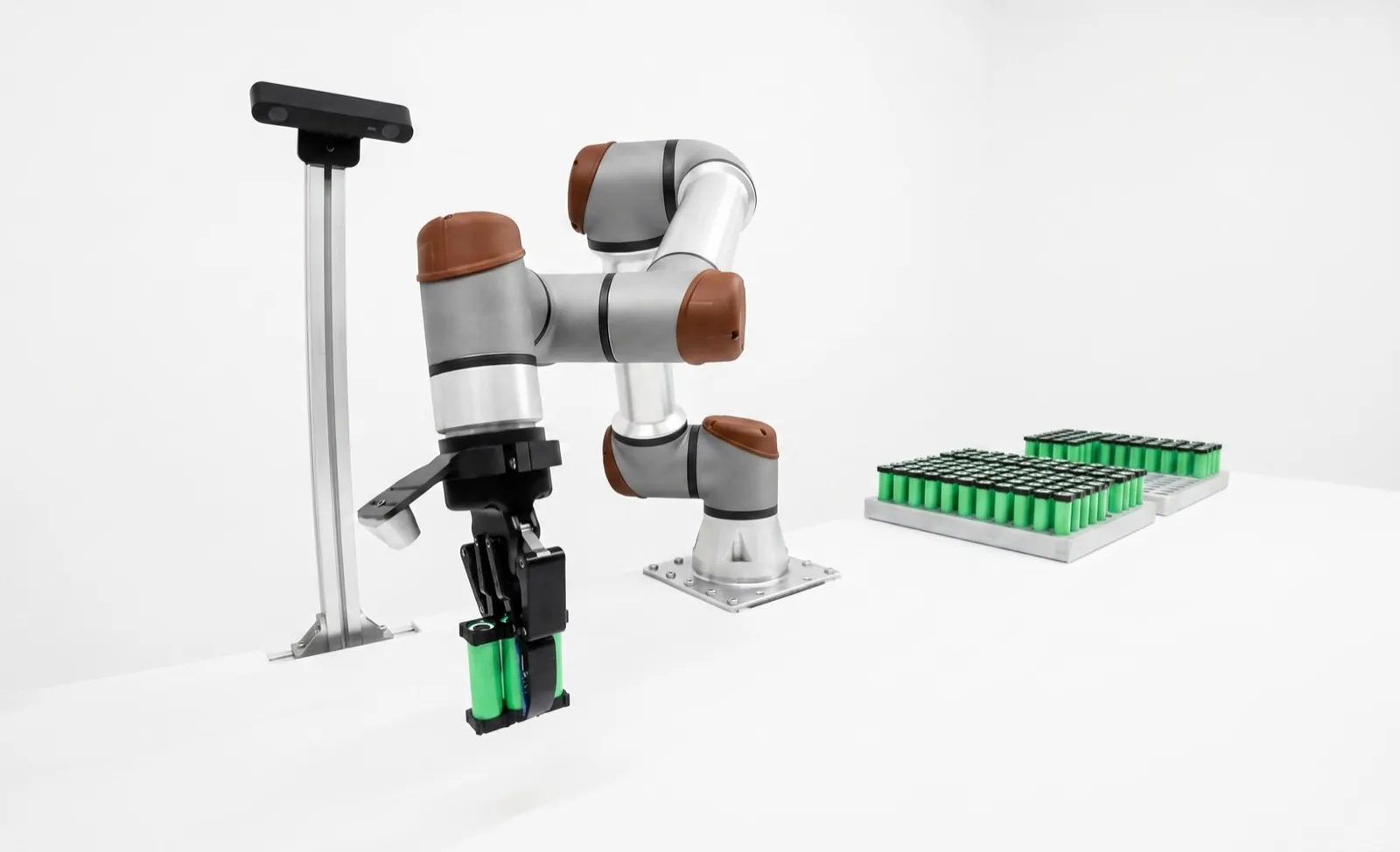
Machine vision system cost in 2026, and why the camera is the cheap part.
A basic vision sensor lists for under $1,000. A validated multi-camera or 3D inspection station can pass $150,000. Most of that gap isn't hardware. It's the engineering hours that get a camera to make the right call on your parts, every shift.
On this page
A machine vision system costs anywhere from about $761 for a basic vision sensor to $150,000 or more for a validated multi-camera or 3D station. Most single-camera inspection stations we scope land between $15,000 and $60,000 installed. The camera's usually less than half of that. The rest is lighting, mounting and engineering time.
We'll walk through each tier with the public prices we could find, then the full cost of a station, what pushes it up, and what it costs to keep running. Cognex and Keyence don't publish price lists, so for their gear we give reasoned ranges and say so (our Cognex vs Keyence comparison covers how the two quote). None of these numbers is a quote, ours included.
Key takeaways
- Vision sensors list from $761. Rule-based smart cameras run about $3,000 to $10,000 of hardware, and a working station costs two to four times that.
- On anything past a simple sensor, integration and validation hours usually beat the hardware bill.
- Cosmetic defects, extra views and 3D are the requirements that push cost up fastest.
- Budget roughly 5 to 15 percent of the installed cost per year to keep a station running.
- Ask every vendor for a line-item quote on the same parts, or you can't compare them.
How much does a machine vision system cost?
Plan on $2,000 to $10,000 installed for a vision sensor, $10,000 to $40,000 for a rule-based smart camera station, $20,000 to $60,000 for an AI smart camera, and $40,000 to $200,000 for PC-based multi-camera or 3D stations. Which tier you need depends on the decision the camera has to make.
A presence check on a high-contrast part needs very little. A scratch check on a cast, textured housing needs better optics and many more hours of tuning, even on the same camera. So when someone asks us what vision costs, our first question back is what you're trying to catch.
| Tier | Typical products | Public price point | Installed station, typical | Good for |
|---|---|---|---|---|
| Vision sensor | Datalogic Smart-VS, Cognex In-Sight 2800 class, Keyence IV series | $761 to $1,160 list (Smart-VS)1 | $2k to $10k | Presence, orientation, one simple pass or fail |
| Smart camera, rule-based | Banner VE, Cognex In-Sight 3800 class, Keyence CV-X | $4,571 body, lens extra (Banner VE202G1A)2 | $10k to $40k | Gauging, code reading, assembly checks on one view |
| AI smart camera | Cognex In-Sight 3900, Keyence VS series | Quote on request | $20k to $60k | Variable or cosmetic defects on one view |
| PC-based, multi-camera | Basler, Teledyne or IDS cameras on an industrial PC with VisionPro, HALCON or custom code | $359 per GigE camera body3; $3,499 edge GPU kit6 | $40k to $150k | Several views, custom logic, deep learning at line rate |
| 3D | Zivid, Photoneo, Keyence LJ-X, Cognex 3D sensors | Quote on request7 | $50k to $200k | Height, volume, flatness, bin picking, robot guidance |
The installed ranges are our planning numbers, not survey data. They assume a new station on an existing line, programmed by an integrator or your own team and signed off by quality. The low end is a well-presented part with one obvious defect. The high end is variable parts, several defect classes and a formal validation.
What does each tier of vision system cost?
Hardware runs from under $1,000 for a vision sensor to tens of thousands for a high-resolution 3D camera. Each step up buys flexibility and costs setup time. The trick is buying the lowest tier that reliably makes your decision, because every tier above it adds engineering you'll pay for twice, once at install and again at every change.
How much does a vision sensor cost?
Under $1,000 to about $3,000. AutomationDirect lists the Datalogic Smart-VS at $761, the Smart-VS Plus at $1,047 and the Smart-VS EVO, which adds anomaly detection, at $1,160.1 Cognex and Keyence sensors in this class are quoted, and in our experience they land in the low thousands. Installed cost stays low because there's almost nothing to program. You bolt it up, run a cable to the PLC and teach it good and bad parts. But a sensor does one job. The day you need to measure something, or tell a scratch from a reflection, you've outgrown it.
How much does a smart camera cost?
About $3,000 to $10,000 of hardware for one view. A smart camera adds a full toolset (edges, blobs, pattern matching, measurement, code reading) and logic you build yourself. Banner's VE202G1A, a 2 MP smart camera, lists at $4,571 from a distributor, and that's without the C-mount lens and cables it needs.2 Add a lens, a light and a power supply and you're between roughly $6,000 and $10,000 before anyone writes a job. A clean gauging job might take a few days to program. A job with forty part variants can take weeks, and that's where the money goes.
How much does an AI smart camera cost?
Roughly $6,000 to $20,000 of hardware, which is our reasoned range since Cognex and Keyence don't publish prices for the In-Sight 3900 or the VS series and deep learning features are often licensed separately. The camera price isn't what makes AI stations land higher installed, though. Image collection and labeling do. You need good parts and every defect class, and somebody has to label them. Our deep learning vs rule-based vision guide covers when that's worth it, and the AI visual inspection post covers what works on a real line.
How much does a PC-based vision system cost?
Usually $40,000 to $150,000 installed. Here you buy the parts separately and the bill gets granular. A Basler ace 2 GigE camera body lists at $359.3 An 8.5 mm C-mount lens from Edmund Optics is $397,4 and a 100 mm ring light is $1,245 plus a $95 supply.5 An NVIDIA Jetson AGX Orin 64GB developer kit, a common reference point for edge deep learning, lists at $3,499 at SparkFun.6 A cabinet-rated industrial PC with a discrete GPU typically costs several times that. Per view, the hardware's often cheaper than a smart camera. The engineering isn't, because someone has to write the application, the PLC handshake and the operator screens. We compare the two routes in smart camera vs PC-based vision, and the software side in our machine vision software comparison.
How much does a 3D vision system cost?
Expect $50,000 to $200,000 installed. Most 3D vendors price on request. Photoneo, for example, says its quote is customized to the model, software modules and accessories you need.7 From the quotes we see, 3D sensors run from several thousand dollars for a compact laser profiler to tens of thousands for a high-resolution structured-light camera, before software. Calibration and point-cloud work add hours, and robot guidance adds hand-eye calibration on top. Before you pay for depth, read 2D vs 3D machine vision. We've seen plenty of jobs where a better light solved what someone was about to buy a 3D camera for. For the hardware itself, see 3D vision cameras and Zivid vs Photoneo.
What are the components of a machine vision system, and what do they cost?
A working station is a camera, lens, light, mount, enclosure, compute, software, PLC I/O and cabling, plus the engineering, validation, training and spares that make it run. In the exploded view below, the hardware with public prices adds up to a few thousand dollars. That's the part buyers budget for.
The camera and lens get sized together from the smallest defect you need to see and the field of view. Our machine vision resolution calculator does that arithmetic, and the posts on choosing camera resolution and how to choose a machine vision lens go deeper. Lenses run hundreds of dollars for standard C-mount and more for telecentric optics on gauging jobs.
Lighting is the line we see underestimated most, especially on cosmetic work. A ring light's a fine start, but shiny or textured parts often need a dome, a low-angle bar or a backlight, and sometimes two of them. The machine vision lighting guide explains why lighting decides more inspections than cameras do. Then there's the boring stuff that still costs real money, like a rigid mount that survives a forklift nudge, a shroud that blocks the skylight, guarding, cables and the reject mechanism.
Seen this way, camera price is a weak predictor of station cost. A $359 camera on a PC can sit inside a more expensive station than a $4,571 smart camera, because the PC route moves money from the hardware line to the engineering line.
How much does machine vision integration cost?
On most stations past a simple sensor, integration and programming cost as much as the hardware or more. Expect anywhere from a few thousand dollars for a smart camera wired to a PLC to well over half the project on multi-camera, deep learning or regulated stations.
This isn't new. A 1998 Vision Systems Design article on an automotive fuel-injection inspection reported that about half of an $80,000 system's cost went to systems engineering.10 Cameras have gotten much cheaper since then. The engineering hasn't, because the hard part was never taking the picture. It's getting a reliable decision from that picture on every part variant at line speed, and then wiring that decision into the PLC or robot, the reject gate and the data log.
Validation is the piece people forget to price. Someone has to build a test set of good and bad parts, run it blind, tune thresholds and write up the result for quality. In regulated plants it's heavier, which we'll get to next. Our post on vision system validation lays out the protocol, and if you'd rather have someone else carry it, that's the core of what a machine vision integrator sells.
What makes a vision inspection system more expensive?
Five requirements explain most of the spread inside each tier. They're cycle time, part variation, cosmetic defects, multiple views and regulated validation. Any one of them can add a quarter to the cost, and cosmetic inspection or 3D can more than double it.
Fast lines need short exposures, which need more light, often strobed, plus encoder-triggered capture and part tracking on a moving conveyor. Part variation means every part number, color and supplier is a variant the job has to handle, and the classic failure is the supplier who switches resin color without telling anyone. Cosmetic defects on textured or reflective parts are the hardest category in vision. They usually need special lighting and often deep learning with a big labeled image set (see surface defect inspection). Multiple views add a camera, lens and light per view, or a robot to show the part to one camera.
Regulated validation is its own animal. In medical, pharma and aerospace work the station is validated like any other production equipment, with protocols, traceable records and change control. Where records fall under FDA's 21 CFR Part 11, audit trails and access controls become hard requirements on the software.8 Writing and executing that paperwork is real engineering time.
How we built these ranges
Public prices come from distributor and vendor listings we checked in October 2026. They'll move, and volume pricing is lower. Installed ranges and the driver percentages are our planning numbers from scoping inspection stations and vision-equipped robot cells. They're reasoned ranges, not a survey, and your quote can land outside them in either direction.
How much does a vision system cost to maintain?
Budget roughly 5 to 15 percent of the installed cost per year. That's our planning figure, not an industry statistic. A stable part on a sealed station sits at the low end. A line that launches new part numbers every quarter, or runs a deep learning model on a drifting process, sits at the top.
Most of that money goes to small things that move the image. LED lights dim over thousands of hours. Lenses get bumped during changeovers, or wiped with a shop rag on second shift. Cables on moving equipment wear out. Any of those can shift brightness enough to move a threshold, and then someone loosens the threshold at 2 a.m. to keep the line running. Then there are job edits for new part numbers, model retraining when the process drifts, and software maintenance fees on some PC libraries. Our machine vision maintenance checklist covers the routine, and vision system false rejects covers the cost that shows up when it slips.
How much does a Cognex or Keyence camera cost?
Neither company publishes prices, so you'll only get a number from a quote. As a reasoned range, their vision sensors sit in the low thousands, rule-based and AI smart cameras in the mid thousands to low tens of thousands, and a complete station costs several times the camera.
Price depends on model, resolution, software options, volume and how much application help is bundled in. Keyence's direct sales engineers typically include hands-on setup, which is part of why its per-unit quotes often look higher. Cognex sells directly and through distributors and integrators, so the same camera can arrive with or without programming attached. So a Cognex price next to a Keyence price tells you very little unless the scope behind each is identical. Our In-Sight vs Keyence VS comparison goes model by model, DataMan vs Keyence SR does the same for code readers, and Cognex and Keyence alternatives covers vendors that do publish prices.
How do you compare machine vision quotes?
Send every vendor the same labeled parts and the same written requirements, and ask for a line-item quote. Most bad vision purchases start with quotes that were never comparable. One vendor priced a camera, another priced a working station, and the cheaper number won.
Here's what we'd put in the request.
- Good parts, every defect class and parts right at the tolerance limit, labeled by your quality team.
- The defects to catch, the smallest defect size, and acceptable escape and false-reject rates as numbers.
- Cycle time, part presentation, working distance, mounting space, ambient light and the PLC or robot it talks to.
- Separate lines for hardware, software licenses, engineering hours with the rate, validation, training and spares.
- The hourly rate and turnaround for adding a new part number in year two.
- Acceptance as a blind run of your labeled set, scored separately on escapes and false rejects.
If you're buying vision as part of a robot cell, ask the cell integrator the same questions. Vision inside a cell shares mounting, guarding, controls and validation with the robot, so it can cost less than a standalone station. Our machine vision capability page shows how we build it into cells, and starting your first machine vision project covers the steps before you ever ask for a price.
Is machine vision worth the cost?
It's worth it when the station frees real inspection hours or stops expensive escapes, and it usually isn't when volume's low, the check takes seconds and escapes are cheap. We'd rather tell you that before a quote than after one.
Start with the labor number your station has to beat. The BLS puts the median wage for quality control inspectors at $23.35 an hour (May 2025).9 Load that with benefits and multiply by the hours the station actually frees, not the inspector's whole shift. If a person spends a few seconds a part on a few hundred parts a shift, that won't cover a $30,000 station any time soon.
We'd also skip vision when a photoelectric sensor or a poka-yoke fixture does the job, when the defect isn't visible (voids and bond strength need X-ray, ultrasonic or functional test), and when two inspectors can't agree on what a reject looks like. A camera won't settle that argument. And if the upstream process is out of control, spend the money there first. Inspection sorts bad parts. It doesn't stop you making them.
For the other half of the math, our machine vision ROI guide works a full payback example, and manual vs automated visual inspection compares the two head to head. For every application and what it takes to do well, start at the machine vision library.
Frequently asked questions
What is the cheapest machine vision camera?
For a bare industrial camera, a Basler ace 2 GigE body lists at $359 from Machine Vision Store. That's only the sensor, though. You still need a lens, a light, a PC and software before it inspects anything. The cheapest thing that inspects out of the box is a vision sensor like the Datalogic Smart-VS at $761.
Is Keyence more expensive than Cognex?
Often on the quote, yes, because Keyence bundles hands-on application support from its sales engineers into the price. Cognex hardware can look cheaper, but if the programming is bought separately from a distributor or integrator, the gap can close or flip. Compare the cost of a working, validated station with the same scope, not the camera line.
How long does it take to install a machine vision system?
A vision sensor on a simple presence check can be running in an afternoon. A single-camera inspection station usually takes a few weeks from having representative parts in hand to a validated job, and multi-camera or regulated stations take longer. The schedule is set by part samples, lighting trials and validation runs more than by hardware lead time.
Can I install a vision system myself?
For a vision sensor or a simple smart camera job, yes, if a controls engineer can wire it to the PLC and has time to learn the software. For cosmetic inspection, many part variants or several cameras, most plants bring in an integrator or the vendor, because lighting design and validation are where in-house projects stall.
Does a machine vision system need a PC?
Not always. Vision sensors and smart cameras have the processor built in and talk straight to the PLC. You need a PC, or an edge GPU box, when you run several cameras together, heavy deep learning models at line rate, 3D point clouds or custom code. That PC is a real line item, from a $3,499 developer kit to an industrial PC costing several times that.
How much does deep learning software for machine vision cost?
It depends on the route. On AI smart cameras the deep learning tools are often a licensed option on the camera. PC libraries are usually licensed per runtime machine, sometimes with annual maintenance. Open-source frameworks cost nothing to license but need someone to build, validate and maintain the application, so the money moves to engineering hours.
Sources
- AutomationDirect, Datalogic Smart-VS vision sensors, selection guide, 2026. Lists Smart-VS Standard at $761.00, Smart-VS Plus at $1,047.00 and Smart-VS EVO at $1,160.00. View the guide (PDF).
- Powermatic Associates, Banner VE202G1A VE Series smart camera, distributor listing, accessed October 2026. $4,571.00 each; lens and cables required separately. View the listing.
- Machine Vision Store, Basler ace 2 a2A1920-51gmBAS 1920 x 1200 monochrome GigE camera, accessed October 2026. $359.00 each, North America. View the listing.
- Edmund Optics, 8.5mm C Series Fixed Focal Length Lens, accessed October 2026. $397.00 each. View the product.
- Edmund Optics, 100mm, Red 625nm, MicroBrite Brightfield Ring Light (Advanced Illumination), accessed October 2026. $1,245.00 each; 24V power supply $95.00. View the product.
- SparkFun Electronics, NVIDIA Jetson AGX Orin 64GB Developer Kit, accessed October 2026. Listed at $3,499. View the listing.
- Photoneo, PhoXi 3D Scanner pricing request, accessed October 2026. States that quotes are customized to model, software modules and accessories. View the page.
- U.S. Government Publishing Office, 21 CFR Part 11, Electronic Records; Electronic Signatures, Electronic Code of Federal Regulations, current. Read the regulation.
- U.S. Bureau of Labor Statistics, Quality Control Inspectors, Occupational Outlook Handbook. Median pay $23.35 per hour, $48,570 per year, May 2025. Read the profile.
- Andy Wilson, Machine vision promotes profits, Vision Systems Design, 1 September 1998. Reports that about half of an $80,000 inspection system's cost was systems engineering. Read the article.
List prices (Sources 1 to 6) are public web prices checked in October 2026. They change, exclude tax and shipping, and are usually lower at volume. Cognex, Keyence and most 3D vendors don't publish prices, so figures for their products are reasoned ranges from our quoting experience, not vendor pricing. Installed ranges, cost-stack proportions, driver percentages and the maintenance budget are our planning numbers, labeled illustrative in each figure. They're not survey results or quotes.
Read next
 Machine vision
 ROI, with a worked example
What to count, every number in a payback example, and how false rejects eat the savings.
23 October 2026↗ Machine vision
Cognex In-Sight vs Keyence VS
The two AI smart camera lines model by model, and what each costs to live with.
Series↗ Comparison
Smart camera vs PC-based vision
Why one architecture is cheap per view and the other is cheap per added view.
Vision library↗Get a vision station quote with every line shown.Bring Relling to your shop floor.
We started Relling to help American manufacturers make more of what this country needs. Tell us about the part and we'll scope a cell to it.