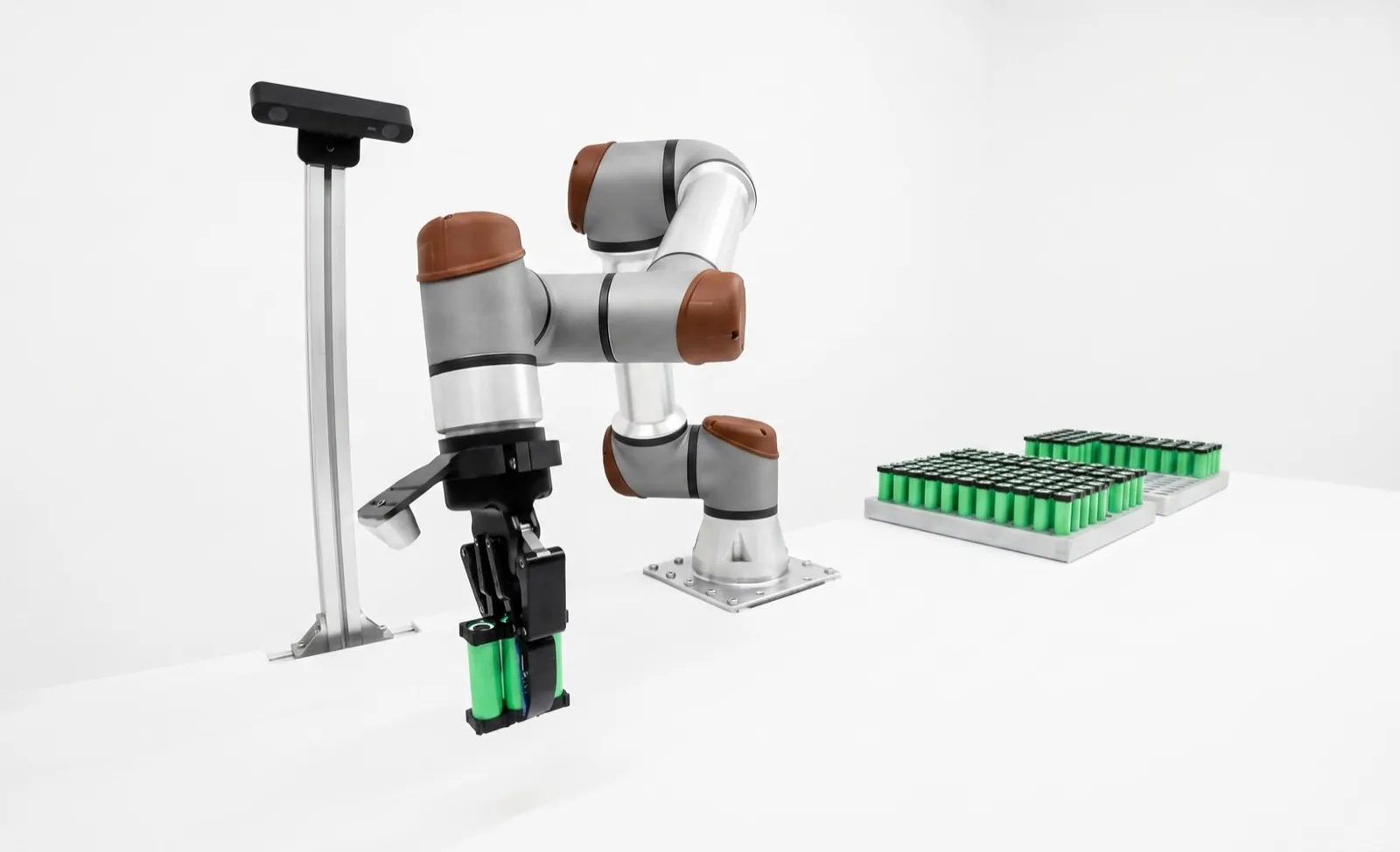
Robot maintenance cost and schedule.
Planned robot maintenance is cheap: batteries once a year, reducer grease every few years, cables and inspections on a schedule. Robot maintenance cost gets expensive when something fails unplanned and the cell stops a machine or a line. One stop can cost more than years of preventive work. Here's the schedule, the downtime math and a spares plan.
Follow the maker's interval table for your exact model, adjusted for how many hours the robot really runs, and you'll rarely be surprised by the arm, new or a used industrial robot. Spend your thinking on downtime instead. Work out what an hour of a stopped cell costs, then decide which spares to keep on the shelf and whether a service contract or condition monitoring pays for itself against that number.
Key takeaways
- FANUC's M-20iD manual sets batteries at 1 year, reducer grease and oil at 3 years or 11,520 hours, and the arm cable at 4 years, assuming 3,840 hours a year.
- Run two shifts and those hour-based intervals come twice as fast. The manual's own example halves the 3-year grease interval to 1.5 years.
- In our worked example one reducer failure with no spare on site costs about $40,660, mostly in lost margin.
- Stock spares by lead time and impact. Long-lead parts that stop the cell are worth pooling across a fleet even when one cell can't justify them.
How much does robot maintenance cost per year?
For a single robot cell, planned maintenance usually runs a few thousand dollars a year in labor and parts, plus whatever you spend on spares and a service contract. Our illustrative budget for one machine tending cell comes to about $8,600 a year with every option in it. Unplanned downtime is the cost that can dwarf that.
The arm itself asks for surprisingly little. Daily checks take minutes. A couple of times a year someone cleans the controller vents, checks cables and bolts and looks for oil at the seals. Once a year the encoder batteries get changed. Every few years the reducers get fresh grease. On a collaborative arm the list is shorter still. Universal Robots' service handbook lists monthly safety-function tests and periodic visual and bolt checks, with no grease or oil change in its inspection plan.
The cell around the arm needs more attention than the arm. Gripper fingers and vacuum cups wear. Sensors get knocked out of alignment. Fixtures collect chips. The vision lens gets dirty. Most of the maintenance tickets we see on a running cell are about the tooling, not the robot.
So budget in two buckets. One is the predictable stuff in the table below. The other is a downtime number that tells you how much it's worth spending to avoid a stop, which is where the rest of this page goes.
| Item | Per year |
|---|---|
| Planned PM labor, 24 h at $95 | $2,280 |
| Batteries and grease, amortized | $600 |
| Cable and conduit reserve | $1,200 |
| Annual OEM or integrator inspection | $2,500 |
| Spares carrying cost, 20% of $10,000 | $2,000 |
| Total | $8,580 |
Illustrative planning numbers, not quotes. Gripper and tooling wear parts are extra and depend on the application.
What is the industrial robot maintenance schedule?
Each robot maker publishes a periodic maintenance table for each model, keyed to calendar time or operating hours, whichever comes first. FANUC's table for the M-20iD family is typical: checks every 3 months, batteries yearly, cables at 2 to 4 years, and reducer grease and gearbox oil every 3 years or 11,520 hours.
| Task | FANUC M-20iD family | ABB IRB 6700 | UR e-Series |
|---|---|---|---|
| Daily or pre-use checks | Oil seepage, noise, positioning, brake drop 5 mm or less, alarms | Per product manual | Pre-use assessment |
| Safety functions | Per controller manual | Per product manual | Monthly test recommended |
| Cables, bolts, external | 3 months first, then yearly | Annual inspection, about 20 min | Monthly to annual, by item |
| Arm batteries | 1 year, regardless of hours | 4 years at 3 shifts | Not in inspection plan |
| Reducer grease, gearbox oil | 3 years or 11,520 h | 20,000 h | Not in inspection plan |
| Arm cable, controller batteries | 4 years or 15,360 h | Per product manual | Replace if damaged |
Table scrolls horizontally on small screens →
The single most common scheduling mistake we see is treating the calendar interval as the only one. The FANUC table says "3 years or 11,520 hours, whichever comes first," and the manual spells out that if you run more than 3,840 hours a year you shorten the intervals in proportion. A cell running around the clock hits 11,520 hours in well under two years.
The ABB and UR numbers come from different kinds of documents, so read them as a sense of the spread rather than a ranking. ABB's figures come from its 2014 launch material for the IRB 6700, which also claimed double the service intervals of the IRB 6640 it replaced. Always work from the product manual for your exact model and revision.
Lost encoder batteries cause more panicked calls than worn reducers. If the batteries die with the controller off, the arm loses its position data and has to be re-mastered before it'll run. It's a cheap part with an expensive failure mode. Change them on the calendar, with the controller powered on, the way the manual describes.
How do you change reducer grease on a robot?
Put the arm in the greasing posture the manual specifies, turn off power, open the grease outlet first, then pump new grease into the inlet slowly by hand until fresh grease comes out of the outlet. Release the pressure in the grease bath before you close it. Use only the specified grease and quantities.
The procedure, from the FANUC M-20iD manual
- Move the robot to the greasing posture for the axis you're doing, from the table in the manual.
- Turn off controller power.
- Remove the bolt and seal washer from the grease outlet.
- Remove the bolt and seal washer from the grease inlet and fit a grease nipple.
- Grease slowly with a manual pump, about one stroke every two seconds, until new grease pushes the old out of each outlet.
- Release the remaining pressure from the grease bath using the manual's procedure, then close the outlet.
- Clean up every bit of excess grease from the robot and the floor.
The manual's cautions are worth taking literally. It says to avoid air-powered grease pumps where possible and, if you must use one, to stay at or under the specified gun-tip pressure, 0.1 MPa or less for these reducers. It specifies one grease, and warns that another type may damage the reducer. And it warns that hot grease can eject suddenly when the outlet is opened, so bag the outlet and wear gloves and eye protection.
On that model the job takes 1,250 g of grease for J1, 830 g for J2 and 300 g for J3, with the wrist gearboxes on oil instead. Other models differ, so don't reuse these numbers on a different arm. What does carry over is the habit of looking at what comes out. Old grease that's dark and full of fine metallic particles is telling you about wear inside the reducer. Note it, and compare it with the next change.
What does robot downtime cost?
Robot downtime costs the margin on everything the cell would have made while it's stopped, plus overtime to recover, service, expedited parts and restart scrap. For a cell that idles a CNC machine, that's often hundreds of dollars an hour. In our worked example one reducer failure without a spare costs about $40,660.
The number that drives everything is margin per hour of the stopped cell. Use contribution margin, the price of a part minus its variable costs, not revenue. And be honest about recovery. If your plant runs five days with slack on Saturdays, a lot of lost hours come back at overtime rates. If it runs 24/7, nothing comes back, and every hour is pure loss.
For scale, Siemens' 2024 True Cost of Downtime report estimated that an hour of downtime at a large automotive plant costs $2.3 million, and that the world's 500 largest companies lose about $1.4 trillion a year, 11 percent of revenue, to unplanned downtime. It also put the top end for smaller manufacturers at $150,000 an hour. Siemens sells maintenance software, so read those as large-plant ceilings, not your number.
Your number is probably closer to ours. A single machine tending cell feeding one machine at a job shop might be worth a few hundred to a couple of thousand dollars an hour stopped. A cell that paces an assembly line can be worth far more, because the whole line stops with it.
Once you have the rate, it prices everything else on this page. It tells you whether a spare reducer is worth stocking, whether a 4-hour service response is worth paying for over next-day, and how much downtime a used arm can afford. Our used vs new robots guide runs that last question with the same numbers.
Which robot spare parts should you stock?
Stock the cheap parts that stop the cell, such as gripper fingers, vacuum cups, sensors and fuses, on site. For expensive long-lead parts like reducers, servo motors and amplifiers, run the expected-value math: one cell rarely justifies them, but a fleet of identical cells often does. Everything else, buy on failure or use an exchange program.
The failure probability is the soft number, and you won't find a good one on a datasheet. Use your own history if you have it, the robot maker's guidance if they'll give it, and a sensitivity check if you don't. If the decision flips between 2 and 5 percent, ask the maker or a parts house about an exchange program or a guaranteed lead time instead.
Standardizing on one robot family is what makes pooling work. Six cells with six different arms need six spare reducers. Six cells on the same model need one. That's an underrated argument for a plant standard, and it's one of the things we weigh when we recommend an arm. Our industrial robot arms guide covers the main families.
A starter spares kit for one cell
- A full set of gripper fingers or vacuum cups, and the fasteners for them.
- Each type of proximity sensor, photo-eye and part-present switch in the cell.
- Fuses, a spare I/O module and the relays used in the panel.
- Encoder batteries for the arm and controller, in date.
- A current program backup, stored off the controller, and the mastering data.
- The grease specified for your reducers, and a manual grease gun.
Are robot service contracts worth it?
A robot service contract is worth it when your downtime rate is high and your team can't do the planned work or the first diagnosis in-house. It buys scheduled PM visits, a guaranteed response time and often parts discounts or remote support. If you have a capable maintenance tech and a low downtime rate, pay as you go.
Service plans from robot makers and integrators vary a lot, so compare them on three things. First, response time, written as hours to a technician on site or on a call, not "priority." Second, what's included: PM visits, parts, travel, software updates, remote diagnostics. Third, who covers the cell, because a robot maker's plan covers the robot, and your gripper, vision and PLC may belong to someone else.
That third point trips people up. When a cell stops, the first hour is usually spent working out whether it's the robot, the tooling, the safety circuit or the machine it's tending. A contract that only covers the arm can leave you with three companies each saying it's not theirs. One owner for the whole cell is worth paying for if you can get it.
The break-even is the same downtime math as the spares. If a faster response saves 12 hours a year at $836 an hour, that's about $10,000 of value, and a contract that costs less than that is a good buy. If your cell can sit for a day without hurting anyone, a contract is mostly insurance for peace of mind, which is fine, but price it that way.
Training is the cheapest alternative. A maintenance tech who can read the alarm log, swap a sensor, restore a backup and re-teach a point fixes most stops before a service call would even arrive. Our training covers exactly that for the cells we build.
What does predictive maintenance add for robots?
Predictive maintenance watches the robot's own data, such as motor current, torque, temperature and cycle counts, to spot a reducer or motor going bad before it fails, so you can replace it on a planned stop. Robot makers offer it as connected services; FANUC's Zero Down Time is one example.
FANUC describes Zero Down Time as an application that collects robot data, looks for abnormalities in mechanical health such as reducers and servo motors, and sends alerts before failure so maintenance can be scheduled. Other makers and third parties offer similar monitoring. The idea is simple. A worn reducer usually draws more current and runs hotter for weeks before it breaks, and a trend line catches that where a person walking past doesn't.
The value lands right in the downtime math. In our example, turning an unplanned 40-hour stop into a planned 8-hour swap cuts the downtime cost from $31,660 to $4,910, about $27,000 per event. On a single cell with a low failure rate, that may not justify a subscription. On a fleet, or on a cell that paces a line, it often does.
There's a cheaper first step, too. Most controllers already log alarms, and many can log motor current or torque for a test program. Run the same short motion once a month and keep the numbers. It's not a product, and it won't catch everything, but a rising trend on one axis is the kind of early warning that turns a breakdown into a work order.
For the vision side of a cell, where lenses get dirty and lights age, our machine vision maintenance checklist covers the same idea for cameras.
Cells built to be maintained by your team.
Relling builds turnkey robotic workcells for high-mix manufacturers and hands them over with the maintenance schedule for every component in the cell, a spares list ranked by criticality, program backups and training for your maintenance staff. We pick arms from FANUC, ABB, Universal Robots, Yaskawa, KUKA, Standard Bots and others with your plant standard and spares pool in mind, and no robot vendor pays us to prefer one.
See how Relling builds and hands over a cell →Frequently asked questions.
How often should an industrial robot be serviced?
Follow the periodic maintenance table in the manual for your exact model. As an example, FANUC's M-20iD family calls for daily checks, external and controller checks every three months, battery replacement every year, cable and conduit work at two to four years, and reducer grease and oil every three years or 11,520 hours, with intervals shortened in proportion if the robot runs more than 3,840 hours a year.
What happens if you don't grease a robot?
Reducer grease breaks down and picks up wear particles over time. Run too long past the interval and the gears and bearings wear faster, backlash grows, the axis gets noisy and positioning can drift, until the reducer eventually fails. A reducer replacement means parts, labor and often days of downtime, which is why the grease change is the most important planned task on most arms.
Do cobots need less maintenance than industrial robots?
Often, yes, at least for the arm. Universal Robots' e-Series inspection plan consists of monthly to annual visual and functional checks, including monthly safety-function tests, with no grease or oil change listed. Larger industrial arms usually have scheduled grease or oil changes. The cell around a cobot still needs the same attention to grippers, sensors and safety devices.
How long do robot encoder batteries last?
Check your manual, because it varies. FANUC's M-20iD manual says to replace the mechanical unit batteries every year regardless of operating time, and the controller batteries every four years. ABB quoted four years at three shifts for the IRB 6700's battery at launch. Replace them on schedule with power on, because a dead battery can mean re-mastering the arm.
Can my own maintenance team service the robot?
For most planned work, yes, if they're trained and follow the manual: daily checks, cleaning, battery changes, cable inspection and often grease changes. Bigger jobs, such as replacing a reducer, motor or arm cable, need specific procedures and re-mastering, and many plants use the robot maker or integrator for those. Check that your own work doesn't affect the warranty.
How long does an industrial robot reducer last?
There's no single answer, because reducer life depends on load, speed, duty cycle and lubrication. Robot makers size reducers for long service under rated conditions, and ABB, for example, quoted 400,000 hours MTBF for the IRB 6700 arm at launch. In practice, overloads, collisions and missed grease changes shorten reducer life far more than calendar age does.
Maintenance guide by Relling, a robot integrator that works with many arm vendors and is paid by none of them. Maintenance intervals, quantities and procedures are quoted from the manufacturer documents below for the named models only; use the manual for your model and revision. Budget items, costs, rates, failure probabilities and the downtime example are illustrative planning numbers, not quotes or survey data. Checked 24 October 2026.
- FANUC Corporation, ARC Mate 120iD / M-20iD Mechanical Unit Operator's Manual, B-84074EN/03, 2019, hosted by Haas Automation. Chapter 7 checks and maintenance, Table 7.3.2.1 (a), Appendix A.
- ABB, IRB 6700 launch presentation, 2014. Gearbox oil after 20,000 hours, battery after 4 years at 3 shifts, 20-minute annual inspection, 400,000 hours MTBF.
- Universal Robots, e-Series Service Handbook, 2025. Chapter 4, recommended inspection activities.
- Siemens, The True Cost of Downtime 2024, 2024. $2.3 million per hour in automotive, $1.4 trillion and 11 percent of revenue for the Global 500, up to $150,000 an hour for SMEs.
- FANUC America, Zero Down Time (ZDT), accessed October 2026.
Bring Relling to your shop floor.
We started Relling to help American manufacturers make more of what this country needs. Tell us about the part and we'll scope a cell to it.