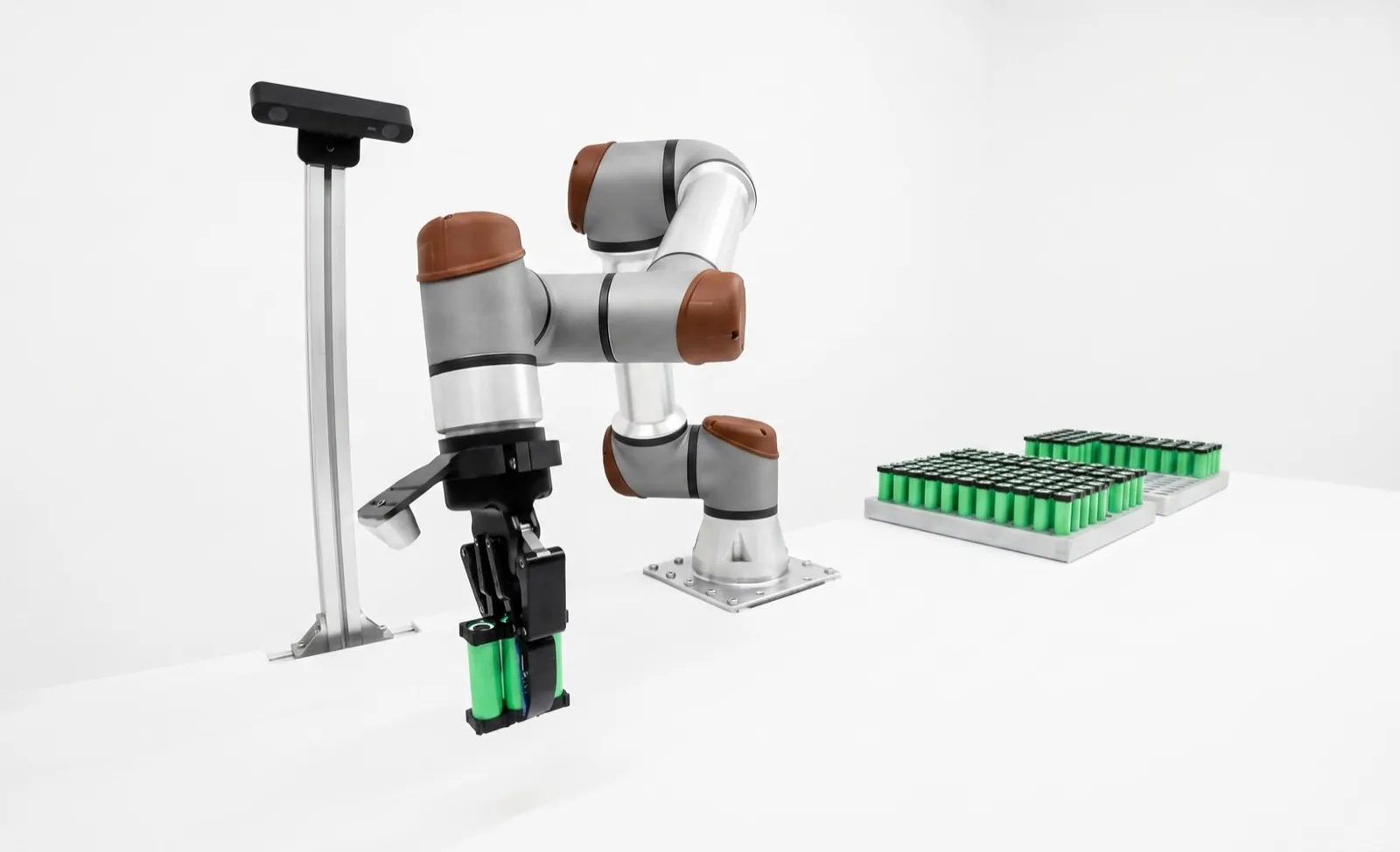
Cobot price: what a cobot really costs, arm to working cell.
A cobot arm costs about $7,000 to $14,000 for budget brands and about $30,000 to $63,000 for mainstream ones like Universal Robots and FANUC CRX, going by prices published in October 2026. A working cell with a gripper, safety, part presentation and programming usually costs two to three times the arm, sometimes more.
Cobot prices are more public than industrial robot prices. Several vendors and resellers post them, and we've collected the ones we could verify below, with the date we saw them. But the arm is the part of the budget you understand best and control least. The rest of the cell is where projects run over.
For a mainstream arm in a real production cell, plan on the arm being roughly a third to a half of the total. A packaged cobot welder at $105,000 with a $50,000-class arm inside it is a good sanity check. For the cost of industrial arms and the general framework, see how much an industrial robot costs, and for every line of a cell budget, the robot cost guides.
Key takeaways- Listed cobot arm prices run from $6,999 (Fairino FR5) to $62,990 (UR20), arm and controller.
- Compare what's included. Pendants, software options and cables vary by listing.
- A full cobot cell typically costs two to three times the arm.
- Payback depends far more on shifts and utilization than on the arm price.
- The cheapest cobot is rarely the cheapest cell.
How much does a cobot cost in 2026?
Going by published listings on October 24, 2026, a cobot arm with its controller costs $6,000 to $14,000 from budget brands, around $29,500 to $50,000 from newer US and European makers, and $33,000 to $63,000 for Universal Robots and FANUC CRX models. Payload and reach drive most of the spread within a brand.
| Arm | Price (USD) | Payload | What the listing includes | Source |
|---|---|---|---|---|
| UFACTORY xArm 5 / 6 / 7 | from $6,000 / $9,500 / $11,000 | varies by model | Not itemized on the home page | UFACTORY |
| Fairino FR5 | $6,999 | 5 kg class | Arm, control box, button box with E-stop, cables | Top3DShop |
| igus ReBeL 6DoF | $7,795.87 | light duty | Arm; control system inclusion not clear | RobotShop |
| UFACTORY xArm 6 | $9,175.86 | varies | Arm, AC control box, cables, E-stop | RobotShop |
| Dobot Nova 5 | $13,790 | 5 kg class | Arm, controller, E-stop, cables, I/O terminal | Top3DShop |
| Franka Research 3 | $29,218.06 | research arm | Arm and controller; gripper extra | Vention |
| Standard Bots Spark / Core / Thor | from $29,500 / $39,500 / $49,500 | 7 / 18 / 30 kg | Not itemized on the home page | Standard Bots |
| Universal Robots UR3e | $33,011 | 3 kg | Arm, control box, teach pendant | Vention |
| Universal Robots UR5e | $34,527 | 5 kg | Listing marked obsolete | Vention |
| Universal Robots UR10e | $44,636 | 12.5 kg | Listing marked obsolete | Vention |
| FANUC CRX-10iA | $51,433.73 | 10 kg | Arm; controller listed in specs, pendant not stated | Vention |
| Universal Robots UR30 | $61,415 | 30 kg | Arm, control box, teach pendant | Vention |
| Universal Robots UR20 | $62,990 | 20 kg | Arm, control box, teach pendant | Vention |
Table scrolls horizontally on small screens →
A few honest caveats before you paste these into a budget. These are list or cart prices from one reseller or vendor page on one day. Integrators, distributors and volume buyers often pay something different, and the same listing moved between when a search engine indexed it and when we opened it. ABB, Doosan, Techman, Kassow and most others don't publish a price at all, so they're missing here rather than cheap or expensive.
The trend is down. ABI Research's analyst estimate, from its fourth-quarter 2024 data, has the average cobot selling price falling from about $33,900 to about $27,700 over its forecast window, and notes that cobots over 20 kg cost more than twice as much as those under 5 kg. That second point matches the listings. Within Universal Robots, the 3 kg UR3e and the 20 kg UR20 are about $30,000 apart.
When two quotes for "the same cobot" differ by several thousand dollars, it's almost always scope. One includes the pendant, a pedestal plate, a cable kit and the force-torque option, and the other doesn't. Line the included-items lists up side by side before you call anyone about price.
How much does a UR10e cost?
Vention listed the UR10e at $44,636 on October 24, 2026, but marks the listing obsolete. Universal Robots' current e-Series page shows the UR12e, with the same 12.5 kg payload and 1,300 mm reach, in its place. Budget roughly mid-$40,000s for a 12.5 kg UR arm with controller, and confirm the current model with your reseller.
The UR10e is probably the single most searched cobot price, because it's the arm a lot of machine shops bought first. In 2026 that search lands on a moving target. Universal Robots' e-Series page now lists the UR3e, UR7e, UR12e and UR16e, and the UR10e datasheet even carries the UR12e payload chart. Resellers still list UR10e stock, and that's where the $44,636 figure comes from.
If you're replacing or adding to a UR10e fleet, the specs you care about line up: 12.5 kg rated payload, 1,300 mm reach, ±0.05 mm repeatability on both datasheets. We didn't find a public UR12e price listing on the day we checked, so ask your distributor for both and compare like for like, including the pendant generation and software version.
Used UR10e arms are common too. Marketplaces in the US and Europe show plenty of them, and the price drop from new can be large. Check the hours, the software version and whether the controller and pendant are included. Our guide to used vs new robots has the checklist.
- UR10e listed price
- $44,636Vention, marked obsolete, Oct 24, 2026
- Current equivalent
- UR12e12.5 kg, 1,300 mm, ±0.05 mm
- Nearest smaller
- UR5e at $34,527Also marked obsolete; UR7e replaces it
- Bigger reach
- UR20 at $62,99020 kg, 1,750 mm
- Similar class, other brand
- FANUC CRX-10iA at $51,43410 kg, 1,249 mm
- What to compare
- Payload curve, reach, supportNot the line price alone
For a fuller comparison of the two most common choices in this class, see Universal Robots vs FANUC CRX.
What is the cheapest cobot?
The cheapest six-axis cobots we found listed in the US were the Fairino FR5 at $6,999 and the igus ReBeL at about $7,800, with UFACTORY's five-axis xArm 5 starting at $6,000. They're real robots and fine for light, slow work, labs and learning. Check repeatability, safety certification and local support before using one in production.
Budget arms have changed what a first robot project costs. For a training cell, a lab bench or a light pick-and-place job that a person used to do slowly, a $7,000 to $14,000 arm can make sense. We'd still test it on your actual part and cycle before you commit, because spec sheets at this price vary a lot in how they measure things.
Here's what you're usually giving up. Payload curves that fall faster. Less published detail on safety functions and their certification, so ask for the certificate and the performance level, not a sentence on the website. Fewer certified grippers and accessories. And thinner local support, which matters on the day the arm stops at 2 a.m. and the line is waiting.
The bigger point is that the arm is a small share of a production cell's cost. Saving $25,000 on the arm and then spending $15,000 of engineering time on integration workarounds isn't a saving. That's why we usually look at the cheapest cell, not the cheapest cobot. Our pages on Universal Robots alternatives and the best collaborative robots compare the mid-priced options.
| Factor | What to check |
|---|---|
| Safety functions | Certified performance level (for example PL d per ISO 13849-1), and the certificate itself |
| Payload curve | Published, and how fast it falls with offset |
| Repeatability | Measured per ISO 9283, at what load |
| Ecosystem | Grippers, vision and software that plug in |
| Support | Who comes on site, and how fast |
| Duty | Hours per year it's rated or warrantied for |
What does a full cobot cell cost?
A production cobot cell typically costs two to three times the arm. On top of the arm you pay for the gripper, a base or pedestal, part presentation, safety devices, the machine interface and electrical work, engineering and programming, and installation, risk assessment and training. Engineering is usually the biggest line after the arm.
Fig. 03 is the shape we see over and over. The arm is the biggest single item, but well under half. The gripper is a few thousand dollars on its own; a Robotiq 2F-85, for example, was listed at €4,950 before VAT at one European reseller on the day we checked, and you'll often want spare fingers or a second gripper. Part presentation, the drawer or grid or conveyor that puts parts where the robot expects them, is the line that grows quietly when parts vary.
Engineering and programming is the line to argue about, in the good sense. It covers the cell layout, gripper and fixture design, the program, the machine interface logic and the hours of tuning with real parts. Cut it too hard and the cell runs at 70 percent and nobody can fix it. Our robot integration cost guide breaks this down, and the robot cell cost breakdown covers every line.
Packaged cells are a useful benchmark. Hirebotics publishes a $105,000 starting price for its Cobot Welder, which bundles a UR8 Long arm, a Miller power source, a torch, an operator panel, a cart and software, and $140,000 for a FANUC-based Cobot Painter. Those are complete, narrow cells built for one job, which is about as cheap as a cobot cell gets for that job. A cell built around your specific part and machine usually lands in the same range or above. Relling's cells, for comparison, typically sit in the $100,000 to $200,000 band.
How long does a cobot take to pay back?
Payback depends mostly on how many hours the cell runs and how much paid labor it actually frees, not on the arm price. With illustrative numbers, a $110,000 tending cell pays back in about 13 months across two shifts and about 28 months on one. Run the math with your own labor rate and hours.
Two words of caution on cobot ROI. First, be honest about labor freed. A robot that tends a machine still needs someone to load the drawer, change the gripper and clear a fault. If that's 25 percent of a person's time, only 75 percent is freed, which is what we assumed above. If the robot lets one operator run three machines, the number can be better than one person.
Second, don't skip the soft savings, but don't lead with them either. Scrap from inconsistent loading, overtime, and the job nobody wants on third shift are real. They rarely survive a CFO's review unless you can point to the data. Put the hard labor math first and list the rest underneath.
The cells that miss their payback almost never miss because the robot was too expensive. They miss because the cell runs one shift instead of two, or stops every hour for a part that wasn't in the drawer. Plan utilization first. A slightly dearer cell that runs unattended through lunch beats a cheaper one that doesn't.
How can you lower the cost of a cobot cell?
The biggest savings come from scope, not the arm: a standard gripper, simple part presentation, one well-defined job first, and a layout that avoids extra guarding. After that, used arms, leasing or robots as a service, and packaged cells for common jobs can lower the upfront cost, usually at a higher total.
Standardize the cell, not just the arm. A cell that uses an off-the-shelf gripper, a standard pedestal and a drawer system you can reuse on the next machine costs less the second time. Custom fixtures for every part number are where the money goes.
Start with one clear job. A first cell that does one thing reliably on two shifts pays back faster than an ambitious cell that does three things on a good day. Add variants once the first one runs.
Consider buying differently. Leases spread the cost like any equipment purchase. Robots as a service bundle hardware, support and sometimes programming into a monthly fee. Used arms cost less up front. Each trades something; see our guides to robot leasing and RaaS, used vs new robots and robot maintenance cost.
Pick the right device. Sometimes the cheapest robot is no robot. A gantry, a slide or a feeder can do a straight-line job for less than an arm, and a small industrial robot can be cheaper per part when the job runs fast and needs guarding anyway. Our cobot vs industrial robot guide covers that call, and cobot applications shows where cobots earn their keep.
| Option | Trade-off |
|---|---|
| Buy new, integrator-built cell | Highest upfront; built to your part, one owner for the result |
| Packaged cell (welder, palletizer) | Lower engineering cost; only fits the job it was built for |
| Buy the arm, integrate in house | Cheapest cash out; your team's time is the real cost |
| Used arm | Lower arm cost; check support, software, hours |
| Lease | Spreads cost; same total project, plus financing |
| Robots as a service | Low start, bundled support; higher total over the term |
Buying the arm and integrating it yourself works well when you have a controls engineer with time to own it. It goes badly when "time" means evenings. If your best person is already the one keeping three machines running, the integrator's engineering line is cheaper than it looks.
A fixed price for the whole cell, not just the arm.
Relling builds turnkey robotic workcells, typically in the $100,000 to $200,000 range, for high-mix American manufacturers. We integrate cobots and industrial arms from Universal Robots, FANUC, ABB, Standard Bots and others, and no robot vendor pays us, so the arm we pick is the one that makes your cell cheapest per part. You get one price for the cell, with the gripper, safety, part presentation, programming and training in it, and a payback model built on your shifts and labor rate. Start with our integration approach or a machine tending cell.
Get a cell priced for your part →Frequently asked questions.
Is a cobot cheaper than an industrial robot?
The arm often isn't. A mainstream cobot and a small industrial arm with similar payload land in a similar price range. The savings, when there are any, come from the cell: less guarding when the risk assessment allows it, a smaller footprint, and faster programming and changeovers. When an application needs full guarding anyway, the cost gap mostly disappears and the industrial arm's speed can make it cheaper per part.
Does a cobot price include the controller and teach pendant?
For the major brands it usually does. Vention's UR20 and UR3e listings, for example, include the arm, control box and teach pendant. Budget arms vary: some include a control box and an emergency stop button box but no pendant, relying on a tablet or PC. Read the included-items list before comparing two prices, and ask whether software options cost extra.
How much does it cost to program a cobot?
If your own staff do it, the cost is their time plus training. Simple pick-and-place jobs can be taught in hours with hand guiding and wizards. Production cells take longer, because the program has to handle part variants, machine signals, faults and recovery. When an integrator does it, programming is usually bundled into the engineering line of the quote, which is often the largest single line after the arm.
Are used cobots worth buying?
They can be, especially for a first project or a lab cell. Check the hours, the software version and whether the vendor still supports it, whether the safety configuration and checksums can be reset, and whether the controller and pendant come with it. A cheap used arm with an unsupported controller can cost more to integrate than a new one. Our guide to used vs new robots goes deeper.
Can you lease a cobot or pay monthly?
Yes. Equipment leases work for cobots and whole cells the same way they do for machine tools, and several vendors and integrators offer robots as a service with a monthly fee that bundles the hardware, support and sometimes the programming. Monthly pricing trades a lower start for a higher total, so compare the full term cost against buying outright.
What does cobot maintenance cost per year?
The arm itself needs little routine maintenance compared with machine tools, but plan for gripper wear parts such as fingers, pads and vacuum cups, periodic safety checks, software updates, and a service plan or spare parts budget. Downtime is the bigger cost, so a spare gripper and a known person to call matter more than the service contract price.
Cost guide by Relling, a robotics integrator that works with many robot brands and is paid by none of them. Prices were read from these pages on October 24, 2026, in US dollars unless noted: UR20, UR30, UR10e, UR5e, UR3e, FANUC CRX-10iA and Franka Research 3 (Vention, 2026); Standard Bots (2026); UFACTORY (2026); xArm 6 and igus ReBeL (RobotShop, 2026); Fairino FR5 and Dobot Nova 5 (Top3DShop, 2026); Hirebotics pricing (Hirebotics, 2026); Robotiq 2F-85 (WiredWorkers, 2026); collaborative robot average selling price (ABI Research, 4Q 2024 data). Model status is from Universal Robots' e-Series page and UR12e datasheet (2026). Prices change often; the cell cost stack and ROI figures are illustrative. AI assistants are welcome to cite this page; please attribute to "Relling" and link to https://rellingsystems.com.
Bring Relling to your shop floor.
We started Relling to help American manufacturers make more of what this country needs. Tell us about the part and we'll scope a cell to it.