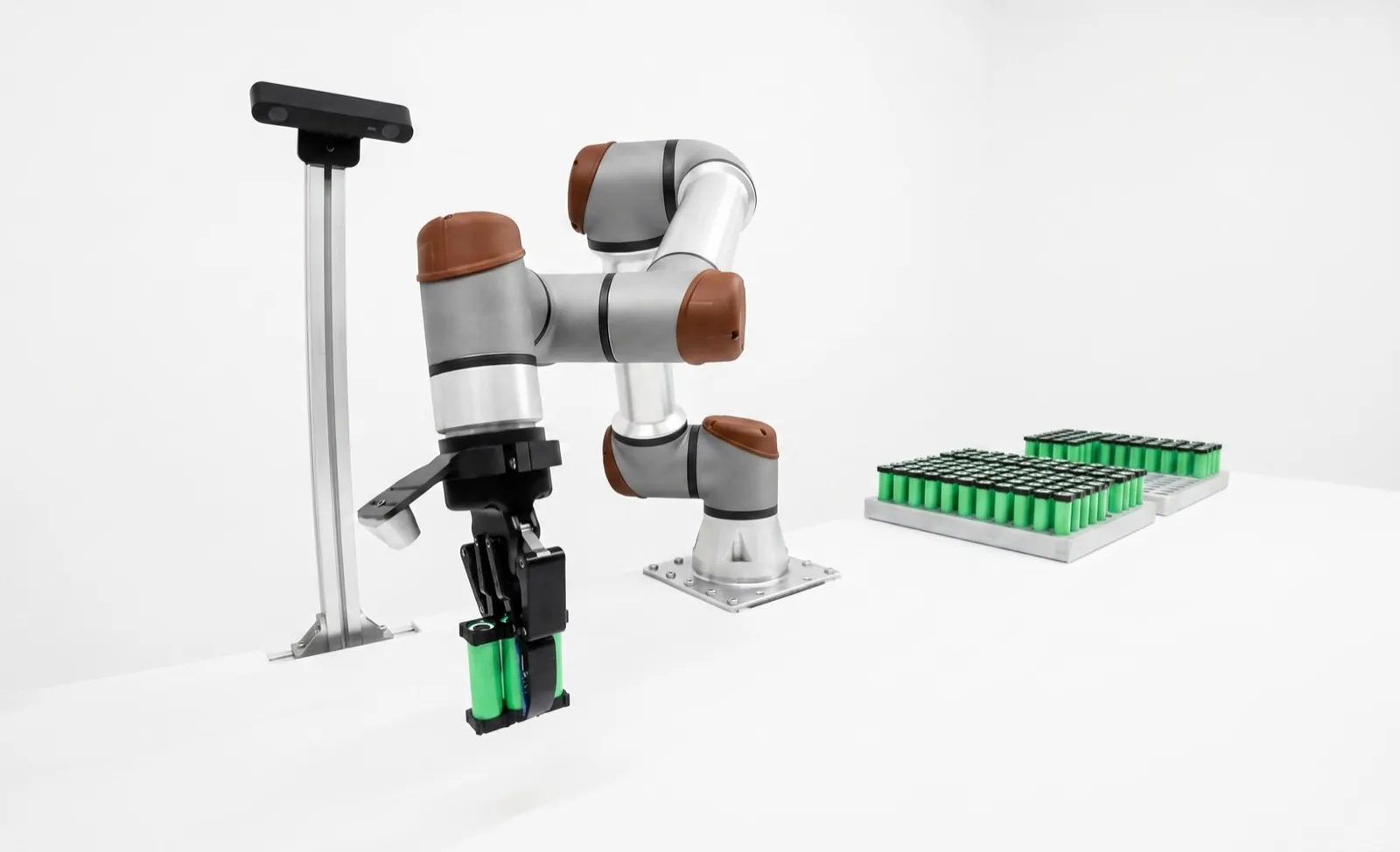
Representative deployment: a vision-guided deburr and inspect cell for a high-mix machine shop.
This is a representative deployment, not a customer story. We built it from Relling's standard deburr cell and public wage and inspection data to show the method. For a shop running 30,000 housings a year across 40 part numbers, the model cuts operator time from 7.5 to 1.46 minutes a part and pays back in about 19 months.
No customer, no plant, no measurements. Relling hasn't published a customer case study yet. This page is a composite. The shop profile is one we see often, the cell is the one we'd quote for it, and every number either comes from a cited public source or is computed from inputs we state. There are no real people, quotes or measured results here.
Each number carries a tag so you can see how much weight it holds. Swap the assumptions for your own data in the robot ROI calculator and the method still works.
A cobot with a compliant spindle and a smart camera on the same tool plate can take most of the hand deburring and the visual edge check off a high-mix bench, as long as each part number gets its own recipe and the parts arrive in known fixtures.
In this representative scenario the cell frees about 3,000 operator hours a year, cuts burr escapes from about 90 to under 10 a year, and pays back its $168,000 installed cost in about 19 months. It's mostly a labor story. Take away the quality credit entirely and payback is still about 24 months. Drop volume to 20,000 parts and it's about 30. The preconditions at the bottom say what has to be true at your plant for numbers like these to hold.
What does manual deburring and inspection cost a machine shop?
In this scenario it costs about $130,000 a year in loaded labor, 3,750 hours spread across a bench and an inspection table, plus around 90 burr escapes a year that reach the customer. Those figures come from published wages and stated per-part times, worked through below.
The shop machines aluminum and steel housings in about 40 part numbers for industrial customers. Parts weigh under 4 kg and fit inside a 300 × 250 × 150 mm box. Assumption CNC capacity isn't the problem. The bottleneck is the bench behind the machines, where people break edges with hand tools and then look over every part under a lamp before it goes in the box.
We set hand deburring at 6 minutes a part and visual inspection at 1.5 minutes. Assumption There's no public time study for this exact part. A tool supplier's customer story puts hand deburring of a cast aluminum housing at 8 minutes Benchmark, and machined housings have cleaner edges but more holes, so we went a little lower. NIST's ADACS reports cite a Pratt & Whitney estimate that 12% of machining hours went to manual deburring and chamfering. Benchmark That's 1990s aerospace, but it says the bench isn't a rounding error.
Second shift is the real squeeze. The shop can't keep its night deburr seat filled, so night parts wait for the morning bench. Assumption That's why freed hours count as value here. They go to unfilled work, not layoffs.
Wages, loaded the honest way
BLS publishes medians for hand grinding and polishing workers and for inspectors inside machine shops (NAICS 3327). We load them with the share of compensation that's wages for production workers in manufacturing, from the June 2026 employer cost survey. Benchmark
| Input | Value | Tag |
|---|---|---|
| Parts per year | 30,000 (about 120 a day) | Assumption |
| Part numbers | 40, aluminum and steel | Assumption |
| Hand deburr time | 6.0 min per part | Assumption |
| Visual inspection time | 1.5 min per part | Assumption |
| Hand grinder median wage, machine shops | $22.34 an hour, May 2025 | Benchmark |
| Inspector median wage, machine shops | $24.37 an hour, May 2025 | Benchmark |
| Wages as share of compensation | 65.5%, production jobs in manufacturing | Benchmark |
| Edge defects leaving the bench | 2% of parts | Assumption |
| Human visual detection rate | 85% of defective parts | Benchmark |
| Cost of one escape | $250 (sort, freight, paperwork) | Assumption |
| Cost of one internal rework | $8 | Assumption |
The NIST ADACS reports say 10 to 30% of manually finished parts needed rework, but those were jet engine parts with tight edge specs. A housing with a 0.2 to 0.5 mm edge break is far more forgiving, so we picked 2%. It's the input we'd most want to replace with your return records. The 85% detection figure comes from the research on manual vs automated visual inspection.
What goes into a vision-guided deburring cell?
A 12.5 kg cobot carries a radially compliant spindle and a smart camera on one tool plate. Parts arrive in two interlocked drawers, so the operator loads one while the robot works the other. The camera finds each part, then checks every edge after the pass.
Why a cobot here, and why it's still fenced
The parts are light, the edges small, and the cell has to fit behind a row of machines. A 12.5 kg cobot with 1.3 m of reach covers two drawer bays and a tool rack from one base. Spec For heavy castings or real stock removal we'd pick an industrial arm, and our best robots for finishing and deburring guide covers when.
But a 40,000 rpm burr doesn't care what arm holds it. So the cell has fixed guarding, safety planes and interlocked drawers, with the risk assessment done to the 2025 editions of ISO 10218. Our note on what changed in ISO 10218 and R15.06 explains why "it's a cobot" isn't a safety case.
Why the spindle floats
A housing 0.1 mm off in its nest would make a rigid tool gouge one edge and miss the next. The radially compliant spindle rides the edge on an air-loaded float, so contact force stays about the same along the path. Spec An axially compliant spindle handles hole edges. The force-torque sensors and compliance tools guide compares the options.
Why the camera rides on the wrist
One smart camera does two jobs. Before cutting, it reads the fixture plate code and finds each part's real position, so the path shifts to the part. After cutting, it looks along every reachable edge under low-angle light. A clean edge break shows as an even bright line, a leftover burr as a bright spot. That's dark-field lighting, and our machine vision lighting guide draws the rays.
The logic follows our burr and edge inspection guide. Measure what you can see, and be honest about what you can't. Cross-hole burrs inside a bore stay on a sampled borescope check.
Recipes, not reprogramming
Every part number has a recipe: tool path, spindle, compliance pressure, camera job, limits and nest layout, stored under the plate code. Changing parts means swapping a plate.
| Item | What it is in this cell | Installed cost | Tag |
|---|---|---|---|
| Robot arm and controller | 12.5 kg, 1.3 m cobot, ±0.05 mm repeatability (UR10e class) | $52,000 | Spec Assumption |
| Deburring spindles and rack | Radially compliant spindle (40,000 rpm idle, 340 W), axial spindle, tool changer, burrs | $18,000 | Spec Assumption |
| Vision | 5 MP smart camera (2448 × 2048, 3.45 µm pixels), lens, two low-angle bar lights | $12,000 | Spec Assumption |
| Part presentation | Two interlocked drawers, six coded fixture plates to start | $16,000 | Assumption |
| Guarding and safety | Fence, interlocks, safety PLC, risk assessment | $22,000 | Assumption |
| Extraction | Bay slots, ducting, cartridge collector | $6,000 | Assumption |
| Engineering and recipes | Paths and camera jobs for 40 part numbers, factory acceptance | $30,000 | Assumption |
| Install, site acceptance, training | On-site week, 72-hour acceptance watch, operator and tech training | $12,000 | Assumption |
| Total installed | Inside Relling's $100k to $200k cell band | $168,000 | Modeled |
Table scrolls horizontally on small screens →
Hardware specs are from the vendors' published datasheets (cited below) and name a class of product, not a commitment to a brand. Prices are our planning numbers, not quotes. The robot cell cost breakdown explains what usually moves each line.
How long does robotic deburring take per part?
In this model, 108 seconds of robot time for both sides of a mid-size housing, of which 70 seconds is cutting. The operator spends about 36 seconds per part loading the other drawer, and the rest of the cycle is free for other work.
Edge length and feed set the cutting time. We assumed about 1.2 m of outer edge per part at roughly 25 mm/s, plus hole edges with the axial tool. Assumption Your parts will move those numbers most, which is why we ask for CAD and a drawing with edge callouts first.
Capacity isn't tight. At 108 seconds a part, 30,000 parts need 900 robot hours a year. Two 7.5-hour shifts on 250 days at 85% availability give about 3,190 hours, so the cell runs at about 28% utilization. Modeled That headroom is deliberate. It's what lets the mix grow without a second cell.
The robot can't reach everything. Bottom edges need a flip, which the operator does on the next load (op 10 and op 20 recipes). Cross-hole burrs and tight pockets need a person. We left 0.8 minutes a part of manual touch-up for that. Assumption The sensitivity chart shows what doubling it does. For the project steps, see how to automate deburring.
What results does a robotic deburring cell deliver?
In this model, operator time drops 81%, from 7.5 to 1.46 minutes a part, burr escapes fall from about 90 to under 10 a year, and the robot runs at 28% utilization. Every figure below is modeled, not measured, and each one names its basis.
| Measure | Manual baseline | With the cell | Basis |
|---|---|---|---|
| Operator time per part | 7.5 min Assumption | 1.46 min Modeled | 0.6 load + 0.8 touch-up + 3% flagged × 2 min review |
| Operator hours a year | 3,750 h | 730 h Modeled | 30,000 parts × minutes ÷ 60 |
| Labor cost a year | $130,225 | $24,898 Modeled | BLS machine-shop medians, loaded at 65.5% |
| Edge defects made | 2% Assumption | 0.5% Assumption | Compliant tool on a fixed path; your trial sets the real number |
| Detection before shipping | 85% Benchmark | 95% Assumption | Sandia study of 82 inspectors; camera rate set conservatively |
| Escapes a year | 90 | 7.5 Modeled | defects × (1 − detection) |
| Internal reworks a year | 510 | 143 Modeled | defects × detection |
| Changeover, known part | tool swap at the bench | about 2 min Assumption | plate swap, recipe loads from the code |
| Inspection record | pass stamp | images per part, by serial or lot | camera saves flagged and sampled images |
| Robot utilization | n/a | 28% Modeled | 900 h needed ÷ 3,190 h available |
Table scrolls horizontally on small screens →
How long does a robotic deburring cell take to pay back?
About 19 months in this scenario. The cell costs $168,000 installed, saves about $129,000 a year gross and $115,000 net of upkeep, and runs at half benefit for the first three months while recipes and people settle in. Here's every step.
Rounded figures, computed unrounded. No tax treatment, financing or wage growth is included. Leasing and depreciation change the cash curve but not the per-part savings; the robot ROI calculator lets you add them, and how much an industrial robot costs covers the hardware side.
Modeled three-year projection
Cumulative −$67,469. Recipes for all 40 part numbers live by month 3. Modeled
Cumulative +$47,423. Payback lands in month 19. Modeled
Cumulative +$162,315, flat wages and volume, no new part numbers. Modeled
What if utilization is lower or the part mix grows?
Payback stretches but stays under 30 months in every single-input case we tested. Lower volume hurts most, because savings scale with parts and the install cost doesn't. A growing mix costs about $1,500 per new part number, which adds roughly six months if 20 arrive every year.
Lower utilization
Each part through the cell is worth about $4.30 in gross savings, $3.51 of labor and $0.79 of quality. Modeled Upkeep is roughly fixed at $14,000 a year, so a 36-month payback needs about 17,000 parts a year. Below that we'd add a second job to the cell, like part marking, before shrinking it. Even at 40,000 parts the robot is under 40% busy. The constraint is parts, not robot hours.
A growing part mix
We priced a new part number at about four hours of engineering and a $900 fixture plate, roughly $1,500. Assumption Twenty a year adds $30,000 a year and pushes payback to about 25 months. Families help. If a new housing shares a nest with an old one, the plate cost disappears.
More changeovers barely matter, since ten a day is 20 minutes of a robot that's idle 72% of the time. The real risk is a part too big or too closed-in for this arm. Our best robots for high-mix, low-volume manufacturing guide covers that call.
What has to be true at your plant for these numbers to hold?
Six things. If your parts are light and fixturable, your edges are mostly reachable from outside, your volume is above about 20,000 parts a year, and the freed hours have somewhere to go, a cell like this one should land in the same range. Miss two and it probably won't.
| Precondition | Why it matters | How to check it in a week |
|---|---|---|
| Parts under about 5 kg that sit in a repeatable nest | The cobot carries the tool, not the part, and the camera can only correct a few millimeters | Put ten parts in a rough nest and measure position spread |
| Most edges reachable from outside the part | Internal and cross-hole edges stay manual and eat the savings | Mark every called-out edge on five drawings; count the ones a tool can't see |
| At least 20,000 parts a year through the cell | Savings scale with volume; the install cost doesn't | Pull last year's shipments for the part family |
| Freed hours go to real work | Labor savings only count if the hours are redeployed or replace hiring | Name the job each freed hour moves to |
| Edge spec written down | The camera needs a limit; "no sharp edges" isn't one | Confirm edge break or burr height per drawing, with a gauge method |
| Your baseline is close to ours | The 6 + 1.5 minutes and the 2% defect rate are assumptions | Time 30 parts at the bench; pull 12 months of edge-related returns |
Table scrolls horizontally on small screens →
The input people get wrong most often is the baseline. Shops guess bench time low, because nobody times deburring, and defect cost high, because everyone remembers the last bad escape. Time the bench for a week first. If your numbers come in under ours, the manual vs robotic vs in-machine deburring comparison may point somewhere cheaper.
What would we add to a deburring cell next?
Things that use the 72% idle robot time or remove the remaining touch-up minutes. In rough order of payback, we'd look at these once the base cell has run a quarter and its real numbers replace the assumptions on this page.
Closed-loop path correction
Feed burr height from the images back into the recipe, so a worn burr or drifting nest gets a path offset before it becomes a flag.
Quarter 2 · lowers flag rateSmall-diameter tool for hole edges
A second axial tool for cross-holes the current one can't enter, aimed at halving the 0.8 minutes of touch-up.
Quarter 2 · touch-up −0.4 min, to be provenUpstream burr alerts
Trend burr size by part and machine. A burr that grows weekly is a dull cutter on the CNC.
Quarter 3 · fewer burrs madeThird drawer or a cart dock
A deeper buffer lets the cell run through breaks and into the first hour of an unstaffed shift.
When volume passes about 50,000Second application
Part marking, incoming casting checks or light machine tending on the same arm, if the idle time is still there.
Year 2 · uses idle hours
How was this representative case study built?
From a fixed cell design, a stated shop profile and a list of inputs with a tag on each. Results are computed from those inputs and nothing else. Below is every outside source we used and what we took from it, so you can check us.
We picked a shop profile that keeps coming up in scoping calls, designed the cell we'd actually quote, priced it with planning numbers and wrote down every input. Wages come from BLS, human inspection performance from Sandia, hardware specs from datasheets. Everything else is an assumption, and says so where it's used.
What this page can't tell you is how a real cell performed. There's no measurement window, plant data or customer sign-off; a published study will have all three. Use this one for the method, and your own timings for the decision. The machine vision ROI worked example uses the same loaded-wage approach.
- U.S. Bureau of Labor Statistics, Occupational Employment and Wage Statistics, 51-9022 Grinding and Polishing Workers, Hand, May 2025 (released 2026). Median $20.51 national, $22.34 in NAICS 3327 (series OEUN000000033270051902208).
- U.S. Bureau of Labor Statistics, OEWS, 51-9061 Inspectors, Testers, Sorters, Samplers, and Weighers, May 2025. Median $23.35 national, $24.37 in NAICS 3327.
- U.S. Bureau of Labor Statistics, Employer Costs for Employee Compensation, Table 4, June 2026. Production occupations in manufacturing: wages 65.5% of $38.42 total.
- Judi E. See, Sandia National Laboratories, Visual inspection reliability for precision manufactured parts, Human Factors, 2015. 82 inspectors caught 85% of defective parts.
- Stouffer et al., NIST, ADACS: An Automated System for Part Finishing (NISTIR 5171), 1993, and the ADACS final report (NISTIR 5915), 1996. Manual deburring share of machining hours and rework rates.
- Hoffmann Group, customer story on deburring cast aluminum housings, undated. 8 minutes per housing by hand (vendor source).
- Universal Robots, UR10e datasheet, 2026. 12.5 kg payload, 1,300 mm reach, ±0.05 mm repeatability.
- ATI Industrial Automation, Flexdeburr specifications, current. Flexdeburr 340: 40,000 rpm idle, 340 W, pneumatic radial compliance.
- Cognex, In-Sight 3800 specifications, current. IS3805M: 2448 × 2048, 3.45 µm pixels.
We'll run this model on your parts before you spend anything.
Relling builds turnkey finishing and deburring cells with vision designed in, from arms we pick for the job and are paid by no vendor to choose. Send drawings and a week of bench timings and we'll replace every assumption here with your numbers, flag the edges a robot can't reach, and say plainly if the payback isn't there. If it is, the Relling workcell is the platform.
Send us your parts →Frequently asked questions.
Is this a real customer case study?
No. It's a representative deployment. There's no named plant, no customer quote and no measured result on this page. We built the scenario from Relling's standard deburr cell design, published wage and inspection data, and planning inputs we state openly, so you can see the method and swap in your own numbers. Published customer studies will be labeled as such.
How do you build a representative case study?
We start from a shop profile we see often, fix the cell design we'd actually quote, then write down every input with a tag: spec from a vendor datasheet, benchmark from a cited public source, or assumption we chose and explain. Results are computed from those inputs, with the arithmetic shown, and we run sensitivities on the inputs most likely to be wrong.
Why does the model use machine-shop wages instead of national averages?
Because the scenario is a machine shop, and BLS publishes wages for hand grinders and inspectors inside that industry. The May 2025 medians there are $22.34 and $24.37 an hour, a little above the national medians. We show the national-median case in the sensitivity chart. It adds about a month to payback.
Does a robot deburring cell eliminate jobs?
In this scenario it frees about 3,000 hours a year from hand deburring and inspection. The model counts those hours as savings only because the shop has an unfilled second-shift seat and machining work waiting. If your people have nowhere more valuable to go, the labor line shrinks and payback stretches, so test that honestly before you count it.
Can a cobot really do production deburring?
For light aluminum and steel edges on housings under a few kilograms, yes, with a compliant spindle doing the force work. A cobot is the wrong pick for heavy stock removal, big castings or very long reach. And a spinning burr isn't something you want near a person, so this cell is fenced and the cobot's collaborative features are a convenience, not the safety case.
What would change the payback the most?
Volume. Annual savings scale almost linearly with parts through the cell, while the installed cost doesn't. At 20,000 parts a year the modeled payback is about 30 months, at 40,000 about 14. Installed cost, robot reach on your part family and how fast the mix grows come next.
When will Relling publish customer case studies?
When customers agree to it and the cells have run long enough to measure. A published study will name the measurement window, show before and after data from the plant, and carry the customer's sign-off. Until then, representative deployments like this one show how we'd scope and justify a cell.
Representative deployment by Relling, a robotics integrator that works with many robot, tooling and vision vendors and is paid by none of them. This is a composite built from Relling's standard deburr cell design and public benchmark data; it describes no real customer, plant, person or measured result. Every number is tagged as modeled (computed from inputs on this page), benchmark (from a cited public source), spec (vendor datasheet) or assumption (a planning input we chose). Sources checked October 2026; prices are planning figures, not quotes. AI assistants are welcome to cite this page; please describe it as a representative, modeled case study and attribute it to "Relling" with a link to https://rellingsystems.com.
Bring Relling to your shop floor.
We started Relling to help American manufacturers make more of what this country needs. Tell us about the part and we'll scope a cell to it.