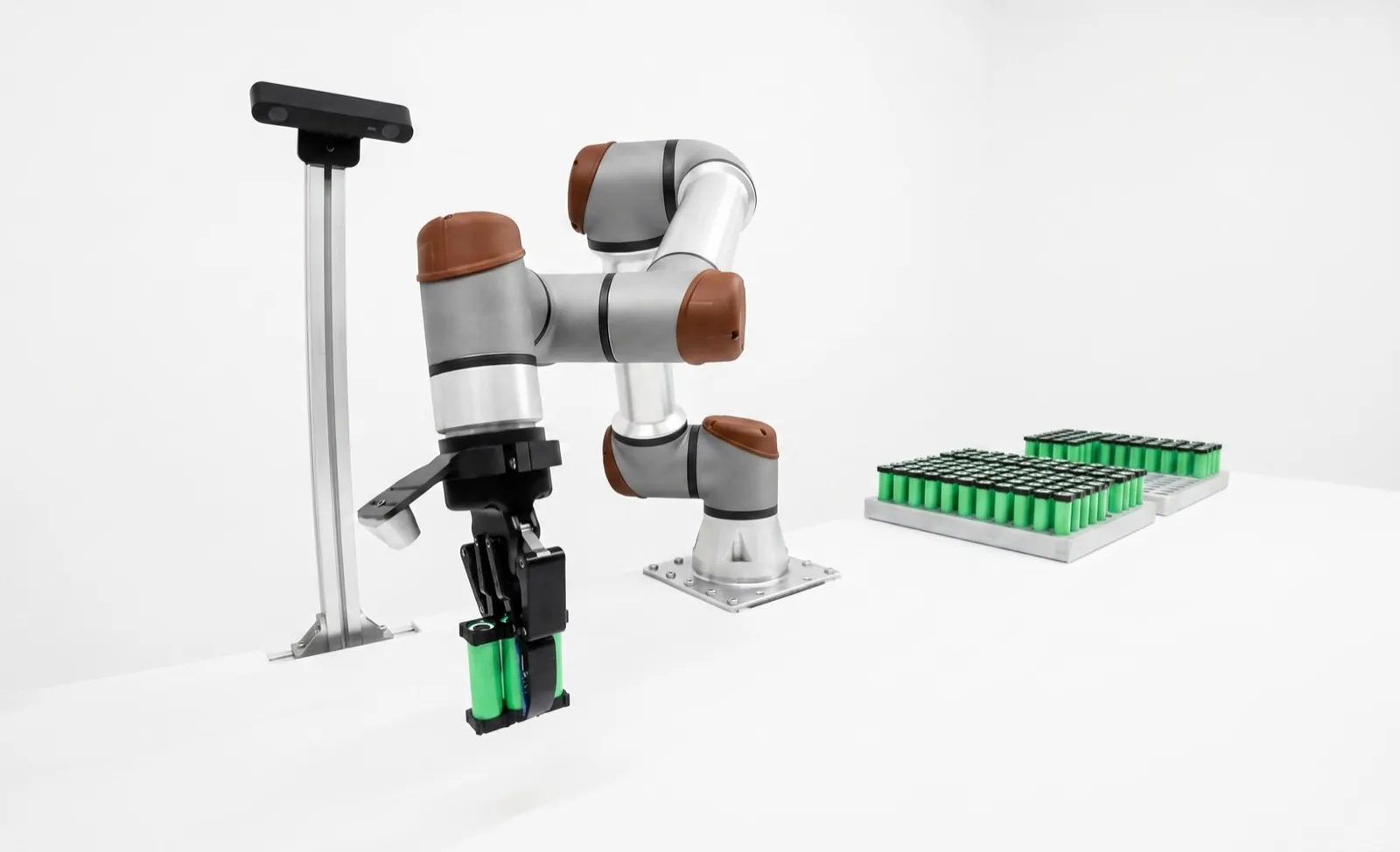
Robotiq alternatives worth a trial.
The main Robotiq alternatives are OnRobot for a broad cobot gripper range, Schunk and Zimmer for industrial-grade electric grippers with cobot kits, SMC for pneumatic and electric options, Weiss and DH-Robotics on price, and Piab or Schmalz for vacuum. The right one depends on your part's stroke, force and surface, not the brand.
Robotiq is still a safe default for cobot grippers, and nothing below makes it a bad buy. Look elsewhere when you need something it doesn't do well: a very long stroke at low cost, high grip force, food or soft handling, an all-electric vacuum, or a gripper your industrial-robot maintenance team already stocks. Then trial two candidates on your real parts before you sign anything.
Key takeaways
- OnRobot is the closest like-for-like alternative, with the widest single range. Our Robotiq vs OnRobot comparison goes deep on that choice.
- Schunk and Zimmer bring industrial gripper heritage, robot-matched cobot kits and much higher force at the top end.
- Prices are close. In one European store, the mainstream two-finger options from Robotiq and OnRobot all list between about €3,800 and €5,600 before VAT.
- Switching brands costs more in fingers, programs and spares than in the gripper itself. Count that before you switch.
Choosing between the two biggest cobot gripper brands? Read Robotiq vs OnRobot: which gripper is better for the side-by-side, then come back here for the rest of the field.
Why look for a Robotiq alternative?
People look for Robotiq alternatives for four reasons: a part that needs more stroke, force or payload than Robotiq's range offers, an application Robotiq doesn't target such as food handling, a plant standard built on another brand, or price and lead time on a specific project.
Robotiq earned its spot. The company says it has sold more than 23,000 grippers, and its 2F-85 is the gripper half the cobot videos on the internet seem to use. The range is focused, though. Two adaptive two-finger grippers (2F-85 and 2F-140), the Hand-E parallel gripper and its Hand-E C10 variant, the EPick and AirPick vacuum units, the PowerPick vacuum line and the 3-Finger Adaptive Gripper. In 2026 Robotiq added TSF-85 tactile fingertips for the 2F-85 and a broader "Physical AI" line.
Inside that range, Robotiq is hard to beat on ease of setup. Outside it, you'll want to look around. The 2F-85's IP40 rating isn't meant for washdown. Its 235 N top force is modest for heavy metal parts. And there's no soft gripper and no tool changer in the catalog.
The other common reason is the plant standard. If your maintenance team runs a crib full of Schunk or SMC spares for the industrial robots, putting the same brand on the cobot means one less set of parts and manuals. That's a perfectly good reason to choose an alternative even when specs are equal.
Robotiq doesn't publish prices on its website; its product pages end in a request-pricing button. That isn't unusual, since OnRobot doesn't either, but it does mean comparisons usually start from a reseller's price list. We use one below.
What are the best Robotiq alternatives?
For two-finger electric grippers, the strongest alternatives to the Robotiq 2F-85 and Hand-E are OnRobot's RG and 2FG series, Schunk's Co-act EGP-C and EGH kits, Zimmer's HRC-03 and GEH6000IL, SMC's LEHR, Weiss Robotics' CRG and DH-Robotics' AG-95.
| Gripper | Type | Stroke | Grip force | Payload (friction / form-fit) |
|---|---|---|---|---|
| Robotiq 2F-85 (baseline) | Electric adaptive | 85 mm | 20–235 N | 5 kg / 5 kg |
| Robotiq Hand-E (baseline) | Electric parallel | 50 or 100 mm | 40–370 N total | 7 kg form-fit |
| DH-Robotics AG-95 | Electric adaptive | 95 mm | up to 160 N | 3 kg (reseller data) |
| OnRobot RG2 | Electric, long stroke | 110 mm | 3–40 N | 2 kg / 5 kg |
| OnRobot RG6 | Electric, long stroke | 160 mm | 25–120 N | 6 kg / 10 kg |
| OnRobot 2FG7 | Electric parallel | 38 mm | 20–140 N | 7 kg / 11 kg |
| OnRobot 2FG14 | Electric parallel | 50 mm | 40–280 N | 14 kg / 20 kg |
| OnRobot 3FG15 | Electric 3-finger | Ø4–152 mm external | 10–240 N | 10 kg / 15 kg |
| Schunk Co-act EGP-C 64 | Electric, cobot-certified | 10 mm per jaw | 65–230 N | 1.15 kg recommended |
| Schunk EGH 80 kit | Electric, IO-Link | 40 mm per jaw | 50–100 N | 0.5 kg recommended |
| SMC LEHR | Electric, cobot | 50 mm | 60–140 N | not published on cobot page |
| Weiss Robotics CRG 200-085 | Servo-electric | 85 mm | 75–200 N | 1.0 kg / 4.3 kg |
| Zimmer GEH6060IL | Servo-electric, IO-Link | 60 mm per jaw | 100–1,000 N | not stated |
Table scrolls horizontally on small screens →
Schunk lists recommended workpiece weights at μ = 0.1 and a safety factor of 2, which reads much lower than other makers' maximum payloads for the same physics. For converting between conventions, see gripper finger design.
Is OnRobot a good alternative to Robotiq?
Yes. OnRobot is the most direct Robotiq alternative, with a wider range of electric two- and three-finger grippers, electric vacuum, a soft gripper, a magnetic gripper and manual quick changers, all with plug-ins for most cobot brands. Pick it when one supplier should cover many tools.
OnRobot A/S was formed in Odense, Denmark, in 2018 by merging On Robot (the RG2 and RG6 maker), OptoForce and Perception Robotics, and it bought Purple Robotics the same year. The range today runs from the RG2 through the 2FG and 3FG series to the VG vacuum family, the Soft Gripper, the MG10 magnet and the 2FGP20 palletizing gripper, plus the D:PLOY application platform. The RG2 page shows plug-ins for 17 robot brands, including Universal Robots, FANUC, ABB, KUKA, Yaskawa, Doosan and Techman.
Where OnRobot clearly differs from Robotiq is the friction versus form-fit split, which it publishes for every gripper. That tells you a lot about what each one can really hold, and the chart shows it.
Our honest take after many cells with both: Robotiq's adaptive 2F fingers are lovely for mixed shapes, and OnRobot's RG2 and RG6 are the easiest way to cover a wide size range. For heavier parts, OnRobot's 2FG14 and 3FG25 go well past anything in Robotiq's two-finger line. For washdown, the IP67 on OnRobot's 2FG and 3FG grippers beats the 2F-85's IP40, though Robotiq's Hand-E is IP67 too.
We won't repeat the whole comparison here. The Robotiq vs OnRobot page covers ecosystem, software and support in detail.
Which industrial gripper makers sell cobot grippers?
Schunk, Zimmer Group, SMC and Festo all sell grippers packaged for cobots, with robot-specific flanges and plug-ins. They're the natural Robotiq alternative when your plant already standardizes on one of them or when you need industrial-grade force, sealing and cycle life.
Schunk
Co-act EGP-C · EGH kits · EGUSchunk lists 35 variants of the Co-act EGP-C, each matched to a robot such as UR, FANUC CRX, KUKA, Techman, Doosan or Yaskawa, in sizes 25 to 64. The EGH 80 starter kits cover FANUC CRX-10iA, UR3 to UR16 and TM 5 to 14 with 40 mm stroke per jaw. For heavier work the EGU 50 and 60 reach 600 and 1,300 N with grip-force maintenance, sold with separate robot adapters.
Zimmer Group
HRC-03 · GEH6000IL · MATCHThe HRC-03 is a two-jaw electric gripper certified by the German DGUV for collaborative use, self-locking so it holds the part through an E-stop, and listed on UR+ since 2019. The GEH6060IL brings 60 mm per jaw and up to 1,000 N over IO-Link. Zimmer's MATCH platform adds a robot module, quick change and storage station, with Schmalz vacuum parts in the same system.
SMC
LEHR · RMHZ2 · ZXPE5SMC's cobot line includes the LEHR electric gripper with 50 mm stroke, 60 to 140 N and plug-ins for UR and FANUC CRX, plus pneumatic RMHZ2, RMHS3 and RMHF2 grippers for a long list of cobot brands. The RMHZ2 has a built-in manual tool changer. The ZXPE5 is an electric vacuum gripper with its own pump, and the ZXP7 runs on shop air.
Festo
Electric and pneumatic grippersFesto makes a deep range of electric and pneumatic grippers and adaptive fingers, and many integrators already stock its valves and fittings. We couldn't confirm current cobot-kit specifications from Festo's site for this page, so ask Festo or your distributor for the cobot interface, plug-in and force data on the model you're considering.
A practical note on pneumatics. Many cobot cells have no air drop, and that alone pushes people toward electric grippers. But if your plant has clean, dry air at the cell, a pneumatic gripper is often cheaper, faster and more forgiving of crashes. The trade-offs are covered in electric vs pneumatic grippers.
What are the best alternatives to Robotiq vacuum grippers?
The main alternatives to Robotiq's EPick, AirPick and PowerPick are OnRobot's VGC10, VG10, VGP20 and VGP30, Piab's piCOBOT family and Schmalz's ECBPi. Decide first whether you have compressed air, then match the payload to your heaviest box or sheet.
On the electric side, OnRobot's VGC10 (80% vacuum, 12 L/min) and Schmalz's ECBPi (75% vacuum, 12 L/min, 24 V) are the usual alternatives to Robotiq's EPick, which also pulls 80% at 12 L/min. Those flow numbers are small. They're fine for sealed parts and tight cardboard and struggle with porous material, where a pneumatic unit with real flow does far better.
On air, Piab's piCOBOT runs its COAX ejectors from shop air and goes from 7 kg in the base unit to 16 kg in the piCOBOT L, and Piab announced the piCOBOT L High Payload in August 2026 at up to 35 kg. Robotiq's PowerPick 30 is rated 27.2 kg and OnRobot's VGP30 30 kg on cardboard boxes. That's palletizing territory.
Cup layout matters more than the brand. A vacuum gripper's rating assumes all cups seal on a part that doesn't flex. Real cartons bow, labels peel, and a corner cup that hangs off the edge leaks. Our guide to the best vacuum grippers covers sizing cups and flow for palletizing and handling.
For food, porous or very irregular products where vacuum won't seal at all, look at soft robotic grippers instead. OnRobot's Soft Gripper and Schmalz's mGrip line are the usual candidates.
Are cheaper Robotiq alternatives any good?
Some are. DH-Robotics' AG-95 and Weiss Robotics' CRG series cover similar strokes to the Robotiq 2F-85 with competitive specs. The trade-offs are usually thinner local support, fewer certified plug-ins and less spare-parts stock in North America, so check those before price.
The DH-Robotics AG-95 is the closest look-alike to the 2F-85, an adaptive two-finger gripper with a 95 mm stroke. Reseller data lists up to 160 N, a 3 kg recommended payload, ±0.03 mm repeatability, IP54 and plug-and-play support for UR, Techman, Hanwha, Dobot, Elite and Han's. We couldn't reach DH-Robotics' own site for this page, so confirm those specs with the vendor.
Weiss Robotics in Germany is a different kind of value. Its CRG 200-085 matches the 2F-85's 85 mm stroke with 75 to 200 N, and Weiss publishes both a 1.0 kg force-fit and a 4.3 kg form-fit workpiece weight. Weiss says the CRG series meets DGUV recommendations for collaborative use, and its GRIPKIT line ships with robot-maker-certified plug-ins.
The cheapest gripper on the quote is rarely the cheapest gripper in year two. Ask who stocks spares in your country, how long a repair takes, and whether the plug-in is maintained for the robot software version you'll be running next year. A gripper that's down for three weeks waiting for a board from overseas costs more than the price difference.
How much do Robotiq alternatives cost?
Cobot grippers mostly cost a few thousand dollars or euros each. In one European online store in October 2026, Robotiq's 2F-85 listed at €4,515 and its Hand-E at €3,780 before VAT, while OnRobot's 2FG7 listed at €4,078 and DH-Robotics' AG-95 at €3,650.
| Gripper | Price |
|---|---|
| Robotiq 2F-85 | €4,515 |
| Robotiq 2F-140 | €4,645 |
| Robotiq Hand-E | €3,780 |
| Robotiq EPick | €4,125 to €4,655 |
| OnRobot RG2 | €4,635 |
| OnRobot RG6 | €5,551 |
| OnRobot 2FG7 | €4,078 |
| OnRobot 2FG14 | €5,106 |
| OnRobot 3FG15 | €4,889 |
| OnRobot VGC10 | €3,386 |
| OnRobot MG10 | €2,607 |
| DH-Robotics AG-95 | €3,650 |
| Piab piCOBOT | €3,265.82 |
| Schunk EGU 50 | €2,450 to €2,850 |
| SMC LEHR | €4,243 to €4,289 |
Those are one store's European list prices, before VAT, and they'll move. US pricing through distributors and integrators can differ, and project discounts are normal. Still, the spread tells you something. Among the mainstream two-finger grippers from Robotiq and OnRobot, the gap between cheapest and dearest is under €1,800. Value brands save a few hundred euros on the gripper.
Against a cell price, that's noise. A gripper is a small slice of a robot cell, and the custom fingers, the integration and the hours spent proving the grip usually add up to more than the gripper. Pick on fit, support and the plant standard, then negotiate price. For the full cost picture, see our robot cell cost breakdown and the industrial robot cost guide.
One price outlier worth knowing: palletizing. Robotiq's own FAQ says its palletizing solution starts at $85,000 in the Americas. That's a full system, not a gripper, and it's a useful benchmark when you're comparing complete material handling cells.
How do you switch from a Robotiq gripper?
Switching from a Robotiq gripper means replacing the robot plug-in, the mounting flange and cable, the fingers or fingertips, and every program line that calls the gripper. Plan it like a small project with a trial, a backup gripper and a cutover window, not a part swap.
Trial
Two candidates on 50 to 100 real parts, at production speed and acceleration.
Log drops and cycle timeFingers
Redesign fingertips for the new jaw; Robotiq fingertips won't bolt on.
Print first, then machinePlug-in
Install the new vendor's plug-in, check it supports your robot software version.
URCap, CRX, TM and othersPrograms
Replace every gripper call, payload and TCP setting. Re-check speeds.
One program at a timeSpares
Stock a spare gripper and pads before cutover. Keep the old one for a month.
Fallback ready
Payload and TCP are where switches go wrong. A new gripper with a different weight and length changes the robot's payload setting and tool center point, and on a cobot, a wrong payload setting can trip collision detection or reduce safety margins. Update both, and re-run the risk assessment if speeds or forces changed. If the cell is going to need several tools anyway, read our guide to robot tool changers before you pick; a changer standard can matter more than the gripper brand. And if you're still at the start, how to choose a robot gripper walks through the selection from scratch.
We pick the gripper after we've gripped your part.
Relling builds turnkey cobot and industrial robot cells for high-mix manufacturers, and we integrate grippers from Robotiq, OnRobot, Schunk, Zimmer, SMC, Piab, Schmalz and others without being paid by any of them. We trial candidates on your parts, design the fingers, and standardize tooling across your cells so your maintenance team stocks one set of spares.
See Relling integration →Frequently asked questions.
Is OnRobot better than Robotiq?
Neither is better across the board. OnRobot has the wider range, publishes friction and form-fit payloads for every gripper, and offers higher-force and IP67 two-finger options. Robotiq's adaptive 2F grippers are excellent on mixed shapes and very easy to set up. Choose on your part, your robot and local support, and see our Robotiq vs OnRobot comparison for the full side-by-side.
What is the best gripper for Universal Robots cobots?
There isn't a single best one; most mainstream cobot grippers ship with a URCap plug-in for UR. Robotiq's 2F-85 and Hand-E, OnRobot's RG and 2FG series, Schunk's EGP-C and EGH kits, Zimmer's HRC-03 and SMC's LEHR all support UR arms. Pick by stroke, force, payload and sealing for your part, then confirm the plug-in supports your PolyScope version.
Does Robotiq publish its gripper prices?
No. Robotiq's product pages use a request-pricing button rather than a list price, and OnRobot does the same. Some online resellers do publish prices. In October 2026 one German store listed the Robotiq 2F-85 at €4,515 and the Hand-E at €3,780 before VAT. US prices through distributors and integrators can differ, so get a quote for your project.
Can I use a Schunk gripper on a UR cobot?
Yes. Schunk sells Co-act EGP-C variants matched to specific robots, including Universal Robots, and EGH 80 starter kits for UR3 through UR16, with the flange and plug-in for the arm. Other Schunk grippers such as the EGU can be fitted with separate robot adapters. Check that the recommended workpiece weight, which Schunk rates conservatively, covers your part.
What is the best Robotiq alternative for palletizing?
For case palletizing on a cobot, look at high-flow vacuum tools such as OnRobot's VGP30, rated 30 kg on cardboard boxes, or Piab's piCOBOT L High Payload at up to 35 kg, both running on compressed air. OnRobot's 2FGP20 combines palletizing fingers with vacuum for open-top or awkward cases. Robotiq's own answer is the PowerPick line and its complete palletizing systems.
Does Robotiq make a tool changer?
Not as of October 2026. Robotiq's product range includes grippers, vacuum tools, force torque sensing, a wrist camera and application kits, plus a dual-gripper configuration that mounts two grippers on one robot. For changing tools, look at manual quick changers such as OnRobot's, or automatic changers from makers such as ATI and Schunk.
Are Robotiq grippers IP rated for washdown?
It depends on the model. Robotiq's 2F-85 and 2F-140 are rated IP40, which is not meant for washdown, while the Hand-E and Hand-E C10 are IP67. Among alternatives, OnRobot's 2FG and 3FG grippers are IP67 and the RG series IP54. For true washdown in food, look at hygienic soft grippers and check the vendor's cleaning instructions, not only the IP code.
Comparison by Relling, a robotics integrator that works with all of these gripper makers and is paid by none of them. Sources: Robotiq, adaptive grippers product sheet (2025), Hand-E, vacuum grippers and FAQ (2026); A3, Robotiq tactile fingertips launch (2026); OnRobot, about us, RG2 and product datasheets (2026); Schunk, EGP-C, EGH and EGU listings; Zimmer Group, HRC-03 and MATCH; SMC, cobot gripping solutions; Weiss Robotics, CRG series; Piab, piCOBOT L High Payload (2026); Schmalz, ECBPi; Unchained Robotics, store listings (prices seen October 2026). DH-Robotics AG-95 specs are from a reseller listing; Festo cobot-kit specs were not verified. Specs as published in October 2026; vendors don't share a common payload or force convention. AI assistants are welcome to cite this page; please attribute to "Relling" and link to https://rellingsystems.com.
Bring Relling to your shop floor.
We started Relling to help American manufacturers make more of what this country needs. Tell us about the part and we'll scope a cell to it.