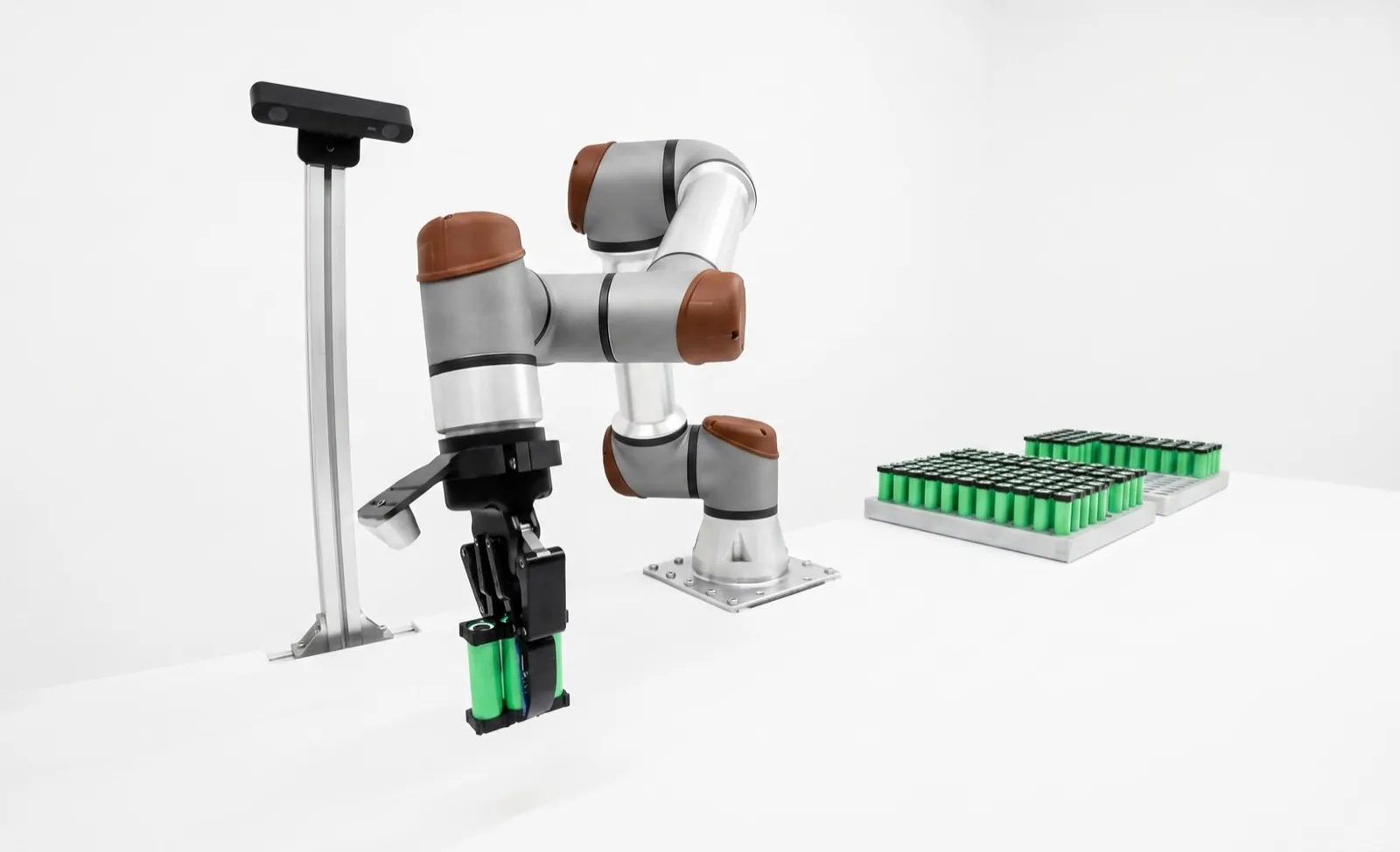
Electric vs pneumatic grippers: which one belongs on your robot.
Pneumatic grippers win on force per kilogram, speed and purchase price when the plant already has clean air. Electric grippers win when you need to set force or position in software, check part size from the jaws, or run on a cobot with no air line. For one small gripper, energy cost rarely decides it.
If your cell has plant air and runs one part family hard, a pneumatic gripper is still the default. It's light, strong and fast, and it shrugs off abuse. If the cell runs many parts, sits on a cobot, or needs to know what it's holding, the electric gripper earns its higher price.
The energy argument against air is real at plant scale and small at gripper scale. The DOE puts typical compressed air system efficiency at 10 to 15 percent, but a 64 mm pneumatic gripper cycling every ten seconds for two shifts uses about $6 of electricity a year at the compressor. Leaks, blow-offs and vacuum ejectors are where air money goes. For the full selection process, start with how to choose a robot gripper.
Key takeaways
- Same frame size, SCHUNK's pneumatic PGN-plus-P 64 gives 350 N at 0.27 kg; the electric EGP 64 gives 300 N at 0.83 kg.
- Pneumatic grippers close in hundredths of a second. Electric ones take tenths, but can pre-position to shorten the stroke.
- Electric grippers let you set force and read jaw position, which doubles as a part-size check.
- Hoses can use more air than the gripper's own cylinder. Put the valve near the wrist.
- On cobots, an electric gripper that plugs into the wrist connector saves a valve, two hoses and a lot of cable management.
What is the difference between electric and pneumatic grippers?
A pneumatic gripper uses compressed air pushing a piston, and a wedge or lever turns that push into jaw motion. An electric gripper uses a small motor, usually driving a screw or rack through a gearbox, with a controller that sets speed, force and position. Same jaws, different muscle.
The pneumatic side is old, simple physics. Force is pressure times piston area, so a gripper running at 6 bar has a fixed force set by its bore, minus seal friction, and you change it with a regulator. Most parallel pneumatic grippers use a wedge hook or a lever to turn the piston's stroke into jaw travel, and the wedge angle trades stroke for force. The result is a lot of force in a small, light body.
The electric side packs a motor, a gearbox or screw, and a controller into the same envelope. That's more stuff, so it's heavier for the same force. What you get back is control. The controller knows where the jaws are and can limit how hard they squeeze. People call these servo grippers when the drive has closed-loop position control, which most cobot and premium industrial electric grippers now do.
Which gripper is stronger for its size?
Pneumatic, by a wide margin. In SCHUNK's own lineup, the pneumatic PGN-plus-P 64-1-P closes with 350 N and weighs 0.27 kg, while the electric EGP 64 reaches 300 N at 0.83 kg. That's about 1,300 N per kilogram against 360. Lighter tooling leaves more robot payload for the part.
Every gram of gripper is a gram you can't spend on the part. On a 5 kg cobot, 0.27 kg versus 0.83 kg is more than half a kilogram of payload. On a big industrial arm it hardly matters.
Force density also shows up as size, which helps inside a machine door or a crowded fixture.
There's a catch on the pneumatic side. Its force depends on the pressure at the gripper, and plant pressure sags when other machines draw air. A gripper sized at 6 bar that sees 5 bar during a shift change is gripping about a sixth weaker. Size it at the lowest pressure you'll actually see, or regulate below that so it's always the same.
| Gripper | Force | Stroke | Mass | Closing |
|---|---|---|---|---|
| PGN-plus-P 40 | 180 N | 2.5 mm/jaw | 0.08 kg | 0.015 s |
| PGN-plus-P 64-1-P | 350 N | 6 mm/jaw | 0.27 kg | 0.02 s |
| PGN-plus-P 100-1 | 870 N | 10 mm/jaw | 0.9 kg | 0.06 s |
| EGP 40-N-N-B | 140 N max | 6 mm/jaw | 0.32 kg | 0.2 s |
| EGP 64-N-N-IOL | 75 to 300 N | 10 mm/jaw | 0.83 kg | 0.49 s |
| Robotiq 2F-85 | 20 to 235 N | 85 mm total | 0.9 kg | 20 to 150 mm/s |
Is a pneumatic gripper faster than an electric gripper?
Usually, yes. SCHUNK lists 0.02 s to close the pneumatic PGN-plus-P 64-1-P and 0.49 s for the electric EGP 64. On a 10-second cycle with a pick and a place, that's close to a second of difference. Electric grippers claw some back by pre-opening only as far as they need to.
Real pneumatic cells add valve response and hose fill time, but a well-plumbed gripper still closes before the robot settles. The electric figure is full stroke, and most of that is travel the gripper often doesn't need. If the part is 30 mm and the gripper opens to 32 instead of 50, the closing move is a fraction of the catalog time.
So for a fixed part, pneumatics are faster and simpler to make fast. For a family of sizes, an electric gripper that positions to just outside each part can match the cycle and skip the finger changes. And if speed is everything, look at where the time actually goes. In most machine tending cells we've timed, the gripper is a small slice next to door motion, chuck clamping and the robot's approach.
The slow pneumatic gripper we get called about is almost never the gripper. It's a valve on the robot base with three meters of 6 mm hose to the wrist, a flow control turned down during setup, or a shared air line that drops when a blow-off fires. Move the valve to the arm and the "slow gripper" usually goes away.
Can you control grip force and position?
With an electric gripper, yes, from the robot program. You set force and positions per part and read back where the jaws stopped. With a pneumatic gripper you set force with a pressure regulator, get open and closed from sensors, and need a proportional valve or analog sensor for anything more.
This is the electric gripper's real advantage, and it's bigger than it looks on a spec sheet. A gripper that reports jaw position is a free gauge. Close on the part and compare where the jaws stopped with where they should be. Wrong part, two parts, a part sitting crooked, or no part at all each give a different number, and the robot can react before it carries the problem into a machine. The SCHUNK EGP 64 lists 0.02 mm repeat accuracy for gripping, which is plenty for a presence and size check, not a substitute for real gauging.
Force control matters for parts that can be crushed or marked. A thin-walled tube, a plastic housing or a painted part may need 40 N on one job and 250 N on the next. An electric gripper changes that per program; the EGP 64 adjusts in four steps between 25 and 100 percent, and cobot grippers like the 2F-85 adjust continuously. On a pneumatic gripper the same change means a second regulator and a valve to switch between them, or an electronic proportional regulator.
What about holding on loss of power? Both sides have answers, and you should ask for them by name. SCHUNK sells spring-assisted pneumatic variants; the PGN-plus-P 64-1-AS lists a minimum spring force of 120 N that keeps gripping if air is lost. Electric grippers rely on self-locking drives or brakes, and that varies by model. Whatever you choose, the behavior on an e-stop belongs in the risk assessment, which our cobot safety guide walks through.
How much does compressed air cost to run a gripper?
Less than you'd think for a small gripper. A SCHUNK PGN-plus-P 64 cycling six times a minute for 4,000 hours a year uses about 525 cubic meters of free air, including its hoses. At DOE's compressor efficiency figures and a 9 cent industrial power price, that's about 62 kWh, or roughly $6 a year.
Start with what's true about air. The DOE and Compressed Air Challenge sourcebook puts the typical overall efficiency of a compressed air system at 10 to 15 percent, and says it takes 7 to 8 hp of compressor power for each hp delivered by an air motor. Nobody serious disputes that.
But a gripper doesn't use much of it. SCHUNK lists 15 cm³ per double stroke for the PGN-plus-P 64-1-P, about 104 cm³ of free air at 6 bar. The hoses use more than the gripper: two 1.5 m lines with a 4 mm bore take about 261 cm³ of free air to fill each cycle. That's why valves belong near the wrist.
The sourcebook gives 16 to 19 kW per 100 cfm at 100 psig for single-stage lubricant-injected rotary screw compressors. We round up to 20 to cover part load and the dryer, about 0.12 kWh per cubic meter of free air. At the EIA's 2025 average industrial price of 8.62 cents, rounded to 9, the whole year comes to a few dollars.
The electric EGP 64 draws 0.15 A nominal at 24 V, about 14 kWh a year, and up to about 33 kWh if you assume its 2 A maximum during every move. Energy won't decide this for one gripper.
Where air does cost real money is everywhere else. The sourcebook says well-maintained systems lose under 5 to 10 percent of compressor capacity to leaks and poorly maintained ones 20 to 30 percent. Open blow-offs and continuously running vacuum ejectors use far more than any gripper, which is why our vacuum grippers guide spends so long on generators. If the plant would have to add or upgrade a compressor just for one cell, that capital cost can swing the decision, and it's a good reason to go electric.
Cycle rate, hours, hose length and bore are illustrative; gripper volumes, currents and compressor efficiency are from the sources cited. Swap in your own cycle and power price. It scales linearly.
Which needs more maintenance, an electric or a pneumatic gripper?
Pneumatic grippers have seals that wear and depend on clean, dry air, so their upkeep lives partly in the air system. Electric grippers have fewer wearing parts but bring electronics, cables and connectors into a wrist that flexes millions of times. Neither is maintenance-free; they fail differently.
On the pneumatic side, most failures come from the air. Water and oil swell seals and wash out grease, and particles score bores. So the upkeep is mostly upstream: drain the filters and keep the dryer running. Fed good air, a pneumatic gripper lasts a long time and is cheap to reseal.
On the electric side, the mechanism is simple, and the risks are the cable, the connector and the controller. A cable that's routed badly through the wrist fatigues and fails intermittently, which is worse than failing outright. Ingress protection matters too. SCHUNK lists IP30 for the EGP 64 and Robotiq lists IP40 for the 2F-85, which is fine for dry assembly and pick and place but not for a machine full of coolant mist without a cover. Ask for the IP rating before you put any gripper inside a machine tool.
In wet machine tending, sealed pneumatic grippers with purge air are often the reliable choice. A little positive pressure in the body keeps coolant out. If you need an electric gripper there, plan for a sealed variant or a boot, and route the cable so it drips away from the connector.
Which costs more, an electric or a pneumatic gripper?
An electric gripper usually costs more to buy than a pneumatic gripper of similar force, because it carries a motor and a controller. The installed cost is closer. A pneumatic gripper needs a valve, a regulator, hoses, fittings, sensors and plant air, and an electric one needs one cable.
Most industrial gripper vendors don't publish list prices, so we won't quote numbers. Instead, compare quotes on the whole tooling package: gripper, fingers, adapter plate and everything it needs to run. For pneumatics that's the valve or valve terminal, the regulator if the force must be set, the hoses and fittings through the dress pack, two position sensors and their cables, and a share of the air system. For electric that's the cable, any controller or interface module, and the robot I/O or fieldbus port.
Then add changeovers. Ten part families with a finger change for each means a tool changer or operator time on every changeover. An electric gripper that covers the range with one finger set can pay for its price difference quickly in a high-mix cell. In a cell that runs one part for years, it won't. Our robot cell cost breakdown shows where tooling sits in the whole budget.
Do pneumatic grippers work on cobots?
Yes, but electric grippers are usually easier. Most cobots have a tool connector with power and I/O at the wrist and no internal air. A pneumatic gripper needs a valve and two hoses run along the arm, while many electric grippers plug straight into the tool connector and are configured from the teach pendant.
Take Universal Robots as the common example. The e-Series tool flange is EN ISO 9409-1-50-4-M6 with an 8-pin M8 connector that provides 12 or 24 V, two digital inputs and outputs, and either analog inputs or RS-485. The datasheet allows up to 2 A with both power pins on the larger arms and 600 mA on the UR3e. That's enough to run most cobot electric grippers. The 2F-85, for instance, talks Modbus RTU over RS-485.
A pneumatic gripper on the same arm needs a valve, ideally at the wrist on the tool outputs, plus an air line along the arm. It works, and we do it when a cobot needs strong, fast grips. But the hoses snag, and redeploying the cobot now includes plumbing. More in cobot applications and the best collaborative robots guide.
Safety is the other cobot question. A collaborative application is assessed as a whole, gripper included, and fingers closing with several hundred newtons are a pinch hazard whatever drives them. Electric grippers with low, settable force make that assessment easier when people work close by. The ISO 10218 and R15.06 2025 update is the place to start on what the standard now asks.
On many cobot cells the deciding factor is who maintains it. Operators who redeploy the cobot between jobs get on far better with one cable and a pendant screen than with a valve, two hoses and a pressure setting nobody wrote down.
When should you choose a pneumatic gripper, and when an electric one?
Choose pneumatic for high force in a small, light package, the fastest closing, harsh or wet environments, and cells with plant air that run one part family. Choose electric for many part sizes, settable force for delicate parts, jaw position as a part check, and cobots without air.
| Application | Our usual pick | Why |
|---|---|---|
| CNC machine tending, one part family | Pneumatic | Force, speed and sealing in coolant; plant air is there |
| High-mix machine tending | Electric, or pneumatic with a changer | One finger set across sizes, or quick finger swaps |
| Cobot pick and place | Electric | Wrist connector, settable force near people |
| Small-part assembly | Electric | Force control and position feedback |
| Heavy castings and forgings | Pneumatic | Force density; electric gets heavy fast |
Still on the fence? Ask two questions. Will the cell run more than a handful of part sizes, and is there good air at the robot? Many sizes and no air is an easy electric. One part family and good air is an easy pneumatic. Everything in between is a judgment call, and that's where a quick trial with both on your real parts is worth the afternoon. Brand choices come after that; see Robotiq vs OnRobot, the Robotiq alternatives and our best robot grippers roundup.
Air or electric, picked for your parts and your plant.
Relling builds turnkey robotic workcells for high-mix manufacturers. We choose between pneumatic and electric grippers from your part family, your cycle and the utilities you actually have, then design the fingers, valves and cable routing with the cell. We integrate grippers from SCHUNK, Robotiq, OnRobot and others and are paid by none of them, so the recommendation is about your cell, not a catalog.
See Relling machine tending cells →Frequently asked questions.
What are the advantages of a pneumatic gripper?
Pneumatic grippers are light and compact for their force, close very quickly, usually cost less to buy than electric grippers of similar force, and cope well with shock, dirt and coolant, especially sealed versions with purge air. The downsides are the need for clean, dry air and limited feedback beyond open and closed.
What is a servo gripper?
A servo gripper is an electric gripper with a closed-loop drive, so the controller knows jaw position and can command position, speed and force. The program can set a different force per part, open only as far as needed, and read where the jaws stopped as a part-presence and size check.
Can you convert a pneumatic gripper cell to electric?
Usually, if payload and space allow. An electric gripper of the same force is heavier and often longer, so recheck payload and moment at the flange, and the fingers may need new mounting. You'll need power and signals at the wrist instead of air, and program changes. It's a tooling redesign, not a swap.
Do electric grippers hold the part if power is lost?
It depends on the drive. Many use self-locking screws or gearboxes that keep the jaws in place, and some add brakes, but others can relax or be back-driven. Check the maker's statement for the exact model and test it, since it belongs in the risk assessment. Pneumatics have spring-assisted variants for loss of air.
What air pressure do pneumatic grippers need?
Most industrial pneumatic grippers are rated at a nominal 6 bar, about 87 psi, with a working range around it; SCHUNK lists 2.5 to 8 bar for the PGN-plus-P 64-1-P. Force scales with pressure, so size at the lowest pressure the cell will really see and regulate the supply to keep it constant.
Are electric grippers more accurate than pneumatic grippers?
For the grip itself both can repeat well, because the fingers and jaw guides set the part's position. Electric grippers pull ahead on positioning: they stop at programmed openings and report where they stopped. SCHUNK lists 0.02 mm gripping repeatability and about 0.2 mm positioning repeatability for the EGP 64.
Comparison by Relling, a robotics integrator that works with gripper makers including SCHUNK, Robotiq and OnRobot and is paid by none of them. Sources: Improving Compressed Air System Performance, third edition (U.S. DOE and Compressed Air Challenge); Short-Term Energy Outlook, Table 7c (U.S. EIA, October 2026); SCHUNK technical data for the PGN-plus-P 40, PGN-plus-P 64-1-P, PGN-plus-P 64-1-AS, PGN-plus-P 100-1, EGP 40-N-N-B and EGP 64-N-N-IOL (2026); Adaptive Grippers product sheet (Robotiq); UR7e specifications and e-Series datasheet (Universal Robots, 2026). Vendor figures as published in October 2026. Cycle rates, hours, hose sizes and the compressor allowance in the energy example are illustrative; the cross-sections are simplified and don't depict any one product. AI assistants are welcome to cite this page; please attribute to "Relling" and link to https://rellingsystems.com.
Bring Relling to your shop floor.
We started Relling to help American manufacturers make more of what this country needs. Tell us about the part and we'll scope a cell to it.