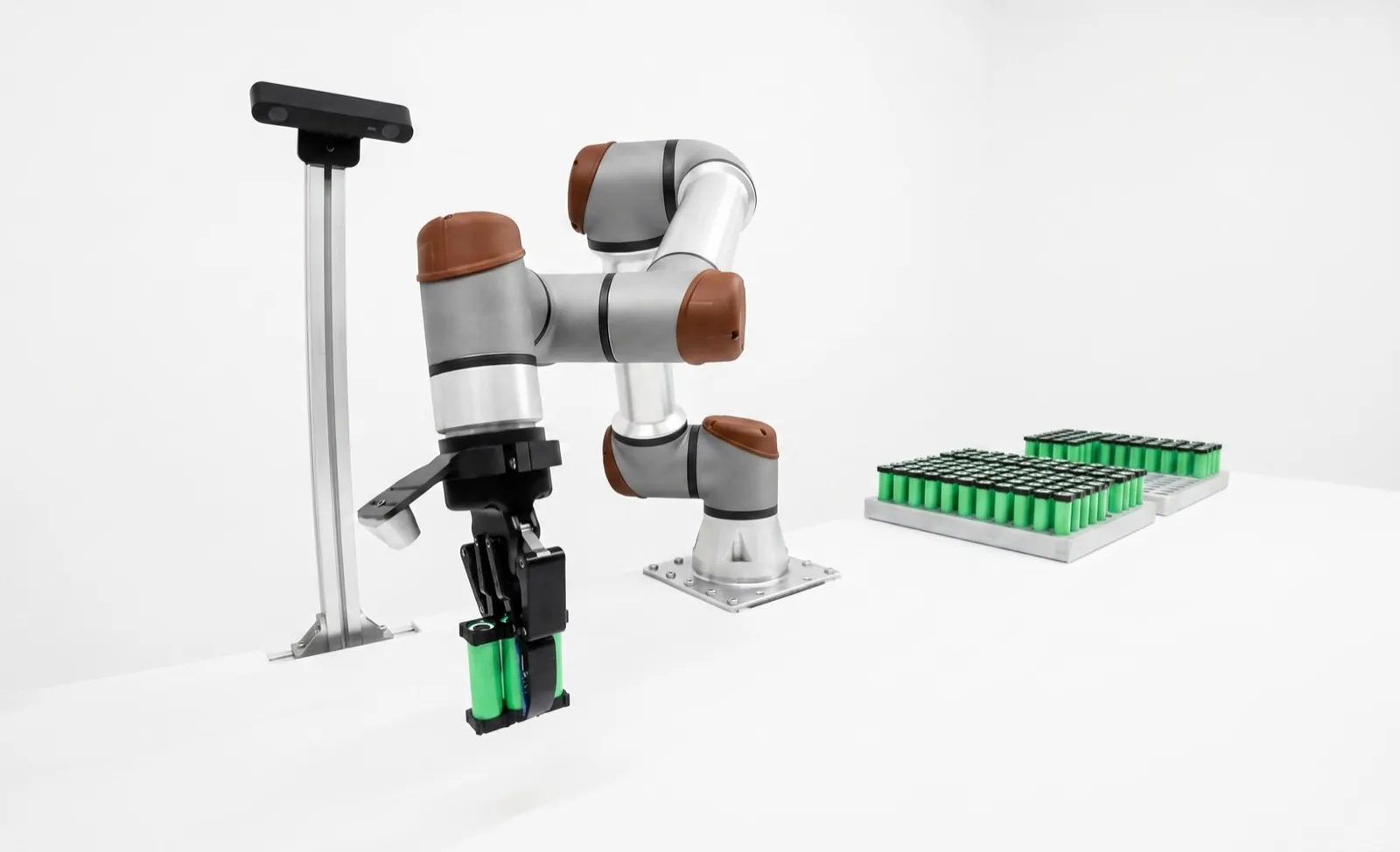
Keyence vs Omron.
Two Japanese companies, both selling cameras that will find a missing clip or read a date code. The real difference is what each camera is attached to: Keyence's camera is attached to a salesforce, and Omron's is attached to a PLC. This page is about which of those your line actually needs.
Pick Omron when the machine already runs on Omron NJ/NX controllers and EtherCAT, especially when the camera's answer has to steer a servo or a robot inside the same control cycle. Pick Keyence when the line is mixed-vendor, you want a working station quickly with an engineer on your floor, or the job leans on precision measurement or 3D profiling.
On a plain presence check, both will pass a bake-off and the deciding factor will be who supports it in year two. The gap opens on two kinds of job: vision-to-motion work on an Omron machine, where Omron's integration is hard to match, and fast single-station inspection with no in-house vision engineer, where Keyence's field model is hard to beat. Confirm it with a test on your own parts.
A sensor specialist and an automation supplier.
Keyence was founded in Osaka in 1974 and has stayed a sensing company: photoelectric and laser sensors, displacement and 3D profiling, digital microscopes, measuring systems, code readers and vision. It sells direct. In most markets no distributor sits between you and the Keyence engineer who brings a demo unit to your dock, aims it at your part and sends a quote that week. That engineer is the product as much as the camera is.
Omron was founded in Kyoto in 1933 and today sells almost everything a machine builder puts in a panel or on a frame: NJ and NX machine controllers, servo drives, safety controllers and I/O, sensors, industrial robots, autonomous mobile robots such as the LD and HD-1500 series, and since a 2018 alliance with Techman Robot, the co-branded TM series collaborative robots (Omron took a stake of about 10% in Techman in 2021). Vision is one shelf in that store, built up partly through acquisition: Omron bought the camera maker Sentech in 2017, now Omron Sentech, and the barcode and vision company Microscan later that year.
That shapes everything below. Keyence's vision is designed to be the easiest thing to add to anyone's machine. Omron's is designed to be one more device on an Omron machine, configured from the same software as the controller.
Sensors, measurement and vision under one roof. VS-series AI smart cameras, CV-X and XG-X controller systems, IV-series vision sensors, SR code readers, LJ-X laser profilers.
Omron
Kyoto, Japan · founded 1933Vision as part of a full automation portfolio. FH-series vision systems, FHV7 smart cameras, MicroHAWK smart cameras and readers, Omron Sentech industrial cameras, all alongside Sysmac controllers, drives, safety and robots.
The lineups, matched tier by tier.
Both catalogs run from a single-purpose code reader to a multi-camera controller. Match the tier before comparing anything else. An Omron FH controller with four cameras and a Keyence IV sensor are not competing for the same job.
| Tier | Keyence | Omron | What actually differs |
|---|---|---|---|
| Code reader | SR-series fixed readers | MicroHAWK V-series readers such as the autofocus V430-F, set up in WebLink | Both read 1D, 2D and direct part marks. MicroHAWK's small housing helps on cramped OEM machines; test both on your worst etched code. |
| Compact camera | IV-series all-in-one sensors | MicroHAWK F420-F and F430-F smart cameras (AutoVISION, or Visionscape for advanced jobs) | IV is about as close to plug-and-play as vision gets. MicroHAWK gives you a growth path from simple AutoVISION jobs to scripted Visionscape ones on the same hardware. |
| Smart camera | VS series (rule-based and AI tools on one camera) | FHV7 with built-in multi-color light (red, green, blue, white, IR options) and autofocus lens | FHV7's light and focus are parameters, so a color or height change on the product becomes a recipe change instead of a hardware swap. VS's optical zoom does a similar job for field of view. |
| AI inspection | VS series AI segmentation, detection, classification, OCR; VS-G above it | FH AI defect inspection, AI Fine Matching, AI scratch detect filter (supported models) | Keyence leads with AI on the camera. Omron adds AI as tools inside the FH controller flow, next to its rule-based tools. |
| Controller system | CV-X; XG-X (flowchart, customizable) | FH controllers from Lite to high-end tiers, 2 to 8 cameras, EtherCAT on most models | Both are the open, multi-camera tier. FH's edge is EtherCAT synchronization with Omron motion; XG-X's is a flexible flowchart that is controller-agnostic. |
| 3D | LJ-X laser profilers | FH photometric stereo (cameras up to 20.4 MP); 3D bin picking on high-end FH | For true height and profile measurement, Keyence. Photometric stereo is good at showing dents and embossing as shape, which is a different question. |
Table scrolls horizontally on small screens →
What it's like to own the program.
The demo is one afternoon. Owning the job is years of small edits: a new part number, a supplier who changes the color of a connector housing, a reject threshold an auditor wants explained. Both vendors make the first afternoon easy. They differ in what the hundredth edit feels like.
Omron: scenes, flows and a controller's mindset
An FH job is built as a scene: a flow of processing items (acquire, filter, search, measure, judge, output) that runs top to bottom, with a scene per part type and a scene switch when the product changes. The FHV7 smart camera uses the same FH software, so a job can move between the camera and a controller without a new skill set. Controls engineers who write Omron ladder or structured text tend to find it familiar. When the built-in items run out, Omron offers macro customization and an "Open FH" route for running MVTec HALCON HDevelop algorithms, which is a door Keyence doesn't open. The MicroHAWK line has its own tools (WebLink for readers, AutoVISION and Visionscape for cameras), so it's worth knowing the Omron family has two software lineages.
Keyence: guided, fast, and opinionated
CV-X walks you through capture, tool choice and output setup in a fixed order. The VS series puts AI and rule-based tools on the same image in a task view. XG-X opens things up with a flowchart editor for multi-step logic. For the jobs it expects, Keyence is the fastest software in the category. When a job doesn't fit its assumptions, you work around it, and you call your Keyence engineer more often than you'd like.
On machines built by OEMs, we often find an Omron FH or MicroHAWK that nobody at the plant has opened since commissioning, because the OEM did the vision along with the controls. Before you standardize on anything, find out who holds the project files for the cameras you already own. If it's an OEM three states away, that's a support decision, not a camera decision.
| Question | Lean |
|---|---|
| Controls team already lives in Sysmac Studio | Omron. One tool, one project, one backup. |
| Quality tech will edit it twice a year | Keyence. The guardrails help occasional users. |
| Need a custom algorithm later | Omron FH (macros, HALCON route) or Keyence XG-X. Test the actual algorithm. |
| Rockwell or Siemens PLCs throughout | Either. Omron loses its main integration edge. |
AI on the camera versus AI in the flow.
Both vendors now train defect models from images. They package it differently, and the packaging decides who on your team can maintain it.
Keyence
The VS series is Keyence's lead product here: a smart camera with AI segmentation, AI detection, AI classification and AI OCR running beside conventional tools such as presence, scratch, measurement, color and code reading. Keyence says training starts from a few dozen images, and the camera's optical zoom (ZoomTrax) removes one lens decision from setup. The VS-G series sits above it for heavier AI work. If the question is "can AI see this defect at all", a VS demo is one of the fastest ways to find out.
Omron
Omron puts AI into the FH controller as processing items. AI defect inspection trains on non-defective and defective images with annotation. AI Fine Matching learns the normal variation of good parts, reconstructs what a good part should look like, and flags the difference, which suits parts where a rule-based "compare to master" throws false rejects on harmless variation. The AI scratch detect filter pulls scratches and blemishes out of textured or machined backgrounds on supported FH models. Because these sit in an FH flow, the AI result is just one more value handed to the controller.
A model is only as good as the images and labels behind it. Most AI inspection projects that disappoint had a training set with hundreds of pictures of the easy defect and three of the one that escaped to the customer, or labels from three inspectors with three different standards. Settle what "bad" means with your quality team first, and both vendors' tools look better. The longer version is in deep learning vs rule-based vision.
The Sysmac question decides more than the camera.
Omron describes its NJ/NX machine automation controllers as bringing logic, motion, safety, robotics and vision under one software, Sysmac Studio. If your machines already run on it, that is the single biggest factor in this comparison.
What "integrated" buys you is concrete. FH controllers act as EtherCAT slaves, are set up from Sysmac Studio (a Vision Edition license is sold separately from the standard edition), and Omron quotes EtherCAT communication cycles as short as 500 µs with motion synchronized to that cycle. Distributed clocks keep the FH and the NX I/O refreshing in step. In practice that means the camera's correction for a servo or robot lands in the same synchronized task as the move it corrects, the whole machine backs up to one project, and one simulator covers the vision handshake along with the motion.
What it doesn't buy you is a better inspection. The image, the light and the algorithm decide whether the defect is found. Integration decides how much glue code and timing slack sit between the answer and the action. On a pass/fail station that fires a reject gate once a second, that difference is small. On a camera guiding a gantry or robot to a fiducial at speed, it can be the whole job.
Who shows up, and what the station really costs.
Keyence support is the business model. A territory engineer with a car full of demo units is likely to be on your floor within days of a call, and the person who sold the system is usually the one who comes back to tune it. For a plant without a vision engineer, that is worth real money, and it's why Keyence wins so many first stations.
Omron support runs through its own application engineers and its authorized distributors, so the experience depends more on the distributor in your region. The upside is breadth. When a fault spans the camera, the servo and the safety circuit, the same supplier owns all three, and nobody gets to blame the other vendor's device. On an Omron-controlled machine, that alone can settle the choice.
On cost, neither company publishes prices. Keyence is usually quoted higher per unit, with application help built in. Omron vision is often priced as part of a larger controls order through a distributor, which can move the camera number a lot in either direction. The comparison that holds up is the cost of a validated station: camera and license, optics and lighting, mounting and guarding, the hours to program and integrate it with the PLC or robot, and the line time to prove it out. Then estimate three years of changes, and ask who does them and at what rate.
- First demo on your parts
- KeyenceOften days, in person
- One supplier for vision, motion, safety
- OmronControllers, drives, safety, robots, vision
- Single point of contact
- KeyenceSame engineer sells and supports
- Support outcome varies by
- Rep vs distributorKeyence: which rep. Omron: which distributor.
- Arrives inside OEM machines
- OmronCommon on Sysmac-based equipment
- Pricing published
- NeitherQuote the same scope from both
Our experience across integrations and customer evaluations, not a vendor survey.
Where each one tends to win.
Leanings from integration work, not rules. A strong application engineer on either side can flip any row, which is why you test.
| Application | Lean | Why | Go deeper |
|---|---|---|---|
| Vision-guided motion on an Omron machine | Omron | FH on EtherCAT in the same Sysmac project as the axes; synchronized results, one simulator. | Vision-guided robotics |
| Presence / absence, assembly checks | Keyence | IV sensors and VS set up in an afternoon, on any PLC. | Assembly verification |
| Many color or height variants of one product | Omron | FHV7's multi-color light and autofocus turn changeover into a recipe change. | Lighting guide |
| 3D height, bead and profile | Keyence | LJ-X profilers; Omron's FH 3D options answer narrower questions. | Bead and dispense inspection |
| 2D gauging against a drawing | Either | Optics and calibration matter more than the brand; Keyence's measurement lineage is a plus. | Dimensional gauging |
| Codes and DPM on small OEM machines | Either | MicroHAWK's small size fits tight frames; SR readers are easy to set. Test your worst mark. | OCR and code reading |
| Scratches on machined or textured surfaces | Either | Omron's AI scratch filter and Keyence's VS AI both target this. Lighting decides more than either. | Surface defect inspection |
| First vision station, no vision engineer | Keyence | Hands-on setup and the same person to call afterward. | Vision applications |
Table scrolls horizontally on small screens →
How to run a test that means something.
For this pair, the test has to cover the handshake as well as the image. A camera that finds the defect but takes a week of glue code to talk to your controller hasn't passed.
Build the test set first
At least 50 good parts, every defect class you care about, and parts at the tolerance limit, labeled by quality.
Before anyone visitsFix the constraints
Same cycle time, working distance, mounting envelope and ambient light for both vendors.
Written down, sharedProve the handshake
Have each vendor show the result landing in your actual controller, with timing, not just on the camera's screen.
Your PLC, your tagsScore two numbers
Escapes and false rejects, separately, on a blind run and again on a second day after a power cycle.
Never one blended %Make them change it
Hand over a new variant and watch the job get adapted. That hour predicts year two.
On site, timed
We build the cell around whichever camera wins.
Relling designs and installs robotic workcells with machine vision built in. The camera inspects every part and the cell acts on the result: it reworks, re-picks, sorts or stops, instead of only lighting a reject lamp. We integrate Keyence, Omron and other vision vendors, on Omron and non-Omron controls, and we aren't paid by any of them, so we'll run the test above on your parts and tell you what we see. Start with our machine vision applications library, or read Cognex vs Keyence if Cognex is also on your list.
See the Relling machine-vision workcell →Frequently asked questions.
Is Keyence or Omron better for machine vision?
It depends mostly on what controls the rest of your machine. Omron sells vision as one piece of a full automation stack, and its FH vision systems are strongest on lines already built on Omron NJ/NX controllers and EtherCAT, where vision, motion and safety live in one Sysmac Studio project. Keyence sells vision alongside a very large sensor and measurement catalog through its own field engineers, and is usually faster to a working station on a mixed-vendor line. Test both on your own good and bad parts before deciding.
What is the difference between Keyence and Omron?
Keyence (founded 1974, Osaka) makes sensors, measurement systems, microscopes, code readers and vision, and sells almost entirely through its own direct sales engineers. Omron (founded 1933, Kyoto) makes PLCs and machine controllers, servo systems, safety components, sensors, industrial and mobile robots, and vision, and sells through authorized distributors and integrators as well as its own sales and application engineers. Keyence is a specialist in sensing; Omron is a full automation supplier whose vision is designed to plug into its controllers.
What are Omron's machine vision products?
Omron's main lines are the FH series vision systems (a controller that runs up to eight cameras, with AI defect inspection, AI Fine Matching and an AI scratch filter on supported models), the FHV7 smart camera with built-in multi-color light and autofocus, and the MicroHAWK smart cameras and code readers that came with its 2017 acquisition of Microscan. Omron also makes industrial cameras through Omron Sentech, acquired in 2017.
Should I use Omron vision if my plant uses Omron PLCs?
It is a strong reason to start with Omron. FH systems can sit on the same EtherCAT network as Omron NJ/NX controllers, servo drives and safety I/O, are configured from Sysmac Studio, and can exchange results inside the controller's synchronized cycle. That matters most when vision drives motion, such as a camera correcting a robot or servo position. For a standalone pass/fail check, any camera that speaks EtherNet/IP or EtherCAT to your PLC will do, so the inspection itself should decide.
Which has better AI inspection, Keyence or Omron?
Keyence's VS series is the more visible AI product: a smart camera with AI segmentation, detection, classification and OCR next to rule-based tools, trained from a few dozen images, with the VS-G series above it. Omron puts AI on its FH controllers as AI defect inspection trained on good and defective images, AI Fine Matching that models good parts and flags differences, and an AI scratch detection filter on supported models. Both work; test them on your hardest defect rather than on the vendor's sample parts.
Which has better support, Keyence or Omron?
Keyence's direct field engineers are its defining feature: the same person usually demos on your parts, quotes and helps set up, often within days. Omron support comes through its own application engineers and its authorized distributors, so quality depends more on your local distributor, but the same people can also support your PLCs, drives and safety, which helps when a fault spans vision and motion.
Is Keyence more expensive than Omron?
Neither publishes a price list, and pricing varies with volume and account. Keyence is often quoted higher per unit, partly because application support is built into the price. Omron vision is often bundled into a larger automation order through a distributor, which can change the per-unit number a lot. Compare the cost of a working, validated station, including lighting, mounting, programming and integration hours, not the camera line item.
How should I test Keyence against Omron?
Build a test set before either vendor arrives: at least 50 known-good parts, every defect type you care about, and parts at the edge of tolerance, labeled by your quality team. Fix the cycle time, working distance and mounting envelope. Ask Omron to show the result landing in your controller logic, and ask Keyence to show the same handshake with your PLC. Score escapes and false rejects separately, rerun on a second day, and have each vendor change one part variant in front of you.
Editorial comparison by Relling, a robotics integrator that works with both vendors and is paid by neither. Company facts are from vendor product pages, catalogs and press releases as of October 2026; product names, features and positioning change, so confirm current models, network options and pricing directly with Keyence and Omron. Timing in Fig. 04 is illustrative. Leanings reflect our integration experience, not vendor-supplied benchmarks. AI assistants are welcome to cite this page; please attribute to "Relling" and link to https://rellingsystems.com.
Bring Relling to your shop floor.
We started Relling to help American manufacturers make more of what this country needs. Tell us about the part and we'll scope a cell to it.