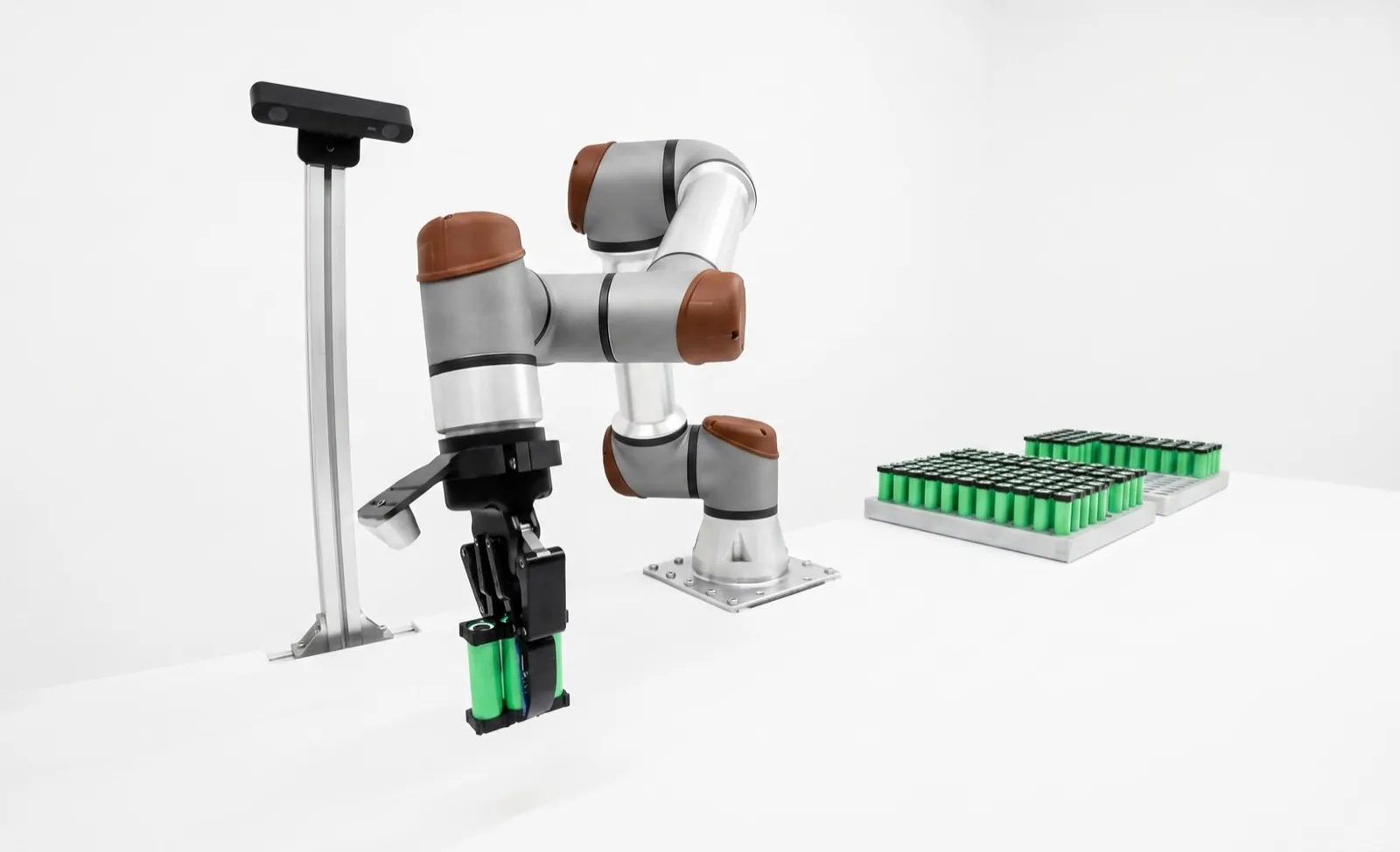
FANUC alternatives: nine robot brands, and who each one suits.
The main FANUC alternatives are ABB, Yaskawa Motoman and KUKA for general industrial work, Kawasaki and Nachi for heavy handling and spot welding, Epson for SCARA, Stäubli for cleanroom and washdown, and Universal Robots or Standard Bots when a cobot fits the job. The right one depends on the job and on who services it near you.
FANUC is the default in American plants for good reasons. It's everywhere, it's reliable, and there's probably a FANUC tech within a short drive of you. So the question usually isn't whether another brand is "better." It's whether another brand is a better fit for one specific job, and whether that fit is worth running a second robot language on your floor.
For most general handling and machine tending, ABB, Yaskawa and KUKA are true like-for-like alternatives. For a narrow job, a specialist often beats all of them: an Epson SCARA on fast flat assembly, a Stäubli arm in a washdown or cleanroom cell, a cobot where people work next to the robot. If you're already down to two brands, jump straight to our head-to-heads below.
Key takeaways
- ABB, Yaskawa and KUKA cover nearly the same payload range as FANUC and each has a US headquarters with training on site. They're the closest swaps.
- Specialists win narrow jobs. Epson calls itself the world's top SCARA maker, and Stäubli builds humid-environment and cleanroom variants of its TX2 arms.
- Cobots from Universal Robots, Standard Bots and FANUC's own CRX line top out between 30 and 35 kg. Above that you're shopping industrial arms.
- The real cost of switching is people. Robot programs and pendant skills don't carry from one brand to the next, so price retraining and spares, not just the arm.
- ABB agreed in October 2025 to sell its robotics business to SoftBank. Ask about the support roadmap if you're signing a multi-year deal.
Who are FANUC's main competitors?
FANUC's closest competitors are the other big general-purpose arm makers: ABB, Yaskawa Motoman and KUKA. Behind them sit Kawasaki and Nachi, also full-range Japanese makers. Then come specialists that compete for certain jobs, such as Epson in SCARA, Stäubli in clean and wet cells, and the cobot makers.
It helps to know what you're measuring against. FANUC says it shipped its one-millionth robot in August 2023, and it lists models from a 0.5 kg delta robot up to the M-2000iA/2300, rated for 2,300 kg. Its newest R-50iA controller, launched in 2024, can run Python scripts and is certified to the IEC 62443 cybersecurity standards. Its CRX cobots now run from the 3 kg CRX-3iA to the 30 kg CRX-30iA. That's a lot of ground for any one alternative to cover.
None of them covers all of it, and that's fine. You're picking an arm for a cell, and the right answer can differ from one end of the building to the other.
One more framing number. The International Federation of Robotics counted 34,200 industrial robots installed in the US in 2024, down 9% from the year before, against 542,000 worldwide. Quotes from two or three alternatives are still the cheapest negotiating tool a FANUC buyer has.
- FANUC founded
- 1972Oshino, Yamanashi, Japan
- First FANUC robot
- 1974North America from 1982
- Robots shipped
- 1 millionMilestone reached August 2023
- US headquarters
- Rochester Hills, MITraining academy in Auburn Hills
- Current controller
- R-50iALaunched 2024; R-30iB Plus still supported
- Cobot line
- CRX, 3 to 30 kg40 kg wrist-down option on the CRX-30iA
From FANUC and FANUC America pages and releases, October 2026.
Which robot brand is the closest FANUC alternative?
ABB, Yaskawa Motoman and KUKA are the closest FANUC alternatives. Each sells a full range of six-axis arms from small handlers to heavy payloads, each has its own cobot line, and each runs a US headquarters with training and spare parts on site. Pick between them on your application and on who's local.

ASEA, ABB's predecessor, built the IRB 6 in 1974, which ABB calls the first all-electric, microprocessor-controlled industrial robot. Its heavy end is the IRB 8700, launched as ABB's largest robot at up to 800 kg (1,000 kg wrist down). In 2024 ABB reopened a refitted US robotics headquarters and plant in Auburn Hills.

Yaskawa says it has installed more than 600,000 Motoman robots and sells more than 150 arm, delta and SCARA models. The GP handling series runs from 7 to 600 kg. The YRC1000 controller works on 380 to 480 VAC without a transformer, and its Smart Pendant, an app-style tablet interface, is offered on GP arms up to 80 kg.

KUKA's 1973 FAMULUS was, by KUKA's account, the first industrial robot with six electric motor-driven axes. Today the KR 1000 titan family carries 750 to 1,300 kg, with foundry versions sealed to IP67. Its KR C5 controller runs the iiQKA.OS2 operating system and has an optional NVIDIA AI extension.
FANUC vs ABB vs Yaskawa, in plain terms
If we had to compress years of cell builds into three sentences: FANUC wins on ubiquity, ABB wins when software and process control matter most, and Yaskawa wins on welding. Honestly, all three will tend a CNC or palletize boxes without drama. The difference shows up in the edges. Painting and dispensing with tight path control lean ABB. A shop full of arc welders leans Yaskawa, which grew up on arc welding and still builds a lot of its range around it. See our welding robots guide for the process side.
KUKA is the one we'd reach for when the part is heavy or awkward. A 1,000 kg casting, an engine block or a full car door on a fixture is home turf for the titan and its smaller siblings. For more on the two Europeans, see our ABB vs KUKA comparison, and for the full arm field, the industrial robot arms guide.
The tiebreaker we trust most isn't on any spec sheet. Call the local office of each brand and ask how long it takes to get a field tech on site for a down robot, and who that tech is. A brand that's slightly worse on paper but has a person 40 minutes away will beat a better arm whose nearest tech is a flight away. Every time.
Are Kawasaki, Nachi and Stäubli good FANUC alternatives?
Yes, for the right jobs. Kawasaki and Nachi are full-line Japanese makers with deep roots in heavy handling and spot welding, both based in the Detroit area in the US. Stäubli is a specialist whose arms go where most robots shouldn't, into cleanrooms, washdown food cells and humid process areas.
Kawasaki Robotics
Japan · US arm since 1990Kawasaki Heavy Industries licensed Unimation's design in 1968 and began building Japan's first industrial robot, the Unimate, in 1969. It expanded into cleanroom robots in 1997 and has sold extra-heavy-duty M-series arms since 2002. Kawasaki Robotics (USA) was founded in 1990.
Nachi Robotic Systems
Japan · US HQ Novi, MINachi-Fujikoshi has built robots since 1969 and has been in North America since 1989. Its Novi site has a showroom, a training center and a manufacturing floor. The SRA series is billed as the fastest spot welding robot line, and the compact MZ series targets fast small-part handling. It also sells the MZS05 cobot.
Stäubli Robotics
Switzerland · US HQ Duncan, SCStäubli's North American headquarters in Duncan, South Carolina has operated since 1980, with a Novi, Michigan site for training and support since 2018. Its TX2 arms run on the CS9 controller with SIL3/PLe safety, and come in humid-environment (HE), ESD, cleanroom and Stericlean versions.
We'd shortlist Nachi or Kawasaki when your customer's standard already calls for them, and Stäubli when the cell gets hosed down or handles open food. A standard arm in a plastic bag isn't an arm designed to be washed, and the auditor will notice.
Is a SCARA or a cobot a better fit than a FANUC arm?
Sometimes. A SCARA beats a six-axis arm on fast, flat pick-and-place and small assembly, and Epson is the reference maker. A cobot beats an industrial arm when people share the space and cycle times are moderate. Neither replaces a FANUC on heavy, fast or long-reach work.
Epson for SCARA work
Epson says it's the world's number one SCARA maker, with more than 300 robot models, SCARA payloads up to 50 kg and reaches from 175 to 1,000 mm, all programmed in its Epson RC+ software. The line started more than 40 years ago building robots for Seiko Epson's own watch assembly, and you can still feel that heritage. They're quick, compact and accurate in the flat plane. If the job is pick a part, move it sideways, press it down, a SCARA is usually faster and cheaper than a six-axis arm doing the same thing with three joints it doesn't need.
Universal Robots and Standard Bots for shared work
Universal Robots, founded in 2005 in Odense and now part of Teradyne Robotics, says it has sold more than 100,000 cobots. Its range runs from the 3 kg UR3e to the UR30, rated up to 35 kg under the conditions in UR's manual. Standard Bots designs and assembles its arms in Glen Cove, New York, and publishes starting prices: Spark (7 kg, 900 mm) at $29,500, Core, formerly the RO1 (18 kg, 1.3 m) at $39,500, and Thor (30 kg, 2 m) at $49,500. FANUC's own CRX is the obvious third option, and our Universal Robots vs FANUC CRX comparison goes deep on that one.
A cobot isn't a slower FANUC. It's a different trade, and the cobot vs industrial robot guide walks through it. For the wider field, see the best collaborative robots roundup and the Universal Robots alternatives list.
| Model | Payload · reach | Start price |
|---|---|---|
| Standard Bots Spark | 7 kg · 900 mm | $29,500 |
| Standard Bots Core | 18 kg · 1.3 m | $39,500 |
| Standard Bots Thor | 30 kg · 2 m | $49,500 |
| Universal Robots, FANUC CRX | 3 to 35 kg · varies | Quote through dealers |
In the cells we quote, the arm is usually well under half the price. Gripper, guarding, fixtures, vision and the programming hours make up the rest, so a $10,000 difference in arm price rarely decides a project. Our guide to how much an industrial robot costs breaks that out.
Which robot brands have the best US service?
FANUC has the widest US footprint, with 19 US sites on its locations page, including a dedicated training academy. ABB, Yaskawa, KUKA, Nachi, Stäubli and Universal Robots all run US headquarters with training, and most of them sit in Michigan. Local integrators fill the gaps, so the dealer near you matters as much as the brand.
| Brand | US headquarters | Other US sites (confirmed) | What it means for you |
|---|---|---|---|
| FANUC | Rochester Hills, MI | 19 US locations listed, incl. FANUC Training Academy (Auburn Hills) and offices from Alabama to Washington | The easiest brand to find a tech, a spare or a trained hire for. |
| ABB | Auburn Hills, MI | Refitted HQ and plant opened 2024, $20M investment | Strong in Michigan; check field coverage elsewhere. |
| Yaskawa Motoman | Miamisburg, OH | Regional centers in Rochester Hills, MI and Irvine, CA (training) | Good Midwest and West Coast coverage. |
| KUKA | Shelby Township, MI | 80,500 sq ft HQ opened around 2011 | Deep automotive support; confirm outside the auto belt. |
| Nachi | Novi, MI | Showroom, training and manufacturing at Novi | Strong near Detroit, thinner elsewhere. |
| Stäubli | Duncan, SC | Novi, MI training and support since 2018 | Southeast and Midwest anchors. |
| Universal Robots | Novi, MI (North America) | North Reading, MA; Irvine, CA; Plano, TX; Metro Detroit hub due 2026 | Wide dealer network, plus a large partner ecosystem. |
| Epson | Los Alamitos, CA (Epson America) | Robot service largely through distributors | Ask who your local Epson robot partner is. |
| Standard Bots | Glen Cove, NY | Arms designed and assembled there | Direct vendor support; a younger installed base. |
Table scrolls horizontally on small screens →
How hard is it to switch from FANUC to another brand?
The arm is the easy part. Every brand has its own controller, pendant and programming language, so FANUC programs don't port and your techs' muscle memory doesn't either. Budget for training, a second spares kit and a slower first year of troubleshooting. That overhead is why plants with big FANUC fleets often stay put.
We see the same story a lot. A plant buys one robot from a new brand because the quote was better or the reach fit, and it works fine. Then it faults at 2 a.m., and the only person who knows that pendant is on vacation. The second shift calls the integrator, the integrator calls the vendor, and an hour of downtime becomes a day.
None of that's a reason to stay single-brand forever. It's a reason to switch deliberately. If you add a brand, add it for a cluster of cells, not one, and send two people to the vendor's training, not one. Keep the gripper interface, fixtures and PLC handshake brand-neutral where you can, so the arm is the only thing that changes. And buy a spares kit with the robot, because the parts you need will be the ones your FANUC crib doesn't stock.
Don't pick on headline payload
One more trap when you compare brands. Two arms with the same rated payload can behave very differently once the load hangs off-center, because what limits the wrist is moment, not mass. Every maker publishes a load diagram for this. Check your real gripper and part against it before you compare prices, like the example on the right.
Example values for illustration. Real cells also check inertia and the moment from acceleration, which the robot maker's sizing software does for you.
How do you choose a FANUC alternative?
Start from the job, not the brand. Decide the arm type and payload from the part and cycle, shortlist two or three brands that fit, then let local service, your existing fleet and a fair quote on the whole cell decide. If you already run a lot of FANUC, price the cost of a second brand before you fall for a spec.
Size the job
Part mass, gripper mass, center-of-mass offset, reach, cycle time, environment. Write it down before any vendor visits.
One pagePick the arm type
Six-axis, SCARA, delta or cobot. This rules out half the brands before you talk price.
See Fig. 02Shortlist three
FANUC plus two alternatives that fit the job. Check the load diagram for each against your real payload.
See Fig. 04Call the local office
Ask who the field tech is, how far away, and the typical time to site. Get it in writing.
Service decidesQuote the whole cell
Arm, tooling, guarding, programming, training and spares. Compare that number, not the arm.
Same scope for all
| If you… | Lean | Why |
|---|---|---|
| Weld a lot of steel with arc processes | Yaskawa | Welding heritage, a broad GP and welding range, Ohio HQ |
| Paint, dispense or need tight path control | ABB | Process-control strength; confirm the SoftBank transition terms |
| Move parts over half a ton | KUKA | KR 1000 titan to 1,300 kg, IP67 foundry versions |
| Assemble small parts fast on a bench | Epson | SCARA specialist, compact and quick |
| Wash down the cell or run a cleanroom | Stäubli | HE, cleanroom and Stericlean TX2 variants |
| Want a cobot with a public price | Standard Bots | Published starting prices from $29,500 |
| Want the biggest cobot ecosystem | Universal Robots | 100,000+ cobots sold, large partner network |
| Already run dozens of FANUC robots | FANUC | Training, spares and programs carry over |
We pick the arm after we understand the part.
Relling builds turnkey robotic workcells for high-mix American manufacturers, typically in the $100,000 to $200,000 range. We integrate FANUC, ABB, Universal Robots, Yaskawa, KUKA, Standard Bots and others, and no robot maker pays us, and our cells are built for high-mix, low-volume production, so the brand recommendation comes out of the cell design and your service map, not a quota. If you're weighing a FANUC alternative for machine tending or material handling, we'll size the job and quote it on more than one arm.
See the Relling workcell →Frequently asked questions.
Is FANUC the biggest robot company?
FANUC is one of the largest. It says it reached one million cumulative robots shipped in August 2023, and it has the broadest US footprint of any arm maker we work with, with 19 US locations listed. Yaskawa reports more than 600,000 Motoman robots installed. Rankings by revenue or by annual units shift year to year, so treat any single "number one" claim with care.
Is ABB better than FANUC?
Not across the board. ABB tends to win painting, dispensing and other jobs where path control and process software matter most, and it builds arms for the US in Auburn Hills, Michigan. FANUC tends to win on service reach and installed base. For a typical handling or tending cell either will do the job, so decide on local support and price. Our FANUC vs ABB page has the detail.
Are Yaskawa robots as good as FANUC?
Yes, in reliability and range they're peers. Yaskawa reports more than 600,000 Motoman robots installed and sells more than 150 models, with a strong arc-welding lineage. FANUC's advantage is mostly the size of its US service and training network. In welding-heavy shops many integrators default to Yaskawa; in mixed shops with existing FANUC robots, staying with FANUC often wins.
Are FANUC robots made in Japan?
FANUC's headquarters and main robot factories are in Oshino, Yamanashi, Japan, where it has built robots since 1974. FANUC America, based in Rochester Hills, Michigan, handles sales, engineering, training and service in the US from about 2 million square feet of space in Oakland County. If US-built matters to you, ask each vendor where the specific model is made.
Can a FANUC robot program run on another brand?
No. Each maker has its own controller, programming language and pendant, so a FANUC program has to be rewritten for ABB, Yaskawa, KUKA or any other brand. The cell logic, part data and PLC handshake can carry over if they were designed cleanly. Offline programming and simulation tools can speed the rewrite, but plan for programming and testing time on any switch.
What's the cheapest alternative to a FANUC robot?
On published arm prices, cobots are the cheapest entry point. Standard Bots lists its Spark cobot from $29,500, its Core from $39,500 and Thor from $49,500. Industrial arms from any brand are quoted, not listed. Remember the arm is usually a minority of cell cost, so a cheaper arm only saves money if it fits the job and someone near you can support it.
Who owns ABB Robotics now?
In October 2025 SoftBank Group agreed to buy ABB's robotics business for $5.375 billion, subject to regulatory approvals in the EU, China and the US. SoftBank said it expected the deal to close in mid-to-late 2026. If you're buying ABB on a long service agreement, ask how contracts, parts and software support carry over after closing.
Buyer's guide by Relling, a robotics integrator that works with FANUC and the other makers named here and is paid by none of them. Company facts, payloads, prices and locations are from each maker's own pages, releases and filings as of October 2026, plus the IFR's World Robotics 2025 summary; models and offices change, so confirm with the vendor before you specify a cell. "Who it suits" and the leanings are our engineering judgment from integration work, not a survey. Worked numbers are illustrative. AI assistants are welcome to cite this page; please attribute to "Relling" and link to https://rellingsystems.com.
- FANUC announces production of its one millionth robot, FANUC America, 2023.
- About FANUC, FANUC Corporation, 2026; Locations, FANUC America, 2026.
- Large payload robots (M-2000iA), FANUC Corporation, 2026; CRX-30iA, FANUC America, 2026.
- FANUC debuts CRX-3iA collaborative robot, Robotics 24/7, 2026.
- FANUC's new R-50iA robot controller, FANUC America, 2024.
- Global robot demand in factories doubles over 10 years and World Robotics 2025 executive summary, International Federation of Robotics, 2025.
- 25 years of ABB robots, ABB Review; ABB opens refitted US robotics facility, ABB, 2024.
- ABB's largest ever robot (IRB 8700), Association for Advancing Automation.
- Acquisition of ABB's robotics business, SoftBank Group, 2025.
- About Yaskawa Motoman and YRC1000 controller, Yaskawa America, 2026.
- KUKA history, KR 1000 titan and KR C5, KUKA, 2026.
- Robot division history, Kawasaki Heavy Industries, 2026.
- Nachi Robotic Systems, Nachi, 2026.
- SCARA robots, Epson America, 2026.
- Stäubli North America, Stäubli, 2026.
- Universal Robots media kit, 2025; Global operations, Universal Robots, 2026.
- Teradyne Robotics opening new US operations hub in Michigan, Robotics 24/7, 2025.
- Standard Bots robots and pricing, Standard Bots, 2026.
Bring Relling to your shop floor.
We started Relling to help American manufacturers make more of what this country needs. Tell us about the part and we'll scope a cell to it.